
Building Resilience in the Face of Climate Change
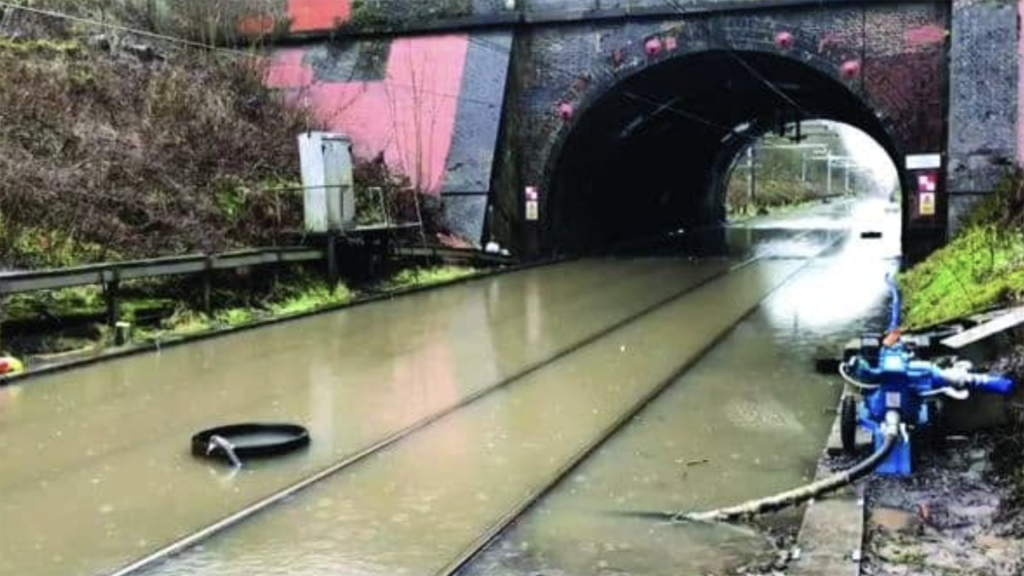
As climate change takes hold, extreme weather events are set to become more and more commonplace. Already the global railway sector is feeling the effects of higher temperatures, heavy rainfall and flooding, wildfires, droughts and landslides. Railways and transit networks in places as diverse as Australia, North America, Germany, Dubai, Taiwan and Japan have all been impacted in recent years, often with devastating consequences.
Railways and infrastructure managers are already spending billions to protect their networks. However, according to a new report from global consultancy Arup this response has largely been reactive—the $7.6 billion spent on the New York City Subway in the aftermath of Hurricane Sandy in 2012, and the $2.17 billion (€2 billion) spent by DB Network to repair flood damage in 2021, are two such examples.
Arup argues that traditional localized attempts by infrastructure managers and operators to mitigate individual risks cannot by themselves protect cities and regions against these growing threats. Instead, it advocates a whole-system approach based on shared responsibilities and common goals across different teams and organizations. Rather than simply responding to emergencies as they occur, the hope is that clearly identifying and addressing vulnerability before an incident takes place will result in the restoration of services more quickly, minimizing network disruption and reducing overall costs to railways and the wider economy.
The guiding force of the report is the Rail Resilience Framework, which sets out collective goals and practical actions that can form the basis of a roadmap for resilient railways. The framework consists of three overarching areas: Economy and Society; Leadership and Strategy; and Assets, Operations and Ecosystems. As TC Chew, Global Head of Rail at Arup, explains, the idea of the framework is to offer a straightforward and holistic approach by clearly identifying and understanding specific vulnerabilities.
“[Infrastructure managers] can then apply their process of maintenance, scheduled upgrades, or asset renewal to incrementally improve their resilience,” Chew says.
Long-term
There are some railways already taking action—British infrastructure manager Network Rail has included $3.54 billion (£2.8 billion) in its latest five-year spending program specifically to address climate change-related issues. While this is a reasonable outlay and a step in the right direction, Chew says the size of the British network and the scale of the problem mean that more spending is inevitable. “How they are integrating together, how well they are achieving it is something we will need to look at in future years,” he says.
These high investment costs may appear intimidating. However, the cost of doing nothing is likely to significantly outweigh upfront investment in the long term. “If you don’t invest, your system will get less reliable,” Chew says, pointing out that there are relatively inexpensive measures that can still have a significant impact—raising the height of some metro station entrances, is one such example. Flood barriers at station entrances is another.
“This framework allows you to think about what is possible, how fast you want to move and how much you want to invest over a period of time,” Chew says. “What we’re trying to emphasise is not to take a piecemeal, silo approach. It needs a totally integrated approach. At least then you can understand that whatever action you are taking, it is a considered action rather than a knee-jerk reaction.”
“What we are saying is don’t stop. Even if you spend 1% or half a percent of your annual budget on improving the resilience of your railway, it is worth it.”
—TC Chew, Global Head of Rail at Arup
While a holistic approach is needed throughout the organization, identifying and addressing vulnerabilities happens at a local level due to the specificity of these issues. In addition, while the adoption of new technologies that improve performance is encouraged, Chew says adoption should be considered in the context of what they will add to overall network performance and resilience.
Securing management and leadership buy-in is essential for railways to successfully introduce these practices. Indeed, a change in mindset is required across the organisation to elevate resilience to a central component of strategic thinking. Chew says the depth of existing thinking on this issue will inevitably vary between organisations. “It would be naive of us to think that they would have done nothing,” he says.
On a wider scale, government support and understanding is also essential as they will provide much, if not all, of the required funding. The case for funding is easy to make in the aftermath of a disaster, but the objective is to prevent this from happening in the first place. This is often a difficult task when funding is scarce, and politicians may have other priorities. This is where Chew says the rail industry lobby needs to earn its keep.
“The more the railway industry talks about it, the more governments are going to pay attention,” Chew says.
One certainty of climate change is that extreme weather events are going to happen more frequently. Disruption is inevitable, but targeted investments to improve resilience can reduce the impact and costs. As Chew points out, by focusing on these issues, solutions, no matter how small, have greater potential to emerge and have an impact.
“What we are saying is don’t stop,” Chew says. “Even if you spend 1% or half a percent of your annual budget on improving the resilience of your railway, it is worth it.”




