From Rails to Trails by Peter Harnik (University of Nebraska Press, 2021). There is an ongoing war between “rails-to-trails” proponents who covet every rail line and wish it could be paved into a trail for recreational cyclists, against advocates who see those lines as providing mobility for non-motorists and motorists who would have another, less-stressful, travel option. As co-founder of the Rails To Trails Conservancy, the author has been a leader on the bicycle trail side, and he spends almost all his 221 pages of content justifying and promoting his side of the conflict.
The battlefields in this war are political in nature. Five years ago, I covered one such battle, fought at the City Council in Augusta, Me., and reported with the headline Rails vs. Trails: The Battle Continues. Proponents of removing a line that was part of the Maine Central Railroad through downtown Augusta called for it to be ripped up and paved over to form a trail for recreational cyclists, essentially all of whom would have access to it only through use of their vehicles.
The trail proponents appeared well-funded and easily able to take on the citizen-advocates who called for using the rail line as a means for bringing people by train to Maine’s capital, which is one of the least-accessible in the nation to non-motorists. The bus station is several miles from downtown. A local connecting bus for downtown is run by a social welfare agency and runs only four times a day and not on weekends. It also takes an hour to walk from the state capital to the nearest motels. On the other side were members of the Maine Rail Group and Wayne Davis of Train Riders’ Northeast, who is widely credited with the advocacy effort that brought passenger trains back to his state as the Downeaster corridor in 2001. One of the strongest arguments for passenger trains to Augusta is that they would transport tourists from places like Portland, Boston, and even New York, who would not otherwise have access to the capital, which brings with it the opportunity to see its sights and spend money there.
Although he did not mention it, Harnik would probably find the Augusta scenario familiar. He spent most of his book gloating over victories for the rails-to-trails movement, even expressing his gratitude for the folks who built the now-obsolete railroads with the flat or gently-sloping rights-of-way that could be repurposed so easily for his style of cyclists, who could be easily distinguished from urban bike riders who use their two-wheeled vehicles for getting around the cities and towns where they live.
In the second page of his Introduction (at xviii), he recalls a youthful fantasy of “Wouldn’t it be cool if there were full-time streets without cars?” Some cities have fulfilled that fantasy with selected streets designated as “auto-free,” reserved for other uses like walking, cycling, and even local transit, perhaps running on rails. Of course, Harnik’s fantasy cannot be accomplished without transit to allow many of that street’s users to get to it, but that is not where the trails he promotes so effusively would be located.
Even Harnik’s chapter titles indicate that his book is a recent history of a movement, told in a way that assumes and proclaims its strength and inevitability of success, an effective way to present his cause. In a twist of derisive irony, he turns the railroad expression “Full Throttle Ahead” into an opportunity to gloat that Congress had approved money for bicycle trails as “transportation” in 1991, a big win for his organization (at 187). His final chapter is titled “If You Want To Count, You Have To Count” (at 215). There and elsewhere in the book, he gives advice on how to conduct what is essentially a lobbying campaign, advice that could even be useful for rail and transit advocates, if they only had the numbers and the backing of the “rich and powerful” at play, which Harnik brags that his movement possesses.
While he says that sometimes a rail line and a trail can coexist (Chapter 14, at 175-86), Harnik writes about the difficulty of accomplishing this because of competing interests and, for narrow rights-of-way, there is not enough room. He acknowledges the possibility of a trail and an active rail line side-by-side, but such an acknowledgment is far from an endorsement of the concept. Even the opposite view, from the standpoint that restoring rail lines for passenger trains or rail transit can provide valuable mobility for both motorists and non-motorists alike, it is questionable how many lines can accommodate both.
For the most part, Harnik seems unable to hide his disdainful attitude toward railroads for very long. Even at the beginning of his book, he proclaims: “The rail-trail is laid onto the detritus of a surpassed technology” (at 2). He praises the early innovations of the railroads (at 12-13) and follows with a list of disparaging nicknames for them (at 14), including some which even I had never heard. He refers to the “railroad dinosaur” (at 26) and calls abandoned rail lines collectively “a discarded miracle from heaven” (at 38), although it seems certain that nobody would ride a train on any of them again.
Harnik spends much of the book recounting in detail the legal, statutory, and regulatory events that handed the bicycle lobby one victory after another, even though the people who could someday ride trains again if rail lines were available to host them and the polity called for trains, were never mentioned as a constituency who should be accorded such mobility.
As expected, much of the book’s content is about politics, and it has some good advice for advocates pushing any sort of civic cause. For example: “We learned that if a trail effort contained three ingredients – a formal plan of action, a public agency agreeing to own the facility, and an advocacy organization pushing for approval – it was likely to succeed” (at 115). That advice is sound, but it is also so generic that, if the same three elements were present for an effort to establish a new rail transit line, the result would probably be similar.
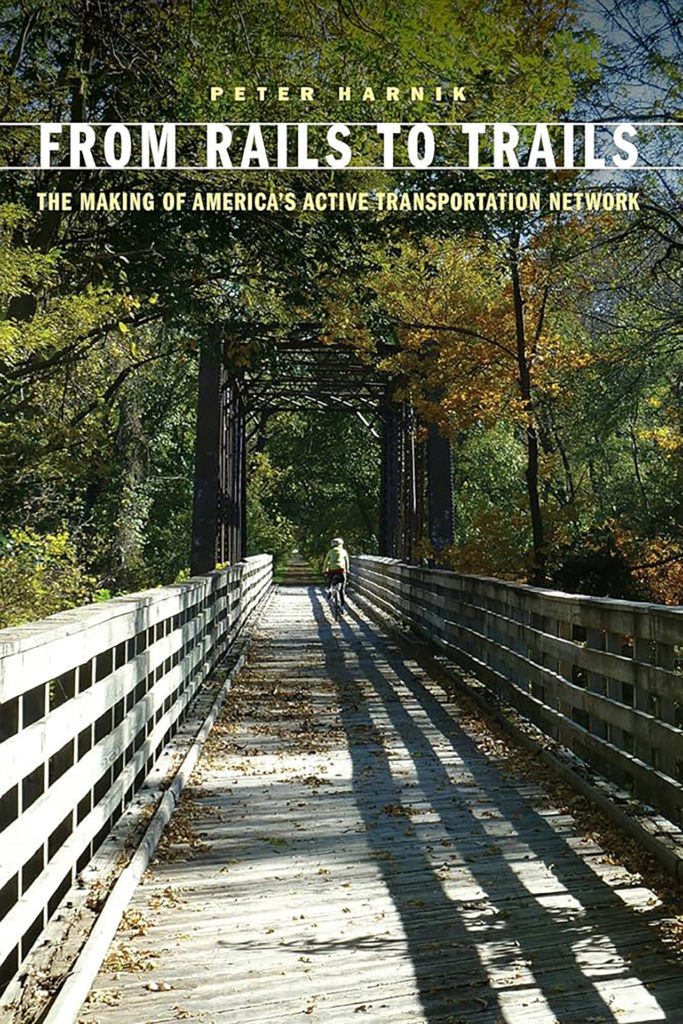
In a sense, the cover illustration appears to summarize Harnik’s vision for America’s transportation future, at least one aspect of it. It is a pastoral scene, with lots of trees in the background and the structure of an old iron truss bridge barely visible in front of the green trees. In the foreground are the decking on the bridge and its sides, all made of wood. A lone cyclist is riding on the bridge, heading away from the viewer, as the sun casts shadows of the slats from the right wall of the bridge across its decking. The rural railroad that once ran there was obviously a single-track line, as were many rail lines that have become trails, like most of the nation’s remaining rail lines, including all-too-many main lines.
Clearly, barring an impracticable cultural reversal, no train will ever run on that line again. “Rails-to-trails” has consistently been a one-way trip, a journey that has seldom been reversed. Harnik and everyone in the organized bicycle movement knows that. So do the advocates for more passenger trains and better rail transit. The subtitle of the book is The Making of America’s Active Transportation Network, but the question of who benefits from such a network persists. Harnik presents no answer.
Not all cyclists are created equal. Cycling in cities is becoming increasingly popular, as many of them are marking bike lanes on major streets. Visitors and locals alike can find rows of bikes for rent with only the need to complete an on-line transaction to pay the rental fee. There are also the urbanites who find a space in their apartments or a nearby storage bin to keep their bikes for when they ride around the city. Often, they use local transit, too, if they can find a place for their bikes on the train or put them in the now-ubiquitous bike racks on the fronts of city buses. But are they the beneficiaries of the trails that were created by precluding trains from running on those rights-of-way anymore? Probably not.
The rail lines that have turned into trails do not normally serve areas that are also served by transit. If the “local” trail is too far away from a cyclist’s home to ride to the trailhead, ride along the trail, and then ride back home, that cyclist could only get to the trail with a private vehicle. Motorists have that privilege, but non-motorists have no such access. That includes “voluntary” non-motorists who choose the urban lifestyle, walk a lot, and use transit to get around town. In contrast, non-motorists who got their status on account of a reason such as a disability of insufficient funds to afford a vehicle, do not have such access. Harnik does not explicitly mention this variety of bias, but it is clearly rooted in his assumptions about the benefits of trails where trains once ran, but not any more. For him, as for all-too-many Americans, non-motorists essentially do not exist within their consciousness.
I found it difficult to read this book. It has a strong undercurrent of disdain for trains (and, to some extent, for the people who ride them), as if railroads were an outdated technology fit only for conversion to trails for recreational cyclists. Implicitly, that attitude restricts the benefit of the trails Harnik promotes to motorists, whose vehicles are the means for getting his constituents to those trails.
Still, I plowed through it and wrote these impressions of it, and a component of my personal experience helped me find the fortitude to do that. I have practiced law for 43 years. Although my experience with litigation, including appellate work, is behind me, I can still familiarize myself with the arguments that my adversaries could reasonably be expected to make. Reading Harnik’s book felt like reviewing an adversary’s brief, except that the book is a longer document. Advocates for passenger rail and transit, and even those who could not care about passengers and only care about preserving the freight-only rail network, should be aware of what the folks who want to rip up the tracks for trails are thinking. Harnik makes those ideas perfectly clear (to use Richard Nixon’s expression), whether we like it or not.
Another thing Harnik makes perfectly clear is that he believes that trails will expand and rails will continue to decline, whether he explicitly says that or not. Time will tell whether he is correct.

David Peter Alan is one of North America’s most experienced transit users and advocates, having ridden every rail transit line in the U.S., and most Canadian systems. He has also ridden the entire Amtrak and VIA Rail network. His advocacy on the national scene focuses on the Rail Users’ Network (RUN), where he has been a Board member since 2005. Locally in New Jersey, he served as Chair of the Lackawanna Coalition for 21 years and remains a member. He is also a member of NJ Transit’s Senior Citizens and Disabled Residents Transportation Advisory Committee (SCDRTAC). When not writing or traveling, he practices law in the fields of Intellectual Property (Patents, Trademarks and Copyright) and business law. Opinions expressed here are his own.