MXV RAIL R&D, RAILWAY AGE MARCH 2026 ISSUE: Under the Association of American Railroads (AAR) Strategic Research Initiatives (SRI) program, MxV Rail developed and evaluated improved techniques for measuring wheel/rail (W/R) vertical impact forces using a combination of onboard and wayside systems. The study compared three key measurement technologies: 1) high‑accuracy instrumented wheelsets (IWS), 2) a new bearing adapter (NBA) that blends force measurement with acceleration compensation, and 3) a high‑accuracy in‑track bi‑circuit (HAC). So-called portable rail bumps (PRBs) were manufactured and placed on the rail to produce controlled impact loads. The study objective was establishing a benchmark method for validating Wheel Impact Load Detector (WILD) systems.
Previous work demonstrated that PRBs could reliably generate repeatable impact loads, enabling the direct comparison of onboard and wayside measurements (references 1-3). This work resulted in the expansion of the dataset and the gathering of simultaneous measurements to support statistical validation of measurement accuracy and repeatability. Existing WILD calibration practices (AAR Standard S‑6101, reference 4) primarily address strain‑gage‑based detectors and lack provisions for alternative systems. The integrated HAC–NBA–IWS approach offers a generalizable framework suitable for emerging technologies.
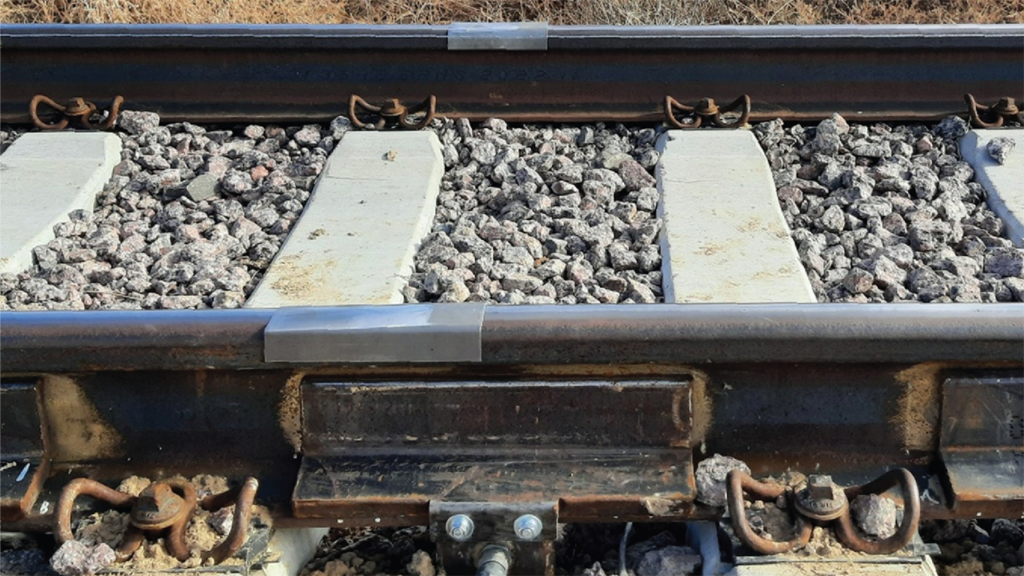
The in‑track HAC uses two full‑bridge strain‑gage circuits per crib to measure vertical loads and contact locations across the crib. Installed on MxV Rail’s High‑Speed Loop, the system consists of six bi‑circuits across seven concrete ties with synchronized automatic location devices (ALDs). Similarly, the NBA incorporates four load cells and an accelerometer on each bearing adapter, enabling force estimation with acceleration compensation. One axle uses eight load cells and two accelerometers across both adapters. Each IWS uses strain gages to produce continuous vertical, lateral and longitudinal W/R forces, plus lateral contact location. Two high‑accuracy IWS units (on axles 1 and 4 of a loaded 110‑ton hopper car) were used and paired with an NBA unit for direct comparison. Four PRB types (different thicknesses) were installed to generate controlled impact forces. Two PRBs were placed on each test run (one on each rail) to minimize crosstalk and ensure stable impulse generation.
A locomotive, an instrumentation car and a loaded hopper car were operated through the test site at speeds from 5 to 40 mph with various PRB thicknesses. The HAC, NBA, and IWS systems were synchronized via ALDs. A total of 162 valid impact events were recorded, with IWS‑measured peak forces ranging from 46.5 to 97.7 kips—exceeding the AAR “actionable” limit (90 kips) in some cases.
The difference between IWS and HAC measurements remained within ±5%, with only one outlier across all tests. Although NBA performance varied between wheelsets, the NBA–IWS differences were within ±10%, indicating a need for improved stability. The impact force magnitude increased with PRB thickness and operating speed, following an approximately linear trend. The PRBs effectively controlled force magnitude and location, validating their use for repeatable impact generation in WILD system testing. The HAC and high‑accuracy IWS provide consistent, benchmark‑quality W/R impact force measurements. The NBA shows potential as a low‑cost, onboard alternative, but it will require stability refinements. The combination of IWS and PRBs offers a practical verification strategy for WILD systems.
As a result of this work, AAR Standard S‑6101B Industry Data Validation: Wheel Impact Load Detector (WILD) was implemented in April 2025. The specification calls for the use of PRBs to generate impact loads measured by an IWS and a wayside detector to facilitate accurate evaluation.
The Technology Digests this article is based on can be found in the MxV Rail eLibrary along with more than 1,000 other publications describing the railway research, testing and analysis available from the AAR SRI program. Explore www.mxvrail.com to learn more about MxV Rail and to register for the 31st Annual AAR Research Review, to be held April 28-30, 2026.
References
Witte, M, Y. Zeng. 2023. “Measuring Wheel Impact Force through the Bearing Adapter.” Technology Digest TD23-014. AAR/MxV Rail.
Stoehr, N, Y. Zeng, and M. Witte. 2024. “Wheel/Rail Impact Force Measurement Validation.” Technology Digest TD24-023. AAR/MxV Rail.
Stoehr, N, Y. Zeng, and T. Sultana. “Wheel/Rail Vertical Impact Force Measurement Comparisons.” Technology Digest TD25-003. AAR/MxV Rail.
Association of American Railroads. 2025. Manual of Standards and Recommended Practices (MSRP). Section F. Standard S-6101B: Industry Data Validation: Wheel Impact Load Detector (WILD). AAR.