
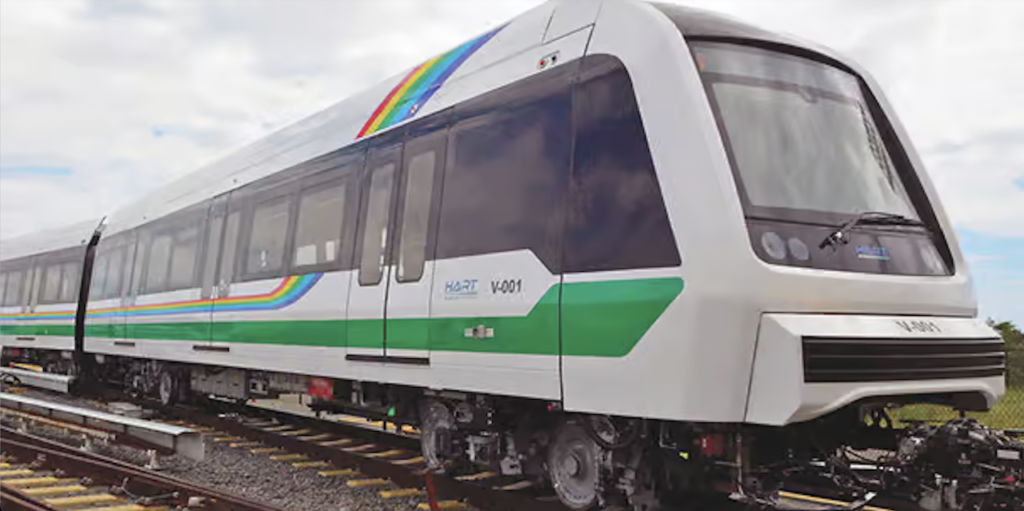
Honolulu Authority for Rapid Transportation (HART) on Aug. 15 reported awarding Tutor Perini Corporation a $1.66 billion contract for design and construction of the third phase of Skyline, an urban rail transit GoA4 (Grade of Automation) system whose first phase opened in 2023. It is expected to be executed in mid-September. Parsons Corporation will serve as design subcontractor.
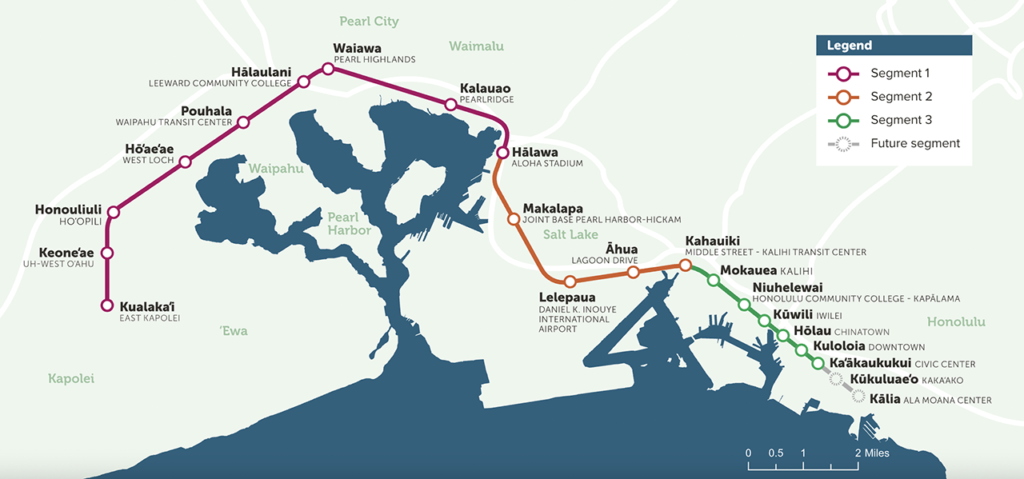
The City Center Guideway and Stations contract includes the design and construction of six stations and approximately three miles of elevated rail guideway beginning just east of the Middle Street Transit Center Station and ending at the Civic Center Station, which will be located just east of the intersection of Halekauwila Street and South Street (see map below). According to HART, project design will begin immediately after contract execution. Construction is estimated to start in second-half 2025 and wrap up in 2030.
The contract award, HART said, is expected to trigger the release of the next $250 million in federal funding to HART under the amended Full Funding Grant Agreement (FFGA), which was executed in February 2024 with the Federal Transit Administration. The original FFGA, signed in 2012, provided a grant of $1.55 billion for the Skyline project. HART has previously received approximately $931 million under this grant.
Los Angeles, Calif.-based Tutor Perini was the only bidder; the City Center Builders Joint Venture, comprising Hawaiian Dredging Construction Co. and Dragados Construction USA Inc., was also prequalified to bid for the City Center Guideway and Stations (CCGS) contract, but dropped out, Honolulu Civil Beat reported Aug. 15. Tutor Perini’s “$1.66 billion proposal will cost $300 million more than the Honolulu Authority for Rapid Transportation had budgeted in its 2022 recovery plan, according to HART [Executive Director and] CEO Lori Kahikina,” the media outlet said. “But Kahikina said … rail officials are confident the rail authority can find the money to cover the difference. That can be done by dipping into contingency funding that is being held in reserve for unexpected costs, or by finding cost savings in other contracts, she said.”
The HART Board on Aug. 13 “met in a closed-door session … for a briefing on various ways HART might be able to save money in the short term to free up cash that can then be shifted to the CCGS contract,” Honolulu Civil Beat reported Sept. 5. “HART recently released a recording of that executive session to Civil Beat — something it had agreed to do once the contract was awarded. Board members were briefed on … reducing ‘contingency’ funding that is held in reserve to cope with unexpected cost increases on major contracts, and deferring rail-related work that the HART staff does not believe is immediately needed. HART said in a written statement that ‘generally speaking, several projects are being considered for deferral … but final decisions about deferrals have not yet been made. No project that is being considered for deferral will have a significant impact on the traveling public.’”
According to the media outlet, the list includes “delaying installation of seven units of Static Synchronous Compensation Equipment, known as ‘STATCOMs,’” which could save more than $60 million. “HART Project Director Vance Tsuda told board members last month the HECO [Hawaiian Electric Company] studies that demonstrated a need for STATCOMs were based on running 17 trains operating at 90-second intervals — headways. The system is not operating at anywhere near that level now — Tsuda said the current headway is six minutes during ‘rush hour’ today.”
Honolulu Civil Beat reported that other savings could come from:
- “defer[ring] work on the makai entrance to the Waipahu or Pouhala rail station above Farrington Highway. It was unclear from the presentation to the board exactly how much savings could be had by delaying that work.”
- “anticipated reductions in contract costs and contingency reserves for utility relocation work that is being done in the downtown area, Tsuda told the board members.” This amounts to more than $112 million.
“HART said in a written statement [to the Honolulu Civil Beat] that the rail authority ‘expects that some level of review and concurrence from FTA will be needed. HART has had preliminary discussions with the FTA about the award of the (CCGS) contract, but the specific level of documentation and review that will be required by the FTA has not yet been determined.’”

“This is another huge milestone for our rail project,” Lori Kahikina said during HART’s contract award announcement in August. “This is the largest single contract of the entire project and sets the course for completing the project through downtown Honolulu. We are excited to begin work with Tutor Perini to make this happen.”
“Tutor Perini is proud and excited to be a part of this transformational project in Honolulu,” Tutor Perini Corporation Chairman and CEO Ronald N. Tutor said during the August announcement. “We look forward to partnering with HART to see this project through to its successful conclusion.”
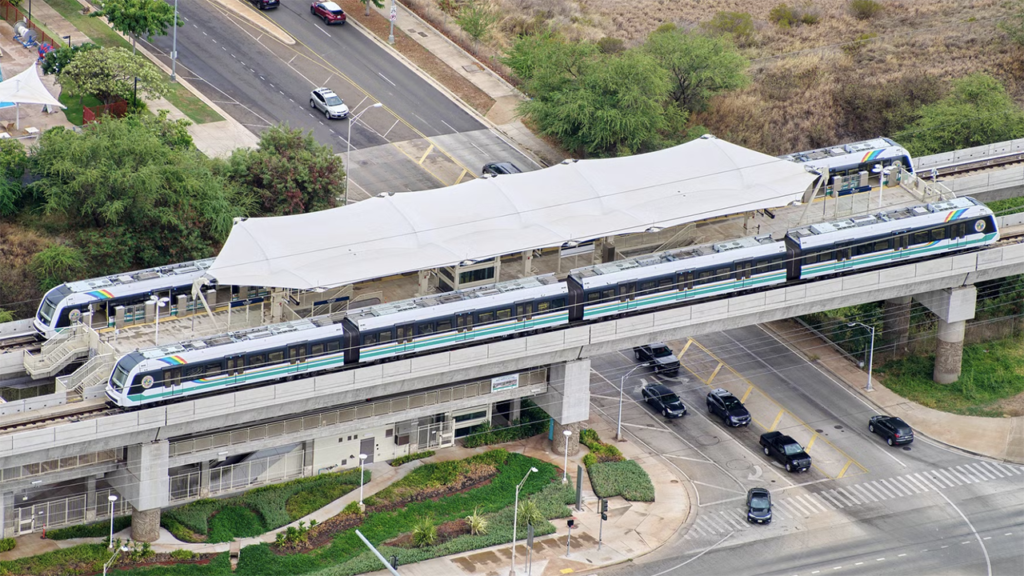
Hitachi Rail in 2023 delivered the first 11 miles of “light metro” service to HART and the City and County of Honolulu Department of Transportation Services (DTS) under a 12-year DBOM (design-build-operate-maintain) contract. (HART and DTS maintain the civil works portion.) That segment includes nine stations from East Kapolei to Aloha Stadium.
Work on Skyline’s second phase is under way. Expected to be operational in late 2025, it will add 5.2 miles and four stations from Aloha Stadium to Middle Street-Kalihi Transit Center, incorporating Daniel K. Inouye International Airport. On June 17, 2024, the third rail was “energized,” according to HART, allowing for train testing.




