
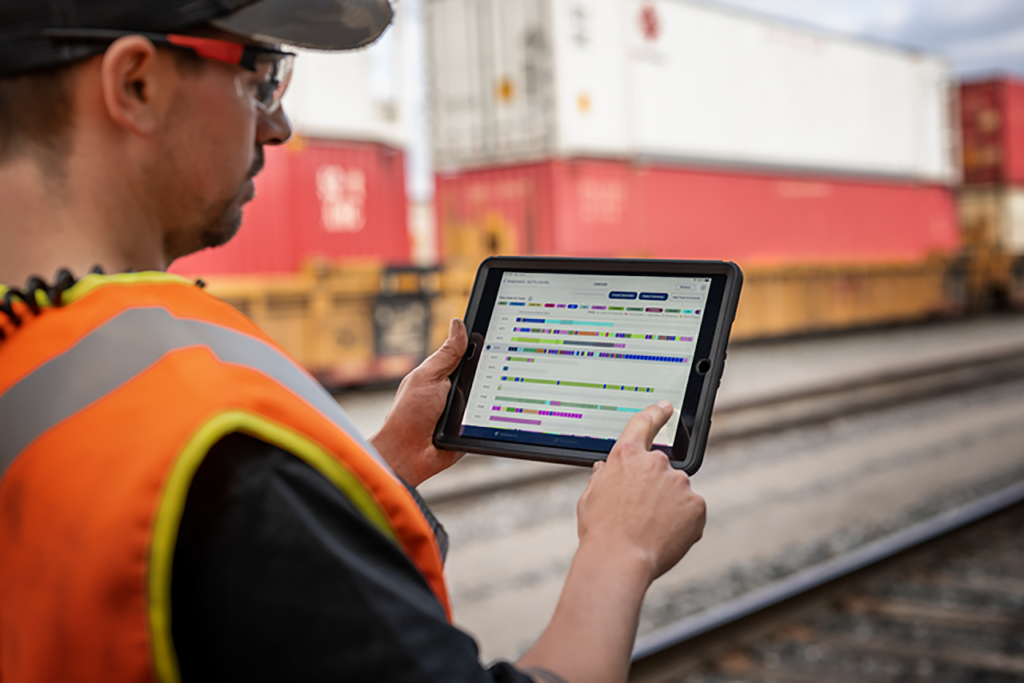
Not so long ago, conducting mechanical inspections and organizing notes on operations might have involved carrying heavy binders or scribbling notes into a thin notebook that would later be stuffed into the back pocket of a pair of coveralls.
Those binders and notebooks still find their use in the day-to-day operations of some freight railroads, as do handheld mechanical gauges. But railroads are also increasingly relying on handheld digital devices such as iPads to help speed up data collection and processing and better facilitate the flow of information among the various departments within a railroad.
“Across the economy, there is movement to reduce paperwork and increase customer visibility into their shipments’ status. From Amazon to the pizza place down the corner, the use of handheld devices is changing how companies operate. Railroads are no different in their drive to innovate in this space,” the Association of American Railroads (AAR) told Railway Age. “By using tablets and handheld devices, railroads are putting key operational and timely safety information at their employees’ fingertips. Instead of carrying reams of paper for rulebooks, timetables, special instructions, job aids, track bulletins, etc., carriers are empowering employees through the thoughtful, widespread deployment of mobile devices that are integrated with their company’s operation management software.”
Devices at Work
Handheld devices are becoming more integrated in day-to-day operations, and those working on the railroads are seeing a difference in making some tasks more efficient and quicker. The railroads also say that the devices are meant to complement existing processes, not to distract employees.
“At Norfolk Southern, the incorporation of technology into work in the field has allowed our teams to operate more efficiently while keeping safety at the forefront,” NS told Railway Age. For instance, the train and engine workforce at NS uses a handheld mobile train reporting (MTR) device for tasks such as near-real-time reporting of inventory movements, interchanges and inspections at outlying points.
“The biggest immediate benefit to incorporating the handheld devices was the elimination of the need for teams to transcribe and fax paperwork after every service or interchange only to wait hours for that information to be updated in our records,” NS said. “Right away, we saw improvements in inventory accuracy and timely reporting to production terminals.” NS also uses handheld devices in situations such as over-the-road reporting, company-wide event broadcasts, real-time windows into inventory and dispatch information, and safety micro-learning.
At BNSF, transportation, yard and engine (TY&E) teams, as well as mechanical teams, have been using handheld devices every day. “It’s part of their regular work stream now,” BNSF said. Approximately 16,000 iPads are in use among TY&E teams, with some apps mandatory for work requirements.
“We run all our train operations through the devices, which historically were paper-driven, to include work order reporting, track bulletins within the iGTB app, train lists and the Switch app, which allows employees to switch freight cars ensuring our electronic car inventory is maintained. The RIDE app is used so crews can call and monitor their own crew transportation, too,” BNSF said. “The iPad has replaced about eight pounds (no joke) of rulebooks that train crews historically had to carry around with them. From search functions, to rules, to job aids, general notices and urgent communications, the iPads have allowed our teams to push out notices on virtually anything needed to thousands of people in an instant.”
Yard switching operations still use people and paper though, and not iPads, BNSF said.
BNSF’s engineering teams use apps on company-issued mobile phones for the tie inspection program and for work order closeouts, while mechanical teams use iPads for work inspections. The railroad’s rapid responders deployed with trucks use company-issued cell phones where they can access real-time information on a service interruption. “We no longer have to enter it into a computer,” BNSF said.
In addition to iPads, BNSF’s transportation teams also use infrared guns.
“We started deploying infrared guns for bearing inspections about a year ago to eventually replace temperature sticks/crayons. We’re moving toward using them unanimously across our entire system,” BNSF said. “This is a big derailment prevention tool and is helping us make great safety strides here at BNSF. These devices are more proficient in indicating a potential problem, more accurate in measuring bearing temperature and are reusable. These devices have opened the door to much more data to be collected in comparing it with the adjacent wheel bearings and their associated temperatures.”
At CN, employees use handheld devices both as a communication tool and as a type of reference manual. “CN continues to leverage technology, including handheld devices as a resource to our employees who are performing inspections and subsequent repairs on equipment. The devices enhance the user experience and allow for efficient record keeping by providing real-time communications within the company,” CN said.
The railway launched a mobile app in November 2022 called Enablon Go by Wolters Kluwer, which allows employees to anonymously report hazards and near misses to their supervisors. That app, which is available on all mobile devices such as tablets, smartphones, and computer rail terminals, enables CN to take the reporting data and implement more impactful safety solutions, the railway says.
But the app’s usefulness doesn’t stop at enabling employees to provide anonymous observations related to safety, according to CN. “We are also looking at using the same digital platform as Enablon Go to further enhance our safety audits and better support health and safety inspections at CN. CN’s goal is to utilize resources that are supportive to the end user and our business model all while promoting a safety culture with our employees,” CN said. “We continue to learn best practices when it comes to technology and safety, and we are proud to be a leader in the rail industry when it comes to this.”
At Canadian Pacific Kansas City (CPKC), more than 2,500 iPads have been deployed to conductors across Canada and in portions of the U.S., “providing a real-time database that enables fluid decision-making,” the railway said. “It keeps everyone informed and up to date as conductors have access to all pertinent, ‘on-duty’ documents electronically.”
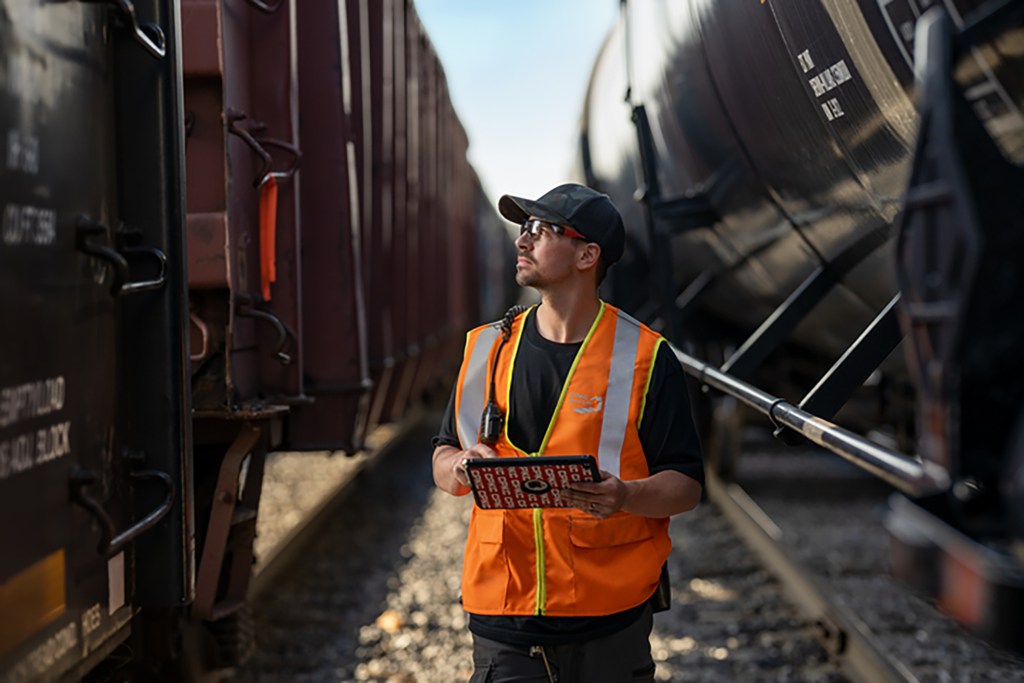
With an iPad, a CPKC conductor can access exactly what equipment is in the yard or customer facility and use the device to optimize work orders. In the past, a trainmaster or yardmaster would provide verbal car spotting instructions, potentially causing delays. “Our teams worked with Apple to roll out the devices while building a new mobile platform-enabled solution to serve the unique needs of our rail business,” said Caryna Pinheiro, CPKC Assistant Vice President Applications and Digital Services and Assistant Chief Information Officer. “We created a custom enterprise solution by putting the conductors in the room with our developers to create a vision for how and where we can use the iPad to increase efficiency, productivity and safety.”
Integration
With handheld devices gaining a foothold in day-to-day operations, the next progression might be their use in outward-facing tasks, such as working with customers or first responders.
“Looking to the future, beyond our constant enhancements to usability, we’re focused on leveraging the device as a tool to help ensure the safety of our teammates and the communities we serve while also enhancing the customer experience,” NS said. “We’re building out ways to more effectively communicate with first responders, and we’re enabling our crews to build the best, safest consist they can based on current rules and guidelines. We are also working to develop more real-time tracking and day-of-service visibility for customers as we continue to look for ways to improve the customer experience.”
BNSF also said handheld devices have enabled the railway to turn into a real-time data and reporting operation. “In the past, crews had to call in work and report it once they arrived at a particular location. From a safety and efficiency standpoint, handheld devices have modernized the railroad by helping our employees be much more efficient with their time and provide us with a direct connection through business capabilities in keeping in touch,” BNSF said. “In the case of urgent communications, being able to push out information immediately to thousands of employees is a massive advantage. Giving real-time updates all at once about an incident across our industry for us all to learn from is incredibly beneficial to us all.”
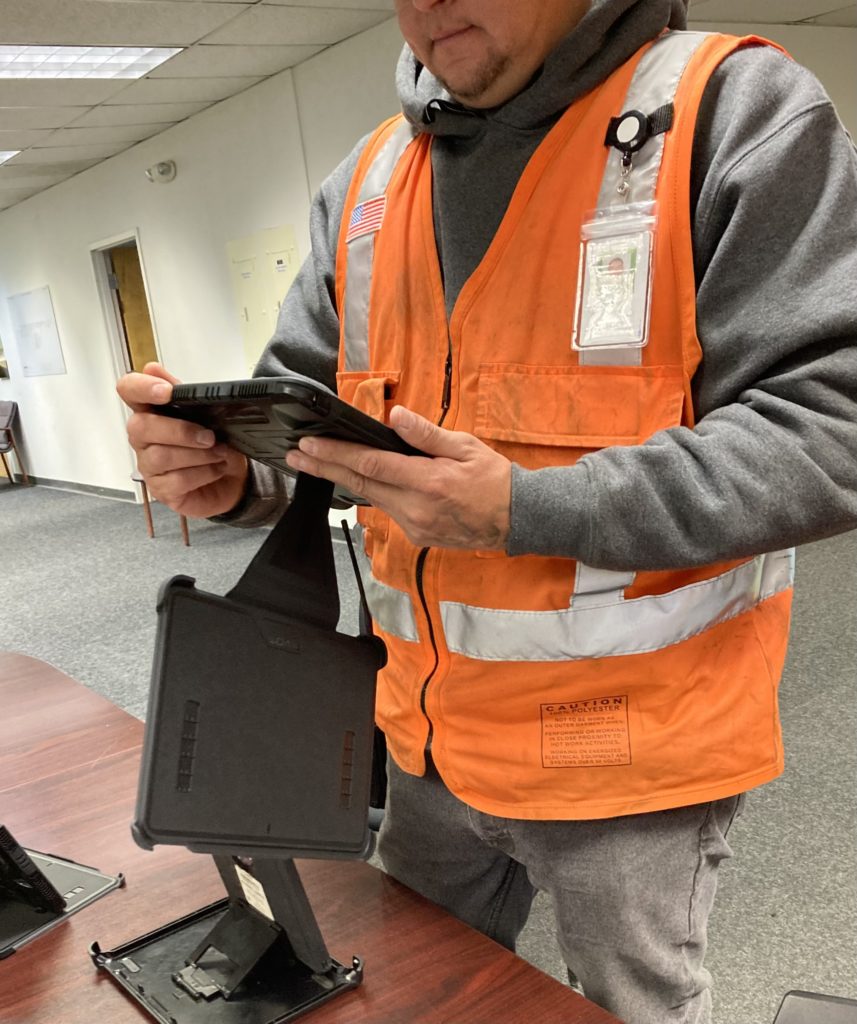
Handheld devices have enabled BNSF to become a real-time data and reporting operation. (BNSF)
There are even more supplemental technologies that BNSF has yet to harness even further, such as virtual reality offerings to help train employees.
“As railroads have deployed and refined their use of these devices, they have continued to prioritize safety, ensuring any electronic device use helps teams execute their job more effectively while not posing a distraction for teams in the field,” AAR said. “Additionally, many carriers have worked with their employees to pilot and enhance the way they use mobile devices in the field.”




