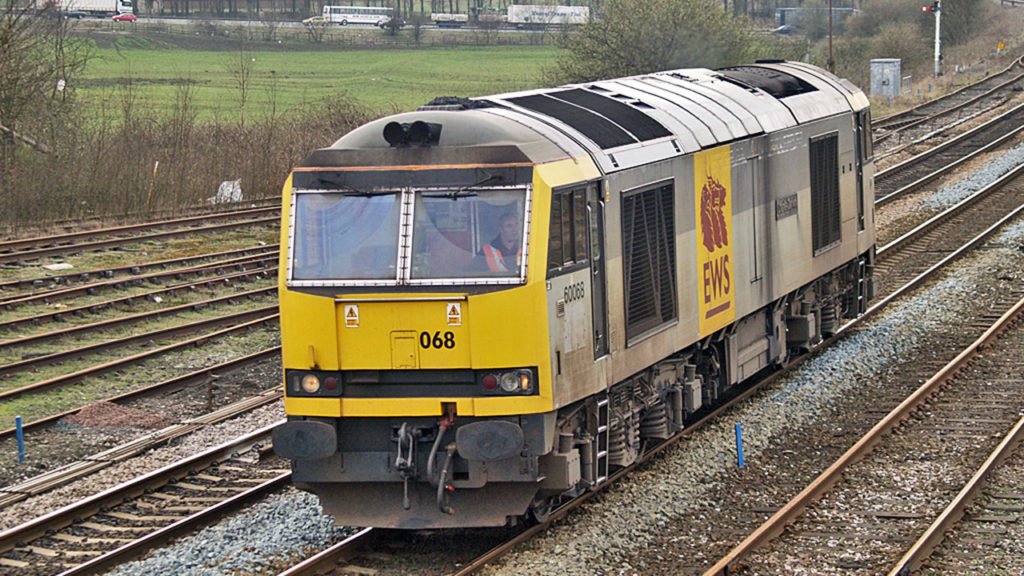
British startup Steamology has secured a contract to test its hydrogen-fueled steam traction system in a converted Freightliner Group (a Genesee & Wyoming subsidiary) freight locomotive. Funded jointly by Arup and rolling stock leasing company Eversholt Rail, Steamology will adapt a 1990-vintage Class 60 diesel locomotive to demonstrate the practicality of its new technology in a working prototype.
Steamology’s patented system is based on small hydrogen-fueled modular steam generators. A total of 20 will be installed in the test locomotive, replacing its 2,300kW diesel engine, together with four steam turbines and 140 Kg of gas storage. Low-pressure steam at 40 BAR will enter the steam turbines at around 400°C, with the turbines driving the traction alternator.
The conversion project, which aims to create a fully-functioning 2MW zero-emission locomotive, is due to start next year. Steamology says that, if successful, its technology could be used to modify existing locomotives or incorporated in new-build designs. Arup is providing consultancy and design services to support the conversion work.
Steamology says that its system has advantages over hydrogen fuel cell and battery systems, which it expects to compete with on price over the long term, as it eliminates the use of rare earth metals and recycles the water emitted. This could be collected in the locomotive, before being passed through an electrolyser running on renewable electricity to produce green hydrogen and oxygen. In addition, fuel gases can be of a lower quality (with a higher water content) than those used in hydrogen fuel cells, reducing gas cleaning and drying requirements.
The steam system provides high power with high torque, making it ideal for a freight locomotive, although Steamology it could also be suitable for passenger locomotives.
“This project will demonstrate the viability of repowering diesel heavy duty transport assets, delivering a full asset life while meeting net zero and ESG targets,” said Steamology CEO Matt Candy.
“We are committed to supporting innovative R&D solutions that help to push the boundaries of rail as a core component of a sustainable infrastructure,” said Freightliner Group CEO Tim Shoveller. “Rail freight is already a greener option over road cutting carbon emissions by up to 76%. It is great to see the evolution of the efficient turbine technology and its application in supporting the development of more sustainable energy sources for the future railway.”
“We are keen to support U.K. innovation and our customers in delivering their carbon reduction targets,” said Eversholt Rail Client Services Director Paul Sutherland. “Eversholt Rail has invested in many rail vehicle innovations and technology upgrades over the past 30 years. We are delighted to bring this experience and our funding to this project, and we are excited to see where this technology goes.”