
RAILWAY AGE, AUGUST 2024 ISSUE: BNSF brings remote locomotive health monitoring to new levels.
BNSF’s approximately 7,500 locomotives comprise the North American rail industry’s largest fleet. The average age of its high-horsepower road fleet is 15.5 years—among the youngest of the “Big 6”—leaving many more years of active duty until replacement or rebuilding/upgrading (the latter option preferred by Class I’s, given the high cost of new EPA Tier 4-compliant units) is required. A typical BNSF locomotive will travel up to 4.8 million miles in its service lifetime, according to the railroad.
Leveraging onboard, real-time health monitoring for improving utilization, lowering fuel consumption, and reducing road failures that can impact service and disrupt network fluidity is essential to maintaining a state of good repair and keeping BNSF’s 32,833-mile (Association of American Railroads 2023 Fact Book, Miles of Road Operated, as of 2022) network rolling.
Railway Age spoke with BNSF General Director Locomotive Utilization Ryan Knox and General Director Strategic Fueling Matt Feldman for this article. Each leads a team of experts responsible for the railroad’s fleet, working closely with such suppliers as Wabtec and Progress Rail/EMD on certain monitoring functions.
“We’ve partnered with Wabtec to develop Power Advisor, a web-based application that is leveraging onboard technology to monitor locomotive component health,” explains Knox. “It’s very close to real-time data. There’s a remote data collection that takes place off the locomotive that is sent to Wabtec’s GPOC (Global Performance Optimization Center) for evaluation. We worked closely with Wabtec to tailor and create what we call ‘buckets’ for risk levels. Each component has a certain weighted value to it that will either increase or decrease health scores, based on failure probability calculations.”
The scores are color-coded—green, yellow, orange or red—for simplicity and visibility. A score of 80 to 100 would be green (similar to “clear” on a wayside signal), indicating a very low probability of failure. A score of 71 to 79, yellow, indicates a medium failure probability. A score of 41 to 70, orange, indicates a high probability of failure. Anything below 40, red, is very high, indicating that a component is on the verge of failure.
“All of this gets pumped into a health dashboard that allows us visibility to multiple reports,” says Knox. “We can view a pie chart: How many components are low? How many fall into each one of those categories? This helps our ability to improve locomotive assignments that increase the odds of mission success. We call this the ‘front end.’ There’s real-time or near-real-time notifications of anything that happens enroute.
“We’ve established ‘points of no return’ all throughout our network. For example, a point will be the final locomotive data source before we climb a grade where all the horsepower is needed to crest the hill, or before going into a heavily congested part of our railroad. We’ll monitor these health scores before power meets that point of no return. That allows us an opportunity to, proactively, either set a locomotive out and add a new locomotive, or redirect a locomotive to a shop before it fails. We can add a locomotive to eliminate the risk of service interruption down line. We found this has been very helpful in reducing service interruptions across our network.
“This tool allows us to quickly diagnose an issue. We have real-time diagnostics that my team can tap into to review. In the past, we would have to talk to the crew, walk them through reviewing the diagnostics, and go through a process of elimination, if you will, to find out what is wrong with the locomotive and then make a decision. Now, more often than not, we see something before it actually becomes an issue. It allows us the opportunity to mitigate that risk. When mechanical components do fail, it allows us to quickly diagnose the problem, therefore providing us the opportunity to decrease service interruption duration.”
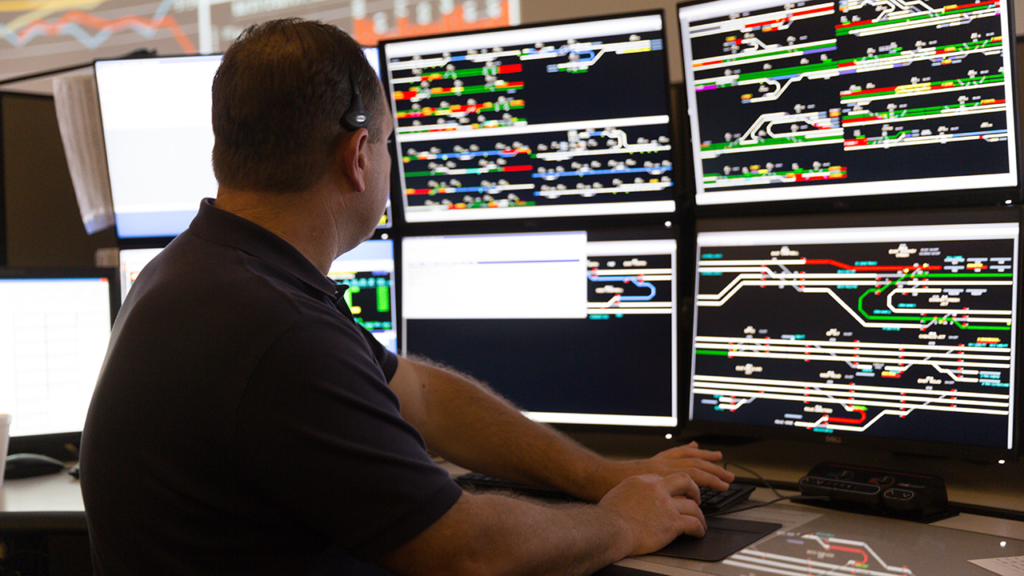
In BNSF’s Fort Worth NOC (Network Operations Center), there are three mechanical desks—North, South, Central—staffed 24/7. BNSF photo.
Knox runs the Locomotive Utilization Group, which manages locomotive assignments. In BNSF’s Fort Worth NOC (Network Operations Center), there are three mechanical desks—North, South, Central—staffed 24/7. There are dedicated Wabtec and Progress Rail desks also staffed 24/7.
“All five desks sit and work together to address locomotive issues on line, 24/7,” Knox says. “These partnerships have been great. We’ve seen a lot of improvement. After Power Advisor was developed and matured, we found ourselves going to multiple systems to chase down certain types of information. We created a data feed that the tool can leverage, interfacing with PTC and DP (distributed power) systems and wayside defect detection systems.
“We spun another tool off Power Advisor called Train Analysis. We can punch in one locomotive number or the train ID, and it’s going to bring up the health of the entire consist and tell us everything we need to know about it. If there are DP alarms, or something happening on a locomotive issued by Wabtec, any faults, any EOA (Wabtec Expert On Alert centralized remote monitoring of locomotive health status and performance in real time) or Uptime Suite™ (Progress Rail’s analytics platform) notes of any kind, we will be able to see all the information we need to diagnose or monitor locomotive component health. We have full visibility into all the onboard diagnostics—fuel readings traction motor temperature and speeds, inlet temperatures, you name it. We can see it all on one screen.”
Working with Wabtec, Knox’s team developed a specialized tool for diagnosing UDEs (undesired emergency brake applications). “We know the speed at which air travels,” he explains. “We know the distance because we know the number of cars and locomotives in the train. We know if there’s an ETD (end-of-train device), the number of head end and DP units or helpers [on the rear]. We developed this algorithm that can detect where in the train is most likely to be the source of an air issue, based on air brake propagation. That started with an idea many years ago, when I used to work on the mechanical desk. I would always ask the crew, did the rear go first or the head end? Then I’d ask them, how long until the head end went if the rear went first? That gave me a ballpark of where to start having the crew look to identify the issue.
“Talking with Wabtec and their technical team, I said, if I was able to figure out a rough location in my head, why can’t we use the speed, travel and all these other measures to create an algorithm to give us a lot more accuracy? We started with ETD trains, where the accuracy of the source of the issue is somewhere within a five-car range. We can direct a crew straight to that section of the train, quickly get the issue resolved and expedite recovery. The next phase is working on the same ability with DP trains.”
Matt Feldman heads “strategic fueling efficiency” initiatives like low fuel alert and energy management systems. The latter involves Wabtec and Progress Rail products.
Developed internally, the low fuel alert system provides far more information than when fuel level drops below a certain threshold. “Most of our road fleet is equipped with fuel sensors that are sending us real-time levels in the fuel tanks,” says Feldman. “But that’s not very helpful if you don’t know how far a locomotive is from its next scheduled fueling and the likelihood of running out of fuel before it gets there. With our system, we’re looking at locomotive location, the next scheduled fueling location, the HPT (horsepower per ton) on the train, and the current fuel level. We compare those parameters with all the other locomotives over the past several years that have run on the same route going to the same scheduled fueling location on trains with the same HPT to calculate for every locomotive a probability of running out of fuel before it reaches its next location. We generate a low fuel alert if it’s above a threshold probability, categorized as low, medium or high priority. When the NOC gets that low fuel alert, they can look specifically at that train and determine if they need to make a plan to fuel it before its next scheduled fueling location.
“We may determine there’s an opportunity to stop the train at a crew change point before its next scheduled fueling event and dispatch a DTL (direct to locomotive) fuel truck—moving the next scheduled event from where it is currently scheduled to the crew change location right before that. If we’re going to fuel at a place we don’t normally fuel, it’s going to be DTL truck. But we also do DTL fueling in yards, where the locomotive just can’t get to a platform to fuel.”
“This initiative is about preventing service interruptions and maintaining network velocity, not reducing fuel costs,” Feldman notes. “For example, it reduces the risk of having to dispatch a DTL truck to where it wouldn’t normally go to fuel a stopped train that might be blocking other trains, and maybe having to recrew that train. The key to the success of this program is correctly flagging locomotives and fueling them before they run out, but also minimizing false positives. We don’t want to be introducing additional fueling events because that just slows down the system and creates unnecessary congestion. This system does a much better job than what was available in the past of correctly identifying locomotives that truly are at risk of running out of fuel, and not falsely flagging ones and creating unnecessary work events.”




