
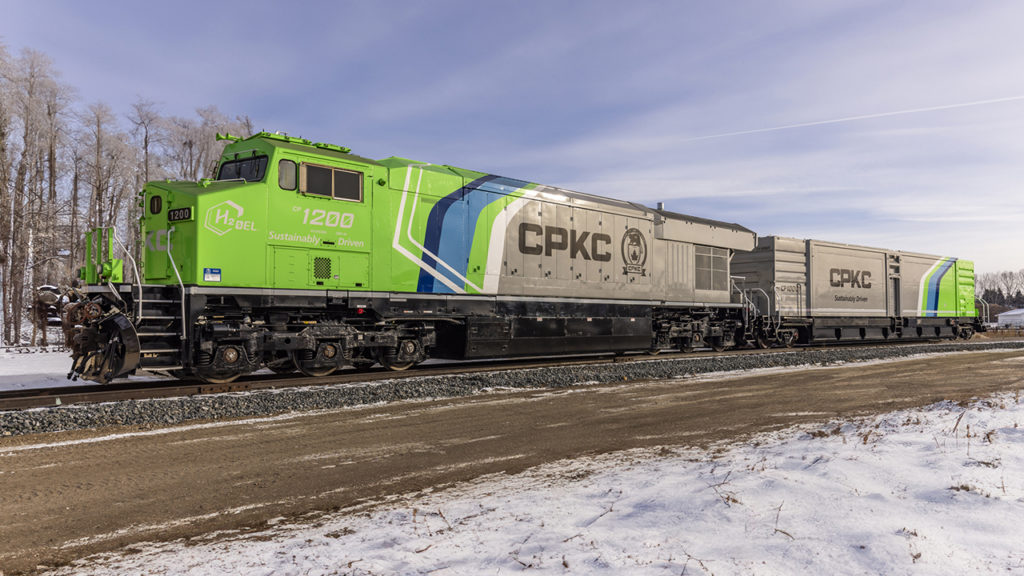
A recent article by Alex Luvishis, Ph.D. was interesting from a factual basis about alternative locomotive fuel and energy options and their costs. However, zero-emissions at point of use is not the whole picture; neither is purchase/conversion cost. Similar issues surround whether any solution is truly “green.”
The accepted process is to look at the total cost of ownership (TCO) over the lifetime of the asset, which will include maintenance and costs associated with the chosen fuel or energy carrier. Similarly, the emissions calculations are not just the locomotive exhaust, but the full “well-to-wheel” calculation of greenhouse gases and particulate emissions involved in production, transportation and storage. Furthermore, additional costs will be necessary to accommodate the infrastructure for refueling and for additional safety considerations when different fuels may be used.
But first, it is necessary to consider the duty cycles the locomotive, or in the case of modern regional and local passenger trains, the multiple-unit, will be performing. From the freight perspective, a Class I’s road locomotive needs to be able to carry enough fuel to cover a significant mileage and have enough power to deal with grades. For many years, we’ve become accustomed to high-horsepower locomotives with massive diesel fuel tanks that can run at least as far as a full day’s work for the engineer will allow and still not necessarily need to be refueled.
Now let’s take a quick look at Battery Electric Locomotives (BELs). Current battery technology could theoretically provide enough tractive effort (especially with multiple or distributed power) to start a train, but would it be able to carry enough battery packs safely to perform its duties? Likely not, as of today. Interchange adds another serious component to the mix. We want to retain flexibility and efficiency by not changing locomotives mid-journey because that creates delays, thereby reducing velocity. It also involves more assets and equipment, and, as the financial folks keep telling us, more capital tied up. Operations folks point out the delay in end-to-end schedules that would be involved.
Batteries are also heavy (loading EVs into autoracks is complicated by the weight factors) and use considerable energy to move themselves. Battery cells do not all have the same life expectancy, so modular battery packs that can be replaced using a fork truck become a possible solution, often involving more capital than first realized. Current battery technology is also somewhat fragile in terms of what can go wrong when a failure occurs. Thermal runaway is a big problem. This happens when heat generated within a battery exceeds the amount of heat that is dissipated to the battery’s surroundings. Just look on YouTube for scary examples in EV cars. Not what we’d want to see at a derailment, eh?
Also, common to many alternative fuel options, a tender may be necessary to enable sufficient fuel/energy carrier to be transported for linehaul operations. That additional weight is non-revenue dead load, thereby reducing the economic efficiency of some solutions.
However, the duty cycle for a short line railroad is different—less distance involved and often much shorter, lighter trains. Thus, the power consumption is lower. The scale of risk is smaller. Where locomotives generally return to a “home base” daily, batteries can be recharged in downtime. However, extra care and attention is required when plugging in to recharge. If the plug is not properly inserted to make a perfect connection, the batteries won’t be properly recharged and the next day’s duty may be missed, or a failure will occur in service. Also, we don’t yet have full experience with BELs.
The cost of providing a quality, safe, reliable battery charging station must be added in to the mix, as well as any additional costs the utility supplier may need to pass on if they need to upgrade their infrastructure with additional transformers, etc. The assessment is not easy … and so far, we’re just looking at BELs.
Next, let’s look at hybrids. Hybrid solutions are a way to adopt two technologies, and many different combinations exist. One solution that has potential appeal for linehaul freight is discontinuous electrification. A diesel-electric locomotive, being basically a generator for electric drive motors, could have the prime mover replaced by batteries and a pantograph (or third rail shoes) added to recharge the batteries at strategic points, along with regenerative braking providing power back to recharge the batteries.
Once (if?) a hydrogen supply pipeline grid is developed, then hydrogen hybrids become a more appealing solution. Currently, the methods of hydrogen production and delivery (fueling point electrolysis or road tanker-delivered compressed gas/liquid) are neither fully “green” nor well-to-wheel energy efficient.
In conclusion, electrification has appeal, but not everywhere all at once! We need to plan the transitions, whatever they are, so that the supply base is developed, asset life is considered and rebuilds could be possible—with a host of other complexities. We shouldn’t reject anything because technology is continually changing and improving. Just because we have been looking at different solutions for years doesn’t mean the same calculations and answers apply today or for the future.




