The first locomotive to successfully use an AC (alternating current) three-phase asynchronous traction motor drive system was the German DE2500 diesel-electric in 1971, built by Henschel-BBC. DB (Deutsche Bundesbahn) Class 202, an experimental C-C (six-axle) unit, had a frequency-controlled traction drive system with asynchronous traction motors and static converters, and was rated at 2,500 hp (1,900 kW).

In 1979, this equipment, which proved successful on the DE2500, was tested on the DB Class 120, a prototype electric locomotive.That year, five Class 120s were built. They underwent extensive testing, and in 1984 60 units were delivered to DB.

Early North American Efforts
Canadian Pacific Railway (CPR, now Canadian Pacific Kansas City, CPKC)) was the first North American railroad to use AC traction technology. CPR no. 4744 was a retrofitted 1971 Montreal Locomotive Works (MLW) M-640 prototype that rolled out of CPR’s Angus Shops on Nov. 7, 1984.

In the 1980s, EMD (at the time, the Electro-Motive Division of General Motors, now Electro-Motive Diesel, a division Progress Rail, a Caterpillar Company), teamed with Siemens to develop six-axle diesel-electric locomotives with AC drive, high axle loads and tractive effort intended for heavy-haul freight trains on U.S. Class I railroads. The Siemens traction motor system used one inverter per truck. In 1987, GE Transportation (now Wabtec) followed with an experimental six-axle unit with AC drive and individual regulation of each traction motor with one inverter per axle. In 1989, EMD produced two passenger prototypes, the four-axle F69РНАС, the first U.S. diesel-electric locomotive to use inverters with GTO (gate turn-off) thyristors and evaporative cooling.

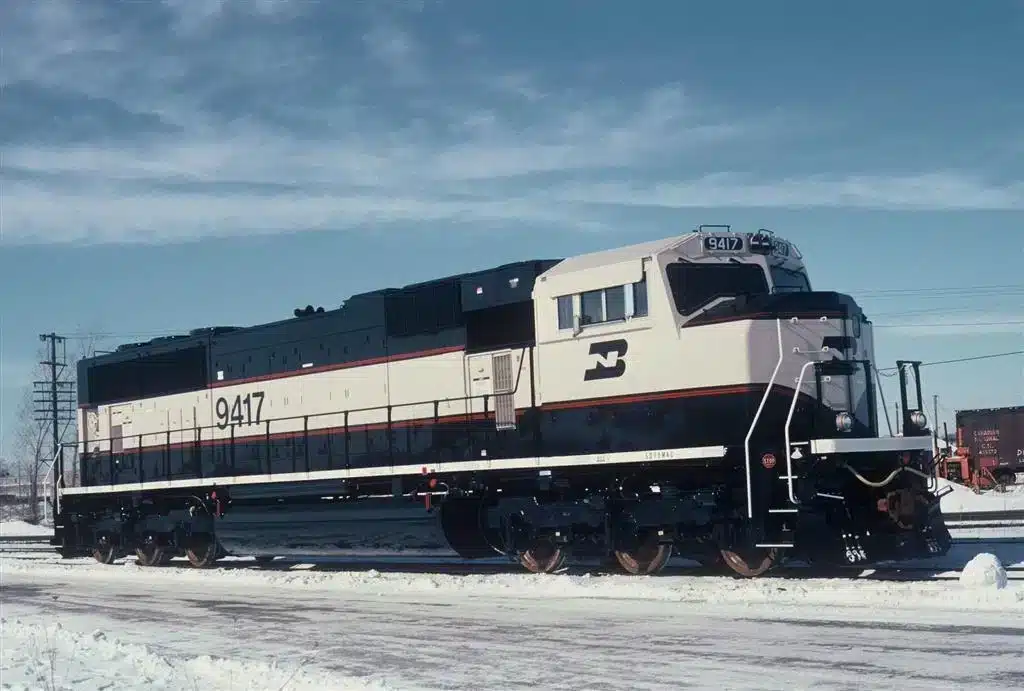
Freight locomotive AC traction gained momentum in 1991-1992 with the EMD SD60MAC. These 4,000-hp, six-axle units used Siemens traction motors. Four demonstrators were built. In late 1992, these units demonstrated high adhesion qualities during testing at TTCI (now TTC Operated by ENSCO), establishing that three AC locomotives could replace five SD40-2 DC traction units, which were commonly used on heavy-haul Powder River Basin unit coal trains on the Burlington Northern (now BNSF). After further testing on BN, these locomotives were demonstrated in experimental service on nine North American Class I railroads in the U.S. and Canada.

In March 1993, BN made an unprecedented move in the history of U.S. railroads by placing an order with EMD for 350 SD70MAC locomotives. Subsequently, this order was expanded to 450. The first unit entered service in December 1993, and by 1994, 130 were in service. During long-term testing, the SD70MAC registered an adhesion coefficient 0.40 hauling a 7,000-ton train—with the rails were coating with water mixed with oil and soap. On dry rails with a 7,600 -ton, the SD70MAC registered an adhesion coefficient of 0.42, and upon restart, 0.45. The high-adhesion properties of diesel locomotives with AC traction combined with low-wear wheelset treads proved to BN that AC traction would allow the railroad to reduce its locomotive fleet size and operating costs.
EPA Tier Standards and AC Traction
The U.S. Environmental Protection Agency (EPA) issued one of the most important regulations that improved diesel-electric locomotives: limiting the release of harmful substances on main line and switching locomotives through Tier standards 0-4 (download EPA specifications below). In response, GE (now Wabtec) developed the Evolution Series™. The ES44AC used an all-new GEVO12 12-cylinder diesel engine producing 4,400 hp (3,280 kW), the same as its 16-cylinder FDL16, with AC traction. To date, there have been a few hundred examples of the ET44AC produced since it debuted in 2015. CN, CSX, Norfolk Southern and Union Pacific have purchased this model.
EMD introduced the SD70ACe with AC traction motors. Unlike Wabtec, EMD chose to improve its existing diesel engine, the 16-cylinder 710, which provided 4,300 hp (3,200 kW), an increase of almost 10% from SD70MAC. At the same time, EMD’s modernized engine complied with Tier 2 requirements.
For the first time, diesel locomotives from Wabtec and EMD had power inverters based on IGBT transistors with air-cooled phase modules.
EPA Tier 3 requirements came into effect in 2011-2012. By this time, Wabtec had developed the ES44C4, a six-axle unit, albeit with four traction motors (A-1-A + A-1-A). The center axles on each power truck did not have traction motors. The ES44C4, a variant of the ES44AC, weighed approximately the same as the ES44AC, but had a lower starting tractive effort approximately equal to that of an ES44DC with six DC traction motors. The ES44C4 also cost about the same as ES44DC, but provided better traction properties and lower operating and repair costs.
To compete with the ES44C4, EMD developed the SD70ACe-P4, whose power trucks were of a B-1 + 1-B configuration (inner unpowered axles). The SD70ACe-P4 is equipped with an EMD 16-710-G3C-T2 diesel engine rated at 4,300 hp (3,200 kW) and starting tractive effort of 640 kN.
EPA Tier 4 requirements came into effect Jan. 1, 2015. By this time, Wabtec had developed the ET44C4 series, which like the ES44C4 was an A-1-A + A-1-A configuration. This model, and the Tier 4 ET44AC, were the company’s final production road switchers before the GE’s Transportation division was sold to Wabtec in 2019. BNSF has acquired more than 200 examples of the ET44C4.

Wabtec engineers solved the problem of creating a diesel-electric locomotive that met Tier 4 without the use of additional equipment, utilizing rational control of internal engine processes with a new optimized control system. The ET44AC and ET44С4 reduced PM (Particulate Matter) levels by 90% and NOX (oxides of nitrogen) by 80%, compared to the Tier 1. The ET44С4’s reliability was the main factor in Wabtec’s decision to cease production of the ES44DC in 2011.
EMD’s Tier 4 offering was the SD70ACe-T4, which was equipped with a new four-stroke, 12-cylinder, 4,400-hp 1010 series engine. EMD employed EGR (exhaust gas recirculation), a method of reducing NOX release by returning part of the diesel exhaust gases to the cylinders, reducing combustion temperature, albeit with a slight power reduction. Like the SD70ACe, the SD70ACe-T4 is equipped AC traction drive and IGBT power inverters but has individual axle control.

For passenger service, EMD developed the F125. Southern California’s Metrolink ordered 40 of these units, which they designated as “SCAX.” The F125 has a 20-cylinder, 4,700-hp (3,500 kW) Caterpillar C175-20. Tier 4 compliance is achieved with SCR (Selective Catalytic Reduction).
SCR technology is based on injection of a strictly regulated amount of reagent into the exhaust gas stream in the presence of a catalyst. The most used reagent is an aqueous solution of urea crystals (67.5% water and 32.5% urea). Vanadium or titanium is used as a catalyst. At high temperatures under the influence of the catalyst, an aqueous solution of urea is converted into ammonia and carbon dioxide. Gaseous ammonia and NOX are converted into nitrogen and water. Nitrogen is a harmless gas, an integral part of the air we breathe.

EMD and GE predecessor Wabtec more than 30 years ago decided to develop diesel-electric locomotives with AC drive for heavy freight trains. Today, 10 railways globally are included in the IHHA (International Heavy Haul Association). They’re in the U.S., Canada, Mexico, Brazil, Australia, South Africa, China, India, Indonesia, Kazakhstan, Ukraine, Azerbaijan, Kyrgyzstan, Tajikistan, Turkmenistan, Moldova and Mongolia. So, the agreement signed more than 30 years ago between EMD and Siemens on the development of a new generation of main line diesel locomotives with AC drive led to the emergence of fleets not only on U.S. railways, but on other railways around the world.
Canada
Aside from CN and CPKC, iron ore hauler Quebec North Shore & Labrador has a fleet of AC traction locomotives, which are typically used in sets of three for its heaviest trains. QNS&L’s road fleet includes 12 AC4400CWs, 19 AC446Ms (rebuilt from BNSF Dash-9s) and 26 SD70ACes.

Brazil
EFVM (Estrada de Ferro Vitória a Minas, the Vitória-Minas Railway) and EFC (Estrada de Ferro Carajás, the Carajas Railway) operate heavy iron ore trains with EMD and Wabtec locomotives. With minor modifications, U.S.-design locomotives are operated on EFC’s broad-gauge (1,600 mm, compared to standard gauge, 1,435 mm) track, which has 31.5-ton maximum permissible axle loads.
Modified U.S.-design locomotives operate on EFVM’s narrow-gauge (1,000 mm) track, which has 25-ton maximum permissible axle loads. Locomotive weight needs to be distributed on a larger number of axles with lower-power traction motors, since the U.S. motors are difficult to accommodate in the narrower space. The most powerful EFVM unit is the Wabtec ES43BBi, a redesigned ES44AC manufactured in Brazil. It is equipped four two-axle trucks (B-B + B-B), a 4,500-hp GEVO12 diesel engine. Maximum speed is 65 kph (40 mph); starting tractive is 588 kN. As the most powerful narrow-gauge diesel locomotive in the world, two ES43BBi units capable of hauling heavy trains that previously required three to five six-axle DC traction locomotives.

EFC’s most powerful locomotive is the Wabtec ES58ACi, which is equipped with a 6,000-hp GEVO16 diesel engine. Weight on rail is 195 tons, maximum speed is 110 kph (68 mph), starting tractive effort is 890 kN. The GEVO16 engine meets U.S. EPA Tier 3 standards only and is used on railways around the world whose comparative environmental standards are lower than Tier 4.

Australia
Large iron ore deposits are located in Australia’s western Pilbara region. The climate is arid, with little rainfall. Often, the temperature in summer reaches 45 degrees C (113 degrees F). About 160 days a year, the temperature averages 38 degrees C (100 degrees F). There are four railways: BHP Billiton, Rio Tinto, FMG (Fortescue Metals) Group and Roy Hill. All new diesel locomotives supplied to Australian railways from the U.S. are manufactured to special requirements associated with a dry, hot climate. For example, the SD70ACe series is equipped with two cab air conditioners, a special roof with sun protection and improved diesel engine cooling.
BHP Billiton rosters 182 EMD diesel locomotives of the SD70ACe and SD70ACeLCi (LC designating low clearance for mining operations) series. Rio Tinto’s locomotive fleet consists 49 Wabtec ES44ACi units. FMG has 21 SD70ACeLCi units, 10 SD70ACe-Р6 units, 28 Wabtec AS44S6M rebuilds and four 4,300-hp EMD SD90/43MACs, rebuilt SD90MAC-H units with replacement 16-710G3С diesel engines. Roy Hill has 28 Wabtec ES44ACi locomotives.

Queensland Railway locomotives used on unit coal trains operate on 1,067 mm narrow gauge tracks with axle loads of no more than 20 tons. In 1999, Siemens and EMD developed the GT42CUAC, a 132-ton, 3,200-hp (2,460 kW), six-axle (C-C) locomotive equipped with a 12-cylinder 12N-710G3B-ES and AC traction motors for narrow gauge applications. It was based on the SD70MAC. This later evolved into the 3,300-hp GT42CUACe. Under license from EMD, Australian manufacturer Clyde Engineering produced 132 GT42CUACs, designated the 4000 series. EDI Rail, also under license from EMD, built 82 GT42CUACe units, designated the 4100 series.

South Africa
In March 2014, Transnet of South Africa awarded Wabtec a contract for 233 1,067-mm gauge, 132-ton ES40ACi locomotives. Designated the 44-000 series, they’re equipped with a 4,200-hp GEVO12 diesel engine.

Indonesia
PT Kereta Indonesia (PT KAI) recently awarded a contract to Progress Rail for 54 EMD® GT38AC freight locomotives for service in South Sumatra, expanding the national railway’s existing fleet. Progress Rail anticipates delivery beginning in 2025.

India
Indian Railways (IR) has 1,188 single-cab, six-axle standard-gauge diesel locomotives of the WDG-4 series. From 1997 to 2007, they were based on the EMD GT46MAC, since 2007 on the GT46ACe. These units are equipped with a 4,000-hp ((2,980 kW) 16-710G3B diesel engine. Weight is 126 tons, maximum speed is 105 kph (65 mph), and starting tractive effort is 540 kN. In August 2017, IR began taking delivery on 488 double-cab WDG-4G series locomotives based on Wabtec’s ES43Aci. These units are equipped with a 4,500-hp (3,400-kW) GEVO12 diesel engine. Locomotive weight is 126 tons, maximum speed is 100 kph (62 mph) and starting tractive effort is 544 kN.


IR had long desired a 6,000-hp (4,500-kW) diesel locomotive. In 2019, Wabtec fulfilled that desire with the WDG-6G series. This 138-ton double-cab unit, based on the ES57Aci, is equipped with a GEVO16 diesel engine. By October 2023, 92 had been produced. Maximum speed is 100 kph (62 mph). Starting tractive effort is 570 kN.
China
After concluding a contract for the supply of imported standard-gauge diesel-electric locomotives from EMD and Wabtec, China’s state-owned railway system began domestic manufacturing of the HXN3 series and HXN5 series at locomotive plants in Kishuyang City and Dalian, respectively, under license. Since 2008, 334 HXN3 and 300 HXN5 units have been built.

The HXN3, based on the EMD JT56ACe, is equipped with a 6,300-hp (4,700-kw) EMD 16-265H diesel engine. The 150-ton unit is rated at a maximum speed of 120 kph (75 mph) and starting tractive effort of 640 kN. The HXN5, based on the Wabtec ES59ACi, is equipped with a 6,250-hp (4,600-kW) GEVO16 diesel engine. Also weighing 150 tons with a maximum speed of 120 kph, this locomotive is rated at a starting tractive effort 620 kN.

Built in Kazakhstan (Mostly)
Since 2009, the Kazakh plant in Astana has been producing six-axle, double-cab TE33A locomotives based on the Wabtec ES44Aci diesel locomotive for broad-gauge (1,520 mm) railways in countries such as Kazakhstan, Azerbaijan, Kyrgyzstan, Tajikistan, Turkmenistan, Moldova and Mongolia. These units, of which 276 of 310 have been built (Wabtec built the first 10 at its Erie, Pa., plant), are equipped with a 4,500-hp (3,356-kW) GEVO12 diesel engine. Locomotive weight is 142 tons. Maximum speed is 160 kph (99 mph). Starting tractive effort is 534 kN. However, since one of the owners of the Astana plant is Russia’s Transmashholding, the Ukrainian railroads have refused to purchase diesel locomotives built there and instead agreed to purchase 30 units manufactured by Wabtec in the United States.


Alex Luvishis, Ph.D. for 18 years headed the laboratory that developed control systems for Russia’s first electric locomotives and asynchronous traction motors in the former USSR. For a further seven years, he headed the rolling stock department at the Institute of Technical Information of Railway Transport in Moscow. Dr. Luvishis is the author of more than 100 articles on electric traction drives and the book “Hybrid Rail Vehicles,” published in 2009. His interests are asynchronous traction drive systems for modern rolling stock, and hybrid drive systems for trams, suburban and regional trains and switching and main line locomotives. He has lived in the U.S. since 1999.