MxV Rail R&D, RAILWAY AGE, JULY 2023 ISSUE: In the North American railroad industry, bearing reconditioning is a common practice that occurs every time a bearing is removed from an axle. The reconditioning process involves the disassembly, inspection, repair and re-assembly of the bearing. MxV Rail has investigated the performance and service life of reconditioned bearings.
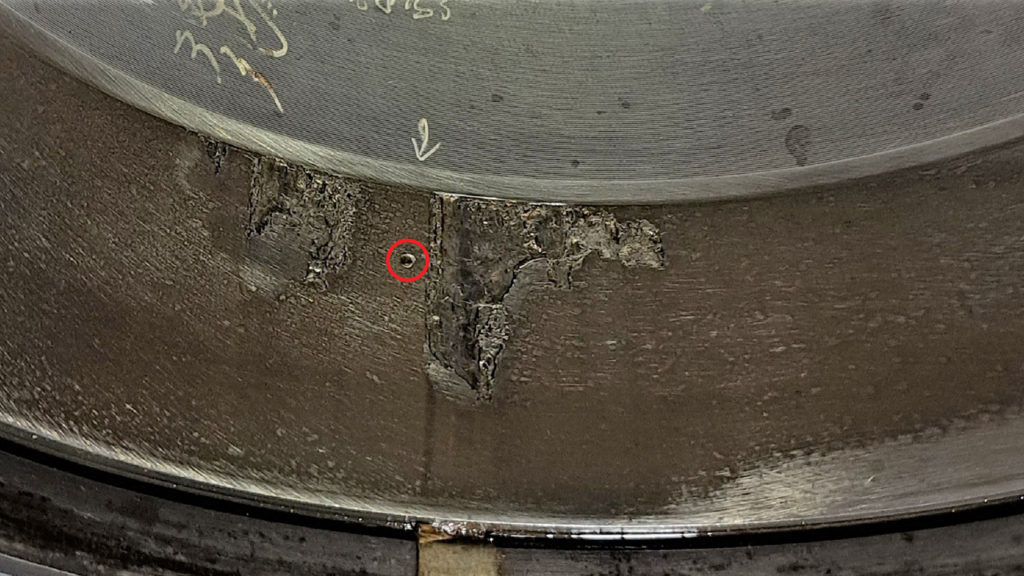
Currently, the bearing reconditioning process entails 1) searching for defects using a visual inspection, and 2) allowing the reconditioner to repair certain defects based on Association of American Railroads rules. As part of the AAR Strategic Research Initiative (SRI) program, MxV Rail is exploring alternative inspection methods that not only can identify damage but also can verify that the repairs were successful. For example, during laboratory testing, flexible eddy current array (ECA) nondestructive evaluation (NDE) technology was used to search for visually undetectable subsurface anomalies in bearing raceways. The NDE-tested bearings were then run in a test rig, disassembled and re-evaluated (Figure 1, above).
Using the ECA system, MxV Rail engineers scanned 204 bearing cups, with each cup having a spall repair on its raceway. Of the 204 cups inspected, 33 showed ECA indications of material anomalies, including seven cups with indications near the spall repair site. After scanning the bearing cups with repaired spalls, two sample sets were chosen from the group: one set of samples with eight bearing cups and one set with seven bearing cups.
The first set (eight bearing cups) showed no indications of anomalies from the ECA testing; the theory is that these eight bearings could run the entire rig test without spalling. The second set (seven bearing cups) had ECA indications of anomalies near the spalled repair area, possibly indicating subsurface damage that was not detected during the visual inspection and repair. It is hypothesized that these seven cups would not last the entire rig test without spalling.
Once the bearing cups were selected for the test, the bearings were reassembled and installed on a laboratory test rig. The bearings were loaded to represent the supporting of a fully loaded railcar. The cup was rotated so that the repaired spall area was directly underneath the load, and the axle was run at an equivalent train speed of 85 mph. During the test, temperature and vibration sensors monitored bearing performance. The test duration was approximately the equivalent of 240,000 service miles.
During the rig testing, two of the repairs in the bearing cup raceways spalled. Overall, the flexible ECA indications of anomalies in the material were predictive of the outcome of repairs in the rig testing 56%of the time. This accuracy rate was calculated by dividing the total number of predicted repair outcomes (both spalling and not-spalling during testing), based on the number of ECA indications, by the total number of cup repairs tested. The indications had a false negative rate of 50%, giving the implication that bearing cups without indications might spall during testing.
The indications also had a false positive rate of 43%, where bearing cups with indications did not spall during testing. While the preliminary results reveal that the flexible ECA indications are not currently an adequate screen for repairs, there is ample potential for improving the accuracy of the screening using other means, including destructive evaluation of any cups that have indications of anomalies.
Future work for this project will focus on two main objectives. The first is to develop an understanding of what the ECA scans are physically detecting in the material. The second is to understand the difference between the indications that spalled during the rig test and those that did not. Knowing which indications will and will not spall will go a long way toward improving the accuracy of the system.