FreightCar America has entered into a multi-year agreement with an undisclosed customer, at an undisclosed contract value, to rebuild and upgrade more than 1,000 legacy DOT-111 tank cars to current DOT-117R standards over a two-year period.
The company notes that its “strong foundation including deliveries of more than 15,000 conversions and rebodied railcars paved the way for this landmark agreement. This expansion into tank car conversions marks a key milestone in ongoing efforts to diversify product offerings while continuing to support its legacy and meet customer needs.”
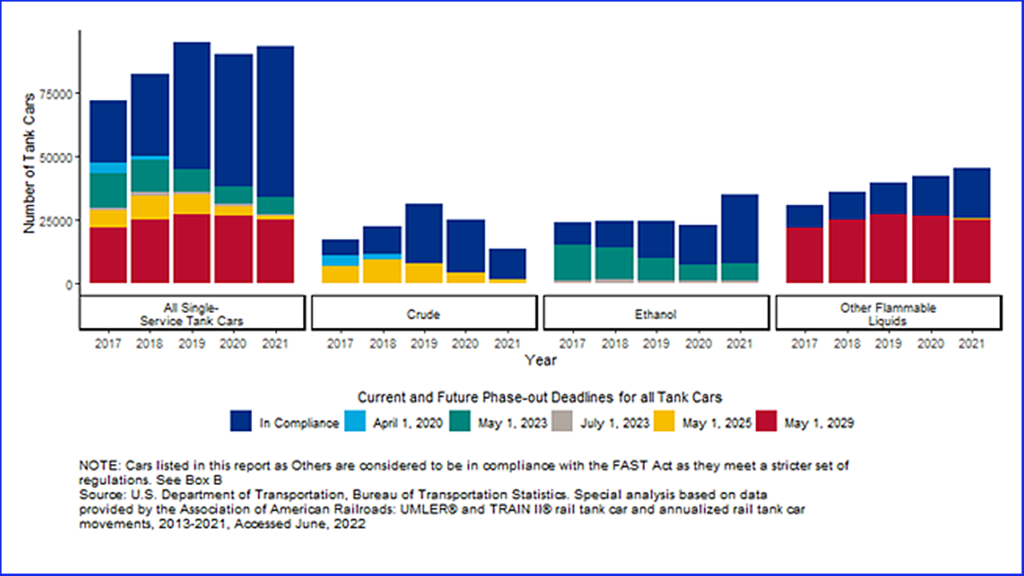
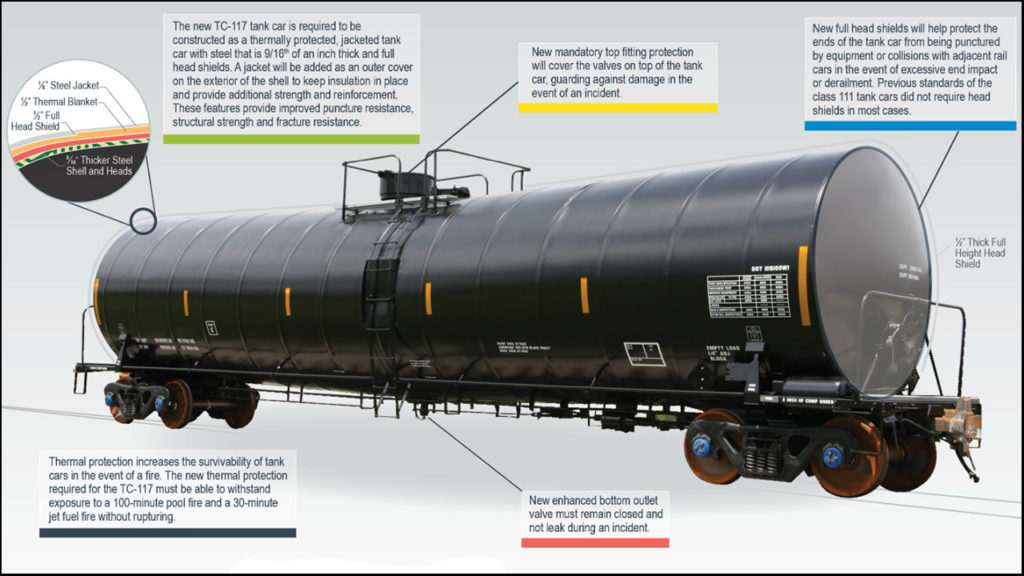
Conversion to DOT-117R standards, which by federal law must be completed by 2029 for all DOT-111s transporting certain hazardous and flammable liquids, includes a new exterior tank jacket, thermal protection, full-height head shields, top fittings protection and upgraded bottom outlet valves. All work will be done at FreightCar America’s sole manufacturing plant in Castaños, Mexico.
FreightCar America said this program “demonstrates the company’s capability as a reliable partner in large-scale projects, while underscoring its commitment to meeting the evolving needs of the rail transportation market and solidifying its position as a key player in the industry.”
“We are excited to enter the tank car space with this significant multi-year conversion order,” said Nick Randall, CEO of FreightCar America. “Coupled with our prominent history in railcar modifications, our commitment to large-scale projects made us an excellent partner for the deal. Our Castaños facility has the capacity to handle these modifications efficiently, minimizing the number of cars out of service at any given time. This expansion broadens our robust offerings of railcars, enhances our opportunity to expand our business, and equips us to grow our addressable market and customer base. We are committed to quality and reliability in large-scale projects as we continue to set new standards in manufacturing and commercial excellence.”
Railway Age Financial Editor and Railroad Financial Corp. President David Nahass comments that, based on the size of the order, FreightCar America’s customer is most likely a petroleum company that owns its tank car fleet, not a railcar lessor or bank. Based on the average cost of converting a DOT-111 into a DOT-117R of $60,000, the contract value appears to be roughly $60 million. The average cost of a new DOT-117J is $170,000.
A DOT-117J (new) or 117R (rebuild) tank car is specified by the USDOT and Transport Canada as “a non-pressurized tank car with a shell thickness of 9/16 of an inch and insulating material providing thermal protection. The tank cars have protected top fittings, a fully protected head shield, and a bottom outlet valve with an enhanced handle designed to prevent the tank car from emptying its contents in an incident. All the enhancements are designed to protect the tank from being punctured and to prevent the valves from being disrupted. DOT-117R tank cars are cars that have been retrofitted to meet the 117 specifications, to include a jacket and head shield.” DOT-117Js have a ⅛-inch thicker tank shell than a 117R but otherwise are identical.