
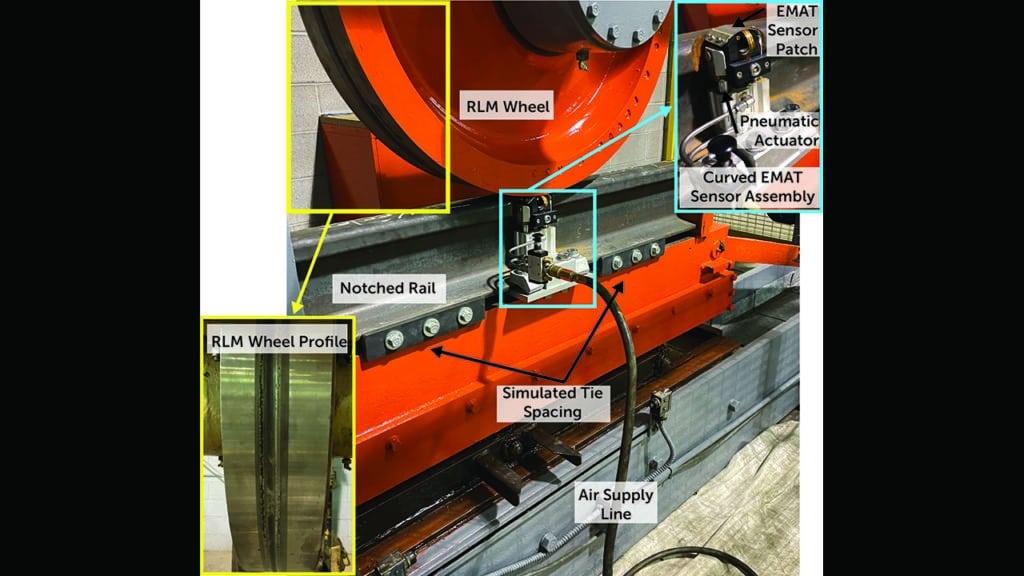
MxV Rail R&D, Railway Age November 2024 Issue: Since 2021, MxV Rail has been collaborating with Innerspec Technologies, Inc. regarding development of a magnetostrictive Electromagnetic Acoustic Transducer (EMAT) sensor and assemblies for freight railroad revenue service implementation. This wheel inspection technology is analogous to the ultrasonic nondestructive evaluation (NDE) of rails.
The reliability and durability of wayside detection systems plays a critical role in whether the system can be successfully implemented for railroad usage. The ruggedness of track-mounted sensors is paramount, especially when these devices are subjected to harsh operating conditions and high dynamic loads from traversing wheels. Recent research focused on 1) ruggedizing the magnetostrictive EMAT sensor assembly and 2) conducting endurance testing of the EMAT sensor/assembly in the rolling load machine (RLM), which applied repetitive loading and unloading cycles to simulate the freight railroad load environment. This work resulted in the design of an improved sensor assembly that was installed and implemented for railcar wheel inspection at the Facility for Accelerated Service Testing (FAST®) track.
Magnetostrictive EMAT sensor assemblies with a pneumatic actuator mounted to a notched rail were fatigue tested in the RLM for up to two million passes at a 40-kip wheel load. A first-generation magnetostrictive EMAT sensor (curved sensor) achieved one million wheel passes in the RLM before being superseded by an improved design. One of the main field implementation challenges identified with the curved EMAT sensor was the complexity of replacing the common wear components (strip, coil, and coil connector). Due to these challenges, the curved EMAT sensor was redesigned as a flat sensor to allow quick replacement of the most common wear components. The foam backing behind the strip and coil was replaced with a solid, flat substrate and moved farther down the sensor. Also, to increase the longevity of the strip and coil, the new design 1) eliminated the flexing of the strip and coil to conform with the wheel and 2) reduced the risk of damaging the strip due to any sharp wheel edges that might pinch or cut the strip.
The new design replaced the permanent magnet with a direct current (DC) electromagnet activated during wheel presence to reduce the amount of ferrous debris attracted to the sensor head in the field. Both versions of the second generation flat magnetostrictive EMAT sensor reached two million wheel passes with minimal wear and damage. The number of wheel passes is equivalent to 40 million gross tons (MGT) of traffic at a 40-kip wheel load.
In addition to a robust design, the signal quality of the EMAT sensors following rigorous load testing is also critical in ensuring the sustained effectiveness of these sensors. A signal quality examination involves careful analysis of signal amplitudes to ascertain there has been no reduction or degradation in the ultrasonic signal performance over time. The EMAT sensor signal quality after the RLM tests was as good as the signal quality prior to the tests.
The EMAT sensor assembly requires the field side of the rail head to be notched to approximately 1 inch deep laterally by 5 inches long with 45-degree transitions from the field side edge. The RLM testing accumulated a total of 110 MGT on a 53.5-inch long 136RE rail section that had been previously used in FAST operations. After 110 MGT in total passes in RLM, the additional vertical wear at the notch averaged 0.01 inch and the additional cross-sectional area loss averaged 0.04 inch.
This rigorous testing methodology focused on uncovering potential weaknesses and vulnerabilities in the EMAT sensor design by providing valuable insights into areas that require improvement. The outcomes of these endurance tests were pivotal to the development and deployment of a prototype system in FAST. The lessons learned from this work also contributed significantly to advancing state-of-the-art sensor technology and paved the way for the creation of more resilient and more dependable EMAT sensors and assemblies for field application. MxV Rail is currently testing track-mounted EMAT sensors in FAST and new findings will be reported in future publications.




