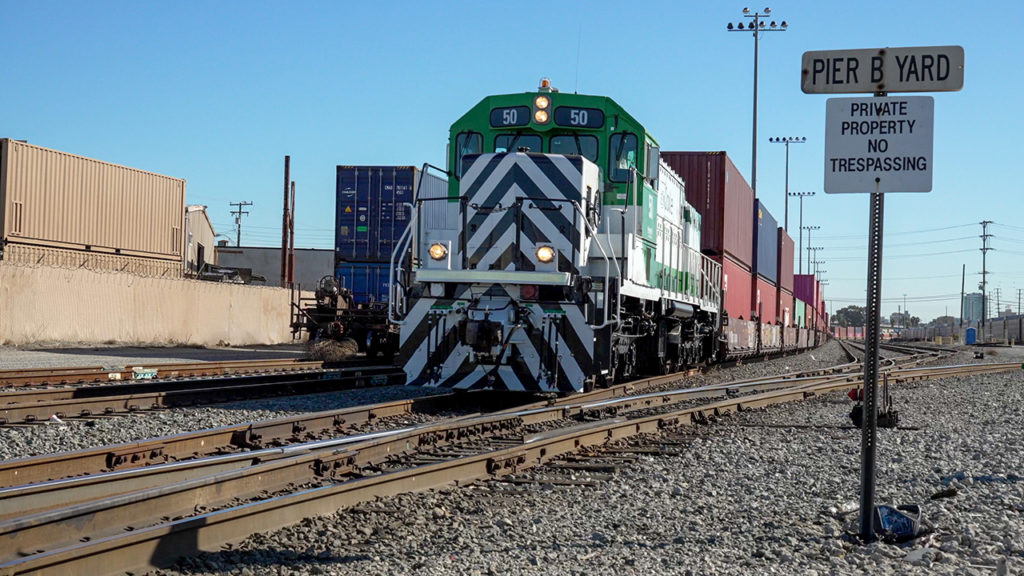
The railroad industry is struggling to determine what the locomotive of the future will look like. Railroads have committed to carbon emission reductions, but there still much uncertainty about the feasibility of various energy solutions.
One problem may be that the industry is too focused on mutually exclusive options. Biofuels or electric? Hydrogen ICE (internal combustion engine) or hydrogen fuel cell? While all these choices are under review, there is one technology that could be beneficial across the board in increasing the energy efficiency of both current and future locomotives: battery-electric (BE).
While unlikely to be an ultimate solution on its own for road locomotives (although being deployed already in yard/local service), the potential benefits of battery-electric technology at every step in the green energy transition make it worth greater rail industry focus and investment—regardless of the ultimate direction the industry chooses for lowering emissions.
When Perfect is the Enemy of the Good
Is the search for the perfect locomotive solution getting in the way of continuous improvement in fuel efficiency/emissions reduction for the rail industry? The breaking of the “virtuous cycle” of locomotive purchases would suggest the answer is yes. There have been few new locomotives bought in the past decade, since Tier 4 broke the cycle of efficiency gains from each new generation of power (Exhibit 1).
Most, if not all, future locomotive concepts could leverage battery-electric technology to further improve their efficiency—and in the process reignite the virtuous cycle, so that railroads would once more have a reason to upgrade locomotives regularly – with ensuing cost, fuel, and emissions benefits.
The primary benefit of battery-electric technology is that it can recapture and store braking energy, which is currently burned off as heat in today’s locomotives. Incorporating battery-electric into new locomotive designs (or consists) could reduce overall energy consumption by 10-20% over-the-road. Wabtec for example has seen 11% fuel savings by including its FLXdrive battery-electric locomotive (BEL) in a diesel consist (capturing only the braking energy of the BEL itself). Other studies suggest that 15% could be achievable, based on the cost and space required for current batteries. Of course, future battery technology might push this number much higher.
Another consideration is that all alternative fuels (such as biofuels and hydrogen) are more costly to make than diesel fuel, at least for the foreseeable future. Including battery-electric in new locomotives would not only further reduce emissions but would mean buying less fuel – thereby reducing operating costs and putting less strain on future fuel supply chains.

Improving on Future Options with BE
At present, railroads are heavily focused on “drop in” biofuels as a potential solution. Capturing regenerative braking energy using battery-electric technology at the same time would double emissions reductions, compared to 20% biofuel usage alone. Given limitations on biofuel feedstocks and competition from other industries (particularly aviation), however, it is unlikely that rail will be able to expand biofuels usage to 100%.
Another option under consideration is using hydrogen fuel cells (HFC), but these don’t scale output up and down as easily as a diesel engine. Thus, hybrid battery technology is being incorporated into HFC locomotive design to provide a buffer for power adjustment – as well as to recapture braking energy. Another type of hydrogen-fueled locomotive—the hydrogen internal combustion engine, which would be more like a diesel engine—also would see a drop in fuel requirements by incorporating battery-electric.
Then there is the potential for electric trains: What if catenary systems end up being the best choice for future power? We know from the experience of increasing clearances for doublestack intermodal that modifying problem areas where clearances are tight, such as tunnels and overpasses, can be expensive, disruptive, and time-consuming. A better solution might be “discontinuous catenary,” in which battery-electric is used to push trains through gaps, making catenary systems more viable. The U.S. Federal Railroad Administration recommended this approach to railroad electrification in a recently released paper. Regenerative braking energy also has been captured and fed into overhead catenary systems for instant use by other trains for decades; the next step will be figuring out how to store this “free energy” for non-catenary applications.
Buying Time for Better Solutions
Battery-electric also could extend the value of today’s diesel engine technology while new fuel solutions are in development. It looks increasingly like diesel will be in use for at least another locomotive generation. Hybrid diesel-battery technology could potentially scale down the horsepower requirements for diesel engines from 4,400 hp to perhaps 3,000-3,200 hp, making space for batteries that would provide surge power as well as recapturing braking energy.
Sophisticated modern control systems should be able to anticipate when batteries would need to provide full output and for how long, when batteries would need to be fully charged to provide maximum benefit, and whether to charge from regenerative braking or from a diesel engine running at full power—further leveraging engine efficiency. And with hybrid locomotives, it would be possible to recapture the braking energy from all locomotives in a consist. CN is in the process of acquiring an SD70H hybrid locomotive from Progress Rail to test in British Columbia, while Norfolk Southern and Alstom are converting two GP 38/40 units to this hybrid design.
Hybrid consists are another way that BELs could be leveraged to improve emissions reduction and fuel efficiency for diesel locomotives. Today’s multiple-locomotive consists rarely need all the power available to them, except when running uphill or starting from a cold stop. Since diesels are most efficient when running at top output, having rarely used extra diesel locomotives attached makes the entire consist less efficient (since all the locomotives must then run at lower power most of the time). In some cases, advanced consist management allows the extra locomotives to be placed in idle—but even then, these units are burning fuel and creating emissions.
BELs could be an ideal booster unit instead, eliminating the need for at least one diesel locomotive and providing a fuel efficiency benefit. Union Pacific and ZTR have started testing such hybrid consists by replacing a standard slug unit with a BEL. (A slug unit has concrete ballast instead of an engine to provide traction, while its traction motors receive current from an attached diesel locomotive.) Let’s expand this concept to road locomotives, which is where the real fuel savings would be generated.
Most critically, starting to use BELs in hybrid consists now would allow more time to develop a diesel engine replacement without creating a stranded investment, as a BEL would provide benefits to a consist regardless of what other locomotive types are used. For example, a BEL coupled to an HFC locomotive would continue to provide surge power and recapture braking energy. The BEL might not even need a cab, if always used in the middle of a consist, providing more space for batteries and eliminating the cost of cab components. These units also can be partially built from recycled assets: In Australia, Aurizon is working with Progress Rail to retrofit a BEL from one of its own 4000-class diesels. And BELs are expected to have lower maintenance requirements than diesels, just like electric vehicles have lower maintenance needs than conventional vehicles.

Stepping Out for Next-Generation Efficiency
Battery technology is improving rapidly, both in capacity and cost. It is important for the rail industry to invest in this technology now and continue to leverage it as battery technology improves. Regardless of what the rail industry ultimately chooses for a solution—be it hydrogen, catenary, hybrid, or simply sticking with diesel for another 20+ years, battery-electric technology has an important role to play. The rail industry could reap cost and efficiency improvements and lower both fuel consumption and emissions quite quickly by including battery-electric in hybrid locomotives and consists —even with today’s diesel engines.
A final consideration: Trucks have improved their fuel efficiency by nearly 15% since 2015, while railroads have barely moved the needle. Battery-electric could be a crucial stepping stone to the breakthroughs in locomotive design the industry needs, not only to trigger new locomotive buying, but to maintain and improve the competitive economics of railroading.