RAILWAY AGE JULY 2024 ISSUE: MxV Rail conducted an in-depth analysis of air hose separation (AHS) incidents using service interruption reports, locomotive event recorder downloads and infrastructure databases from a Class I railroad. The analysis 1) focused on 95 reported UDEs (undesired emergency applications) caused by an AHS, 2) examined factors such as train handling, track profile and equipment details, and 3) revealed a wide range of characteristics in the trains captured in the service interruption reports, including length, weight, and tonnage.
While the train type can have some influence on the likelihood of an AHS occurrence, the data did not suggest that an AHS occurred only on trains with a specific combination of characteristics. Similarly, train handling factors such as throttle and brake status did not show a clear correlation with AHS incidents.
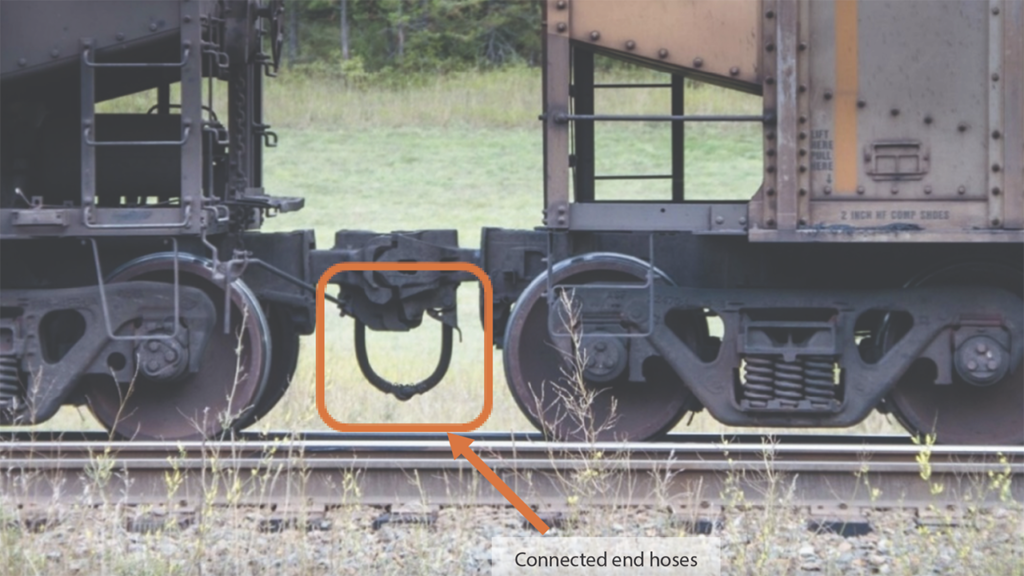
With their intricate design and numerous components, train brake systems are a testament to engineering complexity. Both the air supply and control signal on a railcar’s brake system come from the locomotives via the brake pipe. Flexible end hoses with gladhands connect the brake pipe together throughout the train. As a result, end hoses are a pivotal part of the brake application and release process. Being fail-safe by design, when the pressurized brake pipe suddenly loses air pressure, the brake system automatically applies the emergency brake and stops the train. An AHS-caused UDE can result in everything from significant delays to railway operations and unwanted train stops to increased fuel expenses and potential damage to the train or railway infrastructure.
Track features were also analyzed using a railroad-provided database. Approximately 93% of trains encountered track features such as road crossings, turnouts or bridges when the AHS incident occurred. These could potentially have obstructions that can strike the end hose gladhands, thereby leading to an AHS. However, past studies have shown that gladhand strikes without large debris on the track cannot occur without other preexisting mechanical defects, and no gladhand strikes were recorded in the incident summaries. Therefore, gladhand strikes were not conclusively proven as the primary cause of an AHS.
The way gradients and curvatures change in the area where the AHS occurred was also analyzed to determine the possibility of excessive end hose movement, causing them to separate. Similar to other scenarios, the analyzed trains operated over various terrain types at the time of the AHS, with no particular cause standing out from the rest. However, the statistics indicate that trains that experience an AHS encounter more curvature changes than trains that do not experience an AHS.
Equipment factors, particularly the age and type of equipment, were found to be significant regarding an AHS. Cars equipped with end-of-car cushioning (EOCC) typically use more complex end hose arrangements to accommodate the much longer coupler travel of these cars. Older cars equipped with EOCC were involved in approximately 80% of the analyzed AHS incidents. This information suggests that newer cars equipped with EOCC are less likely to cause an AHS, possibly due to their better design and condition of the end hose arrangements.
The study concluded that, while no single factor could be pinpointed as the primary cause of AHS events, older EOCC-equipped cars were a major contributing factor to the number of recorded AHS events. In the context of previous research on other causes of an AHS, this finding suggests that better design and timely and proper maintenance of EOCC end arrangement equipment could help reduce AHS-related service interruptions.