
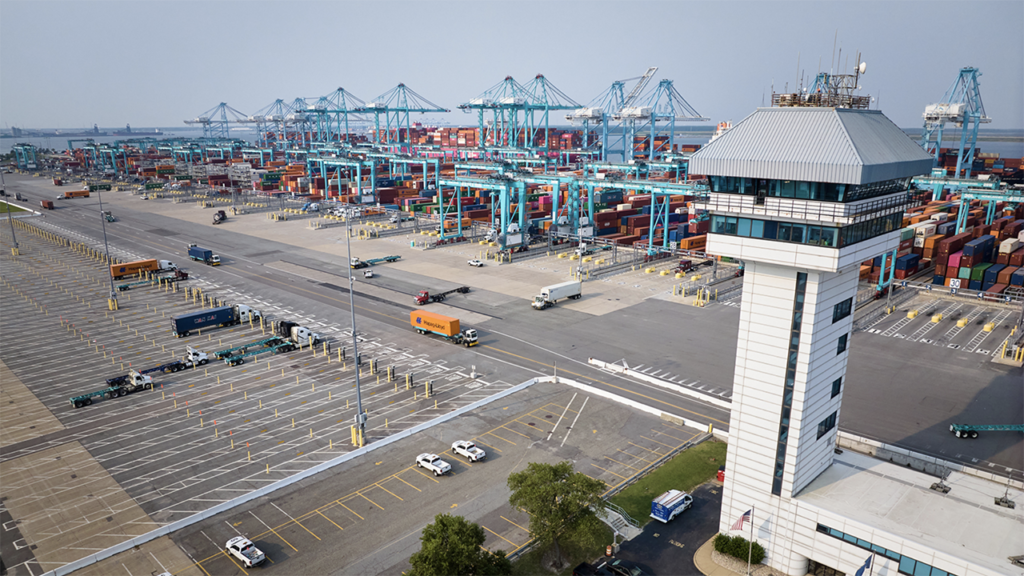
The Port of Virginia reported closing 2024 with its best fiscal year volume since 2020, processing approximately 3.5 million TEUs (Twenty-Foot Equivalent Units) between July 1, 2023, and June 30, 2024. This was a 2% increase over fiscal year 2023.
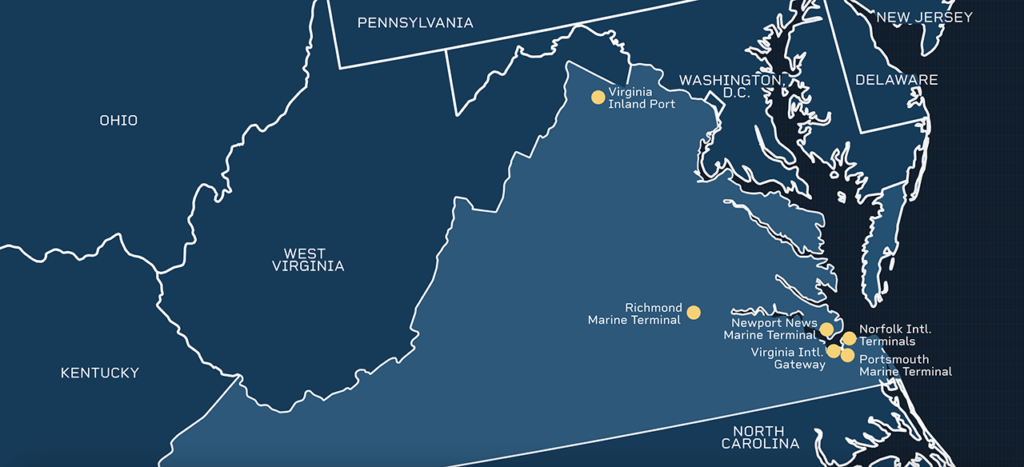
The Virginia Port Authority, a political subdivision of the commonwealth of Virginia, owns and operates four general cargo facilities: Norfolk International Terminals (direct, on-dock access with Norfolk Southern, as well as intermodal access with CSX), Portsmouth Marine Terminal, Newport News Marine Terminal (direct, on-dock rail service from CSX with the ability to transfer with Norfolk Southern) and the Virginia Inland Port in Warren County (see map below). It also leases Virginia International Gateway (offering nearly 20,000 linear feet of track with on-dock connections to Norfolk Southern and CSX) and Richmond Marine Terminal.
The Port of Virginia, By the Numbers:
FY24 vs. FY23
- TEUs – 3,499,639, up 2%
- Containers – 1,930,480, up 1.4%
- Loaded Export TEUs – 1,139,925, up 4.2%
- Loaded Import TEUs – 1,625,267, up 3.6%
- Rail Containers – 784,597, up 13%
- Barge Containers – 64,106 containers, down 24.4%
- Truck Containers – 1,081,777, down 3.7%
- Breakbulk Tonnage – 283,817, up 112.1%
- Ship Calls – 1,733, up 5%
Cargo Highlights, June 2024 vs. June 2023
- TEUs – 295,975, up 12.1%
- Containers – 164,899, up 13.1%
- Loaded Export TEUs – 95,262, up 15.6%
- Loaded Import TEUs – 124,991, up .5%
- Rail Containers – 59,217, down 1.2%
- Barge Containers – 4,328, down 15%
- Truck Containers – 101,354, up 25.5%
- Breakbulk Tonnage – 33,152, up 185.3%
- Ship Calls – 149, up .7%
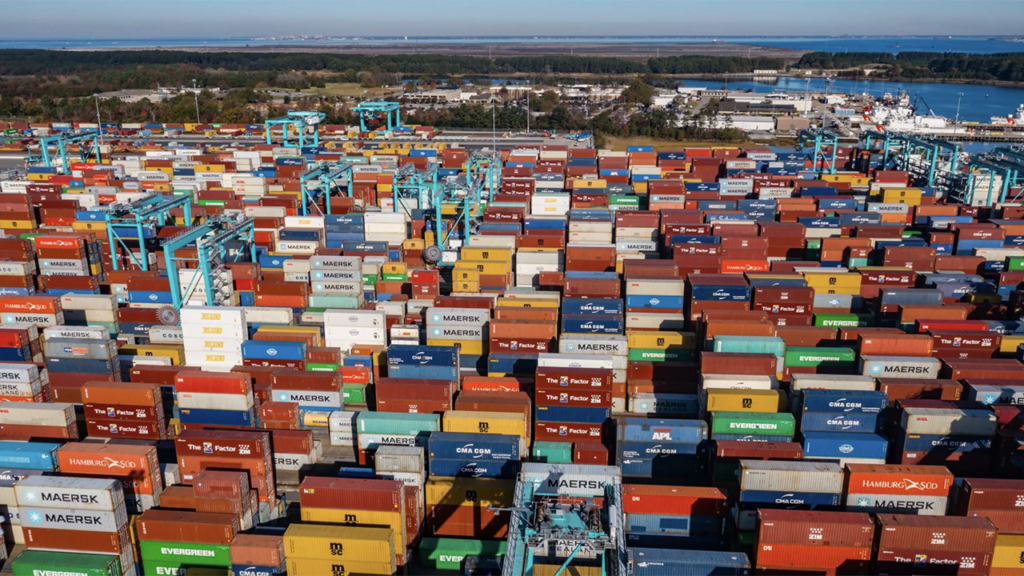
The port said that in fiscal year 2024 it made gains on its $1.4 billion infrastructure program to create “a modern, efficient, and sustainable port that has the capabilities and capacity to serve its customers and users for decades to come.” Among the year’s highlights:
- September 2023: Work began on a $650 million renovation of the North Berth at Norfolk International Terminals. “Virginia will have three ultra-modern marine terminals capable of handling the largest ships afloat when the project is complete in 2027,” the port said.
- October 2023: The first shipment of components to be used in the Coastal Virginia Offshore Wind project arrived, advancing Portsmouth Marine Terminal’s “transformation into the Mid-Atlantic’s leading offshore-wind energy logistics hub,” according to the port.
- January 2024: All Port of Virginia terminals begin using electricity from “clean resources,” which the port said is helping to accelerate its goal of becoming carbon-neutral by 2040. Using clean electricity is said to help the port offset its carbon footprint by reducing carbon emissions by up to 45% per container.
- February 2024: The port introduced what it called “the U.S. East Coast’s widest shipping channel that allows for safe, two-way passage of ultra-large container vessels.” The continuous vessel flow in the harbor, it noted, helps reduce the amount of time vessels spend on berth by up to 15%. In addition to widening the channel, the port is also dredging it and the Norfolk Harbor to 55 feet deep and the ocean approach to 59 feet deep. Upon completion of the $450 million dredging project in fall 2025, The Port of Virginia will have the deepest, widest channels on the US East Coast, it said.
- April 2024: The port reported expanding its western and southern reach with a new daily service with Norfolk Southern between the port’s primary container terminals and Memphis, Tenn., a growing logistics hub. The port and the Class I began this partnership in 2023.
“The work the port team did during FY2024 is critical to the progress we are making on the projects that are part of our [$1.4 billion] Gateway Investment Program,” Virginia Port Authority CEO and Executive Director Stephen Edwards said. “We are doing exactly what we set out to do, which is deliver world-class, twenty-first century service to our users, enhance efficiency and capabilities, expand infrastructure, become a more sustainable operation and make inroads into new markets. We are further developing our assets to ensure the needs of our customers and [port] users will not outgrow our capabilities in Virginia.”
He continued: “Our modern, semi-automated terminals, combined with our unique business model, where we both own and operate our terminals, proved their value during the surge of cargo that came our way because of the tragic bridge collapse that closed the Port of Baltimore for nearly three months. We processed the diverted cargo without any degradation of service and clearly demonstrated our position as the most modern gateway in America.”




