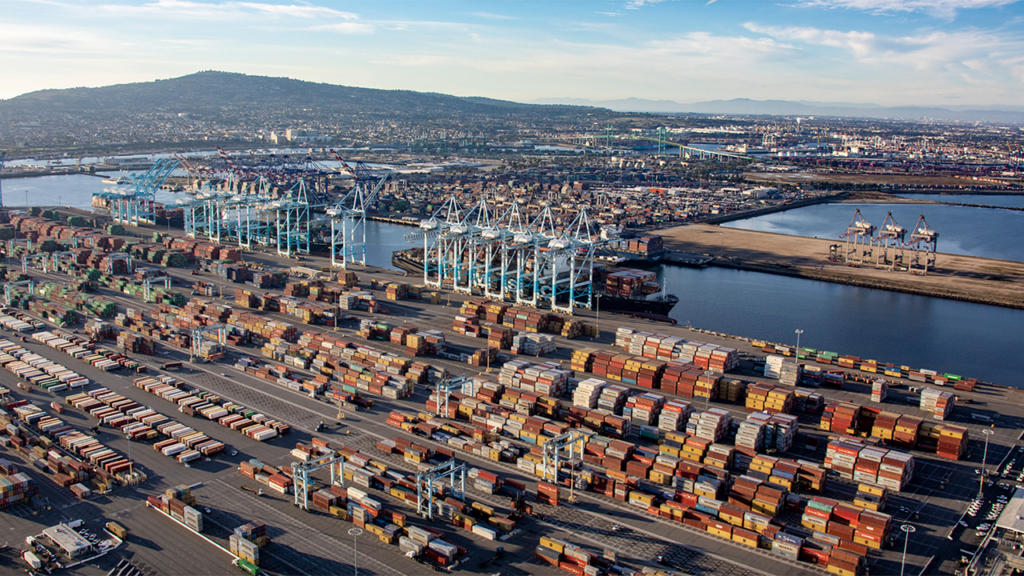
The Herzog/Stacy and Witbeck Joint Venture has wrapped up construction on a $73 million rail expansion project at Pier 400, the Port of Los Angeles, Calif., reported July 10.
The project, begun in 2021, was designed to optimize on-dock rail operations and improve the flow of cargo at the Port. It upgraded and expanded an intermodal rail storage yard near the container terminal operated by APM Terminals.
Work included:
- Adding 31,000 linear feet of track to increase the number of storage tracks from six to 11; a concrete rail bridge with lighting; an asphalt access roadway; and new crossovers and turnouts.
- Modifications to the compressed air system.
- Relocation of a portion of the lead track onto Port of Los Angeles property.
- Realignment of the track connection to the rail storage yard.
- Modifications to Reeves Avenue.
- Relocation of the at-grade crossing from Nimitz Avenue to Reeves Avenue.
The project creates additional rail capacity for all Port of Los Angeles terminal operators, according to the Port, which noted that the rail yard serves as a “critical link between the San Pedro Bay port complex [which includes the Port of Los Angeles and the Port of Long Beach] and the Alameda Corridor, which carries about 10% of all waterborne containers entering and exiting the United States.” Class I’s Union Pacific and BNSF serve the port complex; Anacostia Rail Holding’s Pacific Harbor Line, Inc., provides rail dispatching and switching services.
The Port of Los Angeles in 2018 received $21.6 million in grant funding from the California Trade Corridor Enhancement Program, which funds improving freight corridors in the state. The Port funded the remaining cost of nearly $51.6 million.
“This $73 million rail project will increase cargo efficiency while reducing emissions—a cornerstone of the Port’s blueprint for sustainable growth,” Port of Los Angeles Executive Director Gene Seroka said. “Advancing capital improvement initiatives like this are key to ensuring the Port remains competitive.”
“Thanks to the Port’s significant investment in rail infrastructure, APM Terminals will be able to handle increased volumes of intermodal cargo with greater efficiency across a wider variety of inland locations,” added Jon Poelma, Managing Director of APM Terminals Los Angeles Pier 400. “This strategic upgrade enhances the Port of Los Angeles’ attractiveness as a gateway for cargo owners who rely on fast, efficient and well-connected supply chains to serve their customers.”
As rail demand increases, the Port reported, the expanded rail yard is projected to eliminate an estimated 1,200 truck trips per day by 2040.
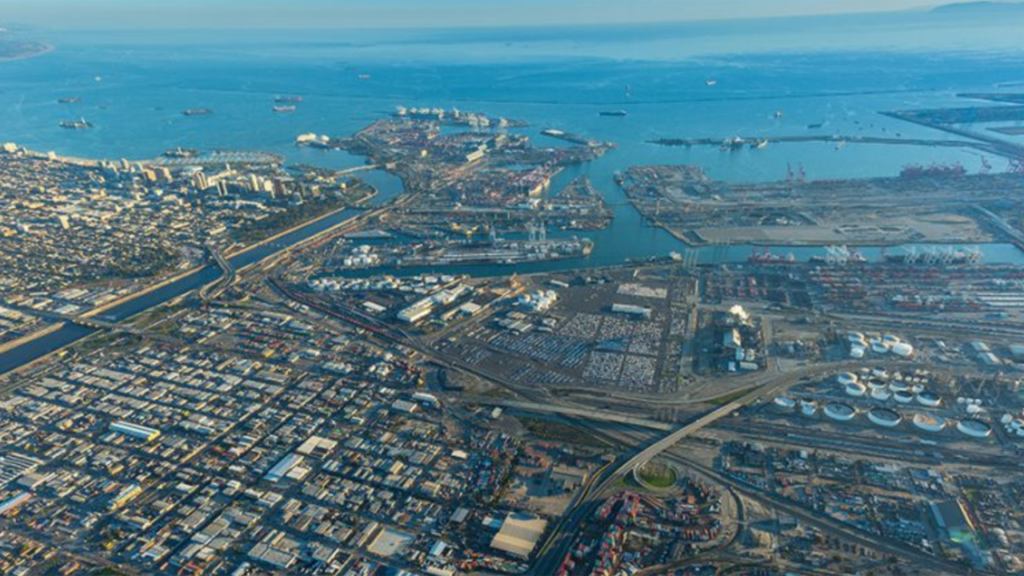
This first phase of the Pier B On-Dock Rail Support Facility project involves building a new retaining wall along the Long Beach (710) Freeway and realigning the east end of the yard to relocate a Los Angeles County flood control pump station. Construction is expected to start this summer and finish in 2026; 32% of the work will be performed by disadvantaged business enterprises.
The Stacy & Witbeck contract is the first of 10 construction contracts that make up the $1.567 billion Pier B On-Dock Rail Support Facility project, which will “increase efficiency and reduce emissions by positioning the Port to move 35% of containerized cargo by rail,” according to the Port of Long Beach. All told, the new facility is slated to more than double the size of the existing Pier B rail yard from 82 acres to 171 acres and more than triple the volume of on-dock rail cargo the Port can handle annually, from 1.5 million to 4.7 million TEUs (twenty-foot equivalent units).