
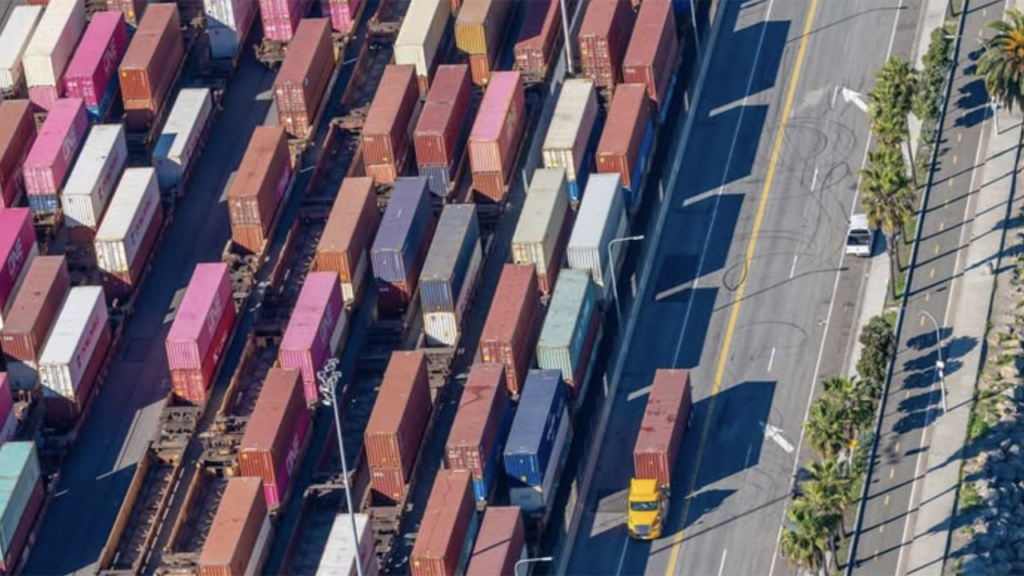
The Port of Long Beach (POLB) on March 18 reported “solid” cargo volumes in February “amid ongoing uncertainty over the impact of tariffs and conflict in the Middle East.”
Dockworkers and terminal operators handled 767,525 TEUs (Twenty-Foot Equivalent Units) of cargo containers last month, up 0.3% from February 2025, the Port said. Year-over-year, imports were down 0.2% to 368,060 TEUs, while exports rose 8.2% to 97,422 TEUs. Empty containers moving through the Port declined 0.15% to 302,044 TEUs.
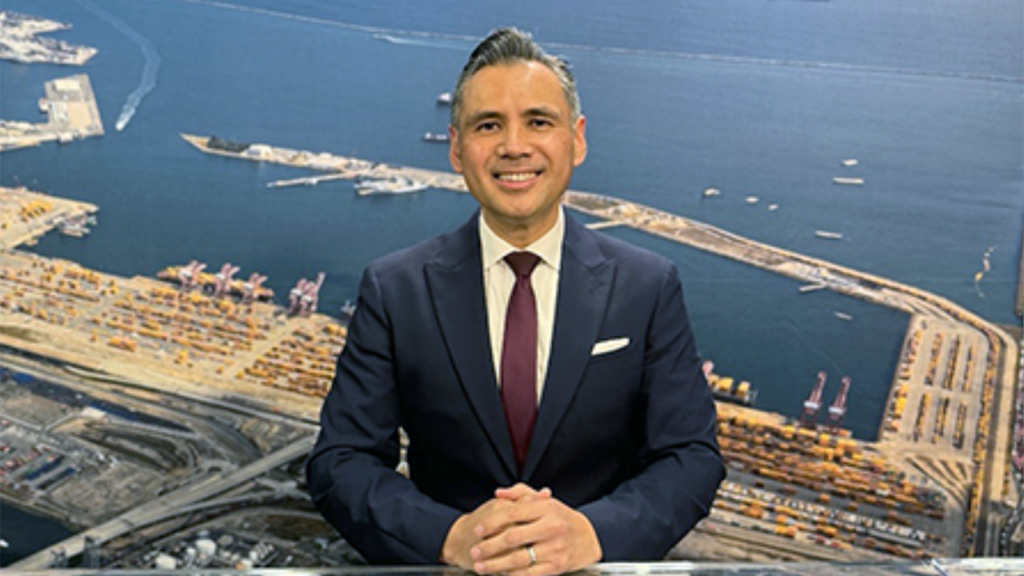
“Cargo volumes at the Port of Long Beach remained positive in February,” Port CEO Dr. Noel Hacegaba said during his monthly Supply Chain Insight virtual media briefing (watch below). “Despite growing uncertainty fueled by the conflict in the Middle East, cargo continues to move fluidly, planned shipments are on schedule and the Port of Long Beach remains a safe harbor in the sea of trade and geopolitical uncertainty.”
Through the first two months of the year, the Port said it has processed 1,615,290 TEUs, down 6% from the same point last year, which it noted was a “record year.”
According to Hacegaba, the Port is following developments in the Middle East and the impact of last month’s Supreme Court ruling on the International Emergency Economic Powers Act, or IEEPA, tariffs, “when the court ruled about two-thirds of tariffs imposed last year under the IEEPA unconstitutional.”
“The conflict in the Middle East has added more uncertainty to global trade and triggered broad market conditions and reactions from parties across the supply chain,” Hacegaba said. “Operations at the Port of Long Beach continue without disruption. All terminals are open and cargo continues to move fluidly.”
Long Beach Harbor Commission President Frank Colonna commented: “The Port of Long Beach continues to be a strategically important seaport in the global market and a reliable option for customers. We are ready to accept additional cargo if shippers need to pivot.”
The Port noted that about 20% of the world’s oil supply is transported through the Strait of Hormuz, where traffic has “slowed to a trickle since the conflict in Iran began.”
“The disruption at the Strait of Hormuz has already triggered a rapid rise in oil prices,” Hacegaba said. “When the price of oil goes up, the cost of shipping increases and consumers pay more at the gas pump and for many everyday goods.”
Despite the higher gas prices, Hacegaba noted, the Port has not seen any impact to cargo movement since it mainly moves goods via the trans-Pacific trade route with Asia.
He added, however, that global supply chains are interconnected. “If this conflict persists and continues to escalate, supply chains everywhere will have to navigate higher fuel and vessel operating costs and seek alternative shipping routes,” Hacegaba said.
The Port on Feb. 25 reported kicking off 2026 with its “second-busiest” January on record. Cargo volume declined 11% from January 2025—the Port’s best January and second-busiest month in its 115-year history—following a “record-setting 9.9 million TEUs moved in 2025, when uncertainty prompted shippers to move goods before tariffs and reciprocal tariffs were implemented last spring,” POLB said.
Hacegaba on Jan. 15 gave his first State of the Port address, following the retirement of Mario Cordero, and he projected that POLB will move 20 million containers annually by 2050. He noted that the $1.8 billion Pier B On-Dock Rail Support Facility project is on track for completion in 2032. Aimed at tripling the volume of cargo moved by on-dock rail to 4.7 million TEUs, the project will help move cargo containers from ships to trains in less than 24 hours and improve connectivity with inland destinations.
The ports of Long Beach and Los Angeles in 2025 extended their agreement with Anacostia Rail Holdings’ Pacific Harbor Line to provide railroad operating and maintenance services within the San Pedro Bay ports complex. Union Pacific and BNSF move cargo in and out of the complex.
For complete POLB cargo statistics, click here.
Further Reading:
- Rail Shippers Raise Concerns About Middle East Conflict
- Port of Los Angeles: February Cargo Volume ‘Second Best on Record’
- Port of Los Angeles: January Cargo ‘Eases’ Compared to ‘Elevated’ 2025 Levels
- POLB: Cargo Volumes ‘Steady’ Through October
- POLB Experiences Cargo Dip in September
- POLB: Second-Busiest August on Record
- POLB Releases Pier B On-Dock Rail Support Facility Draft Supplemental Study
- For Ports of LA, Long Beach, ‘Record’ July Cargo
- Jacobs Tapped for POLB Pier B On-Dock Rail Support Facility




