In April 2019, Matt Rose stepped down as BNSF Executive Chairman. At the end of his tenure, Rose had been Executive Chairman for six years, and BNSF President and CEO for the prior 13 years. During his tenure as CEO, he helped guide the acquisition of BNSF by Berkshire Hathaway in 2009. Thus, we believe he is uniquely qualified to offer public commentary on the proposed UP-NS merger.
Some of those comments, observations and opinions were published in a recent commentary. Rose observed: “In 2001 the Surface Transportation Board, the railroad’s federal regulator, issued new merger rules …that require a proposed merger to enhance competition.”
“Enhance” is a verb meaning to “intensify, increase, or further improve the quality, value, or extent of.” In our professional opinion busting open the existing Norfolk Southern intermodal monopoly at Harrisburg, Pa., would provide an excellent real-world opportunity to genuinely “enhance” competition.
According to. Rose, “Proponents of the merger case will argue that eliminating gateways, the locations where freight is handed off between railroads, will move more traffic from the highway to the rail network. But (according to Rose), intermodal networks (like the one operated by BNSF)—which move imported goods from Asia and elsewhere—already are highly efficient and create little frictional delays at gateways.”
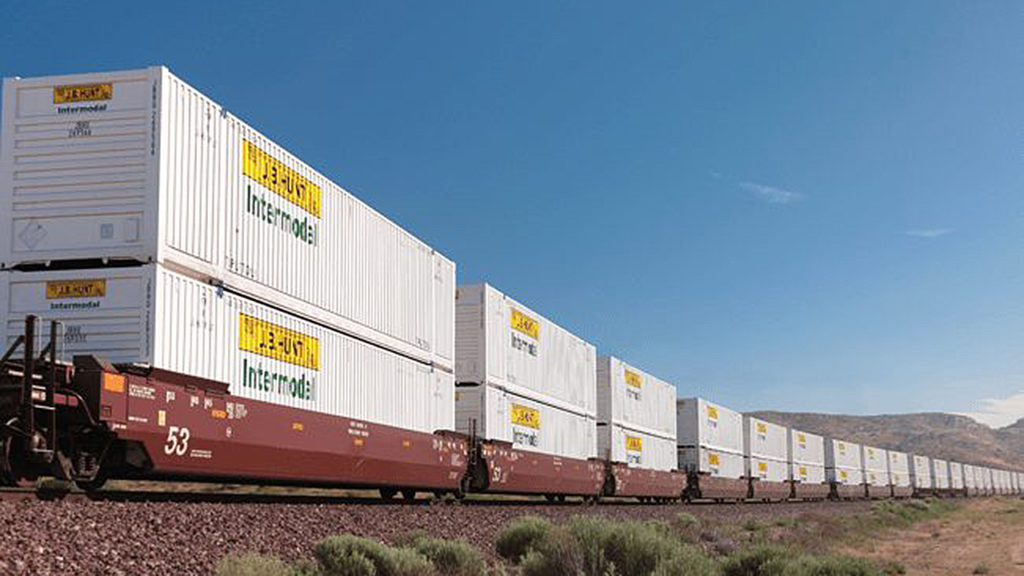
If Jim Vena wanted to check out current North American rail operations on the ground, he would notice that the Chicago market is very well served by a large volume of dedicated double-stack intermodal unit trains handling steamship containers carrying goods from multiple Asian origins. These trains operate direct from West Coast ports of entry (in both the U.S. and Canada) to Chicago. No interchange is required, since most if not all of them terminate in Chicago.
In 1990, when Vena was at CN (where he spent 40 years), I started working for the Atchison, Topeka & Santa Fe Railway. In that year, the railroad was advertising what was arguably the hottest intermodal train on the Santa Fe system (or anywhere in the country). It was called the QNYLA, with an advertised scheduled of 76 hours “coast-to-coast.” It consistently ran on time and rarely if ever was delayed in the Chicago Terminal. This train was and continues to be the epitome of a highly efficient operation and consistently encounters little “frictional delays” at gateways like Chicago.
In November 1989, then Santa Fe Railway President Mike Haverty personally chose the QNYLA for the now-famous railroad “field trip” with Johnnie Bryant Hunt, Sr. that resulted in the famous “handshake” that launched one of the most successful business partnerships in modern railroad history.
For some strange reason, railroad executives love to talk tough about “taking trucks off the roads.” What a joke! In my opinion, most of these so-called rail industry experts do not have the slightest idea what they are talking about. They have been part of the same “gang” that has been losing market share to truckers for almost 100 years now.
America’s trucking industry consists of a highly decentralized collection of entrepreneurial businesses that have elevated mass customization into an art form. By contrast, railroads are large, bureaucratic and incredibly difficult for most customers to deal with. Their marketing approach is one size fits all and any color the customer wants, as long as it’s black and white, or yellow, or orange and green, or blue and silver, or …
The fundamental difference here is between a transport mode operating in a 100% open access marketplace vs. one still hanging on to a marketplace characterized by outdated monopolistic practices.
Those of you still keeping score may be interested in the latest update from Bob Costello, chief economist American Trucking Associations (ATA), who wrote, “With changing supply chains and shifting freight markets … typical of the challenging environment that motor carriers dealt with in 2024, the industry still delivered more than 72% of all domestic freight tonnage in the U.S.”
This reality from both the highway and the marketplace provides new meaning to the phrase “If you got it a truck brought it.”
Now some random thoughts about the proposed UP-NS merger proposal.
Let’s start with talking about the “myth” of the watershed. This “myth” seems to promise vast new untapped sources of rail traffic simply by reducing interchange “complexities” with something new called “seamless service.” Personally, this reminds one of the early Spanish explorers, like Francisco Coronado searching for the mythical Cities of Cibola (“Seven Cities of Gold”).
So exactly, how “underserved” is the “Mississippi River Watershed” area, and underserved by whom?
Outside of major metropolitan areas in the watershed area, the only remaining intermodal terminals are two in Council Bluffs, and one each in Rochelle and Decatur, Ill. BNSF also has a mechanized terminal just across the river from Council Bluffs in Omaha. There are also three recently opened terminals in northwest Wisconsin, near St. Paul.
However, infrastructure and market access in the Midwest for the highly competitive trucking industry presents a radically different picture.
ATA-owned Transport Topics on June 20, 2025 released its 2025 Top 100 For-Hire Carriers list. Assembled by the editorial staff, this is an annual listing of the largest trucking companies in North America ranked primarily by annual carrier revenues. Two of the top five motor carriers on this year’s list are also long-time BNSF intermodal customers. Once again, ranked #1 (by current revenues) is the UPS, Inc., with more than 19,000 power units. Ranked #3 (by current revenues) is the J.B. Hunt Transport Services, with 20,500 tractors (vs. 14,700 for competitor Schneider). As information, the Midwest contains the greatest concentration (by geographic region) of commercial trucking operations in the U.S. Of the Transport Topics Top 100, one-third operated in the 12 Midwest states (with more than a quarter of these domiciled there). This represents the largest regional concentration in the U.S.
Based on my professional experience and on-the-ground observations, some of the better known carriers based in the heartland include Werner Enterprises (Omaha); Prime, Inc. (Springfield, Mo.); Crete Carriers, (Lincoln, Neb.); Heartland Express (North Liberty, Iowa); Hirschbach Motor Lines (Dubuque, Iowa); CRST (Cedar Rapids, Iowa); Marten Transport (Mondavi, Wisc.); and Roehl Transport (Marshfield, Wisc.). Some of these truckers are also intermodal players. Werner was estimated to have a fleet of around 550 domestic containers. Schneider last reported about 26,000 domestic containers, down slightly from the year before. Prime has the second largest fleet of intermodal refrigerated containers, after JBHT. Marten has the third largest container fleet, right behind Prime. Combined, they still have fewer than JBHT.
This Midwest list also includes Schneider, domiciled in Green Bay, Wisc., and reporting 14,500 tractors. Given its physical location. it is probably a safe bet Schneider already has numerous strong commercial relationships with shippers located in the watershed and may already be moving significant quantities of freight in the region. Schneider is also a recent convert to Union Pacific’s intermodal service. Does it the intermodal equivalent of the proverbial “canary in the coal mine” for determining the real and honest impact of the UP-NS merger?
Then there is the impact of the private fleet operators, the largest of which is now retail giant Walmart Inc., which claimed the No. 1 position for a second straight year after slightly expanding its tractor fleet to 12,696 power units. Private fleets reportedly also transport a significant amount of their own freight to help reduce empty backhaul miles. This for-hire vs. private competition for the same freight presents a unique challenge in the marketplace for all for-hire carriers, especially intermodal providers.
I must confess being surprised to learn Walmart briefly experimented with its own domestic container fleet. I always thought the high service levels required by a private fleet precluded little if any use of domestic intermodal. Walmart started this fleet in 2019, peaked to approximately 15,500 units and was eventually sold off to J.B. Hunt in 2024. Walmart reportedly found it extremely challenging to manage/operate a relatively small fleet of 53-foot domestic containers within its vast collection of privately owned highway trailers and tractors. Also, at the end of the day, Walmart reportedly discovered J.B. Hunt Intermodal could provide the same level of service for a lower total cost (and much less hassle) than trying to do it themselves.
Additional private truck operators in the Midwest include Ashley Furniture Industries (Arcadia, Wisc.), which is also an intermodal customer importing product from Asia through the Canadian West Coast ports. I’m not sure how much domestic Ashley uses.
The big surprise for Union Pacific may be that JB Hunt Intermodal is already very active in the watershed region. Two of the largest consumer products shippers in the region and the nation are S.C. Johnson, a very large consumer products company located in Racine County, Wisc., and Quaker Oats, operator of the world’s largest cereal plant, located in Cedar Rapids. J.B. Hunt Intermodal is reportedly the incumbent carrier for both facilities/customers.
And contrary to what UP would have you believe, major markets in Ohio are relatively well-served by rail intermodal today. The new BNSF rail intermodal terminal in North Baltimore, Ohio, also served by CSX is located about 260 highway miles east of Chicago and 36 miles due south of Toledo along I-75. Thus, BNSF and its partner J.B. Hunt Intermodal can now provide high quality door-to-door intermodal service to/from most of the Buckeye State.
Colliers International bills itself as a “global leader in real estate services and investment management.” On June 2, 2025, it released its latest list of The 25 Top U.S. Industrial and Logistics Markets. According to Colliers’ analysis, these 25 markets represent 76% of U.S. industrial activity. I would argue these 25 markets also represent where most of the domestic U.S. freight market can be found. If you eliminate the eight markets anchored by major seaports, almost 60% of the remaining markets are in the Midwest. Anchored by Chicago, nine of these are all located within about a 400-mile radius of Chicago. The Interstate Highway system helps facilitate this hub-and-spoke network, since in the Midwest all roads lead to the Windy City.
In a separate Colliers report, “Emerging U.S. Markets” Omaha and Dayton, Ohio were added to the Midwest mix.
If you combine the Colliers findings with the fact that the largest concentration of commercial truckers is also operating more or less within in the same 400- mile radius of Chicago, the conclusion, as I see it, is that the Midwest is overwhelmingly a regional transportation and distribution market. Remember that commercial trucking is historically a regional business, with an average length of haul now somewhere in the 400–500-mile range.
Heartland Express is truckload carrier based in North Liberty, Iowa. In the For-Hire trucking category, it would be ranked #38 nationwide based on 2025 annual revenues. Heartland’s corporate motto is “Service for Success.” I offer it—a personal favorite—as “Exhibit A” in the analysis of motor carrier length of haul and quality of service.
According to its most recent Annual Report, “Serving the short-to-medium haul market permits us to use primarily single rather than team drivers and dispatch most loads directly from origin to destination without an intermediate equipment change other than for driver scheduling purposes. During 2024, approximately 75% of our loads were less than 500 miles in length of haul.
“We operate 28 terminal facilities throughout the contiguous U.S. and one in Mexico following the CFI acquisition, in addition to our terminal and corporate headquarters in North Liberty, Iowa, about 20 miles south of Cedar Rapids at the junction of I-380 and I-80. These terminal locations are strategically located to concentrate on regional freight movements generally within a 500-mile radius of the terminals.
“We target customers with multiple, time-sensitive shipments, including those utilizing ‘just-in-time’ manufacturing and inventory management. In seeking these customers, we have positioned our business as a provider of premium service at compensatory rates, rather than competing solely on the basis of price.”
Another interesting regional carrier is Werner Enteprises, based in Omaha, (right on the western edge of the “watershed”). Based on 2025 annual revenues, Werner would rank #18 nationally, with 4,840 tractors by the end of 2024. According to its website, “We deliver unsurpassed supply chain solutions to the global marketplace.” Werner also offers a service branded as “Werner Intermodal” offering “nationwide” service. According to its 2024 Annual Report intermodal revenues represented 13%of total Werner Logistics segment revenues. Fleet size was reported as 200 containers.
Within its TTS Segment, which includes One-Way Truckload and Dedicated operations, Werner reported “average completed trip length in miles (loaded)” of 582 miles in 2024 and 590 miles in 2023,” slightly longer than Heartland but still well below the accepted intermodal minimum requirement.
If rail intermodal service needs a minimum linehaul of 750 miles to be viable, then this collection of assumptions and conclusions is probably not good news for the railroad industry. I would also argue that at least in the Midwest, especially in the “watershed,” conventional intermodal is probably permanently relegated to a position of niche carrier.
According to the Union Pacific website, “This combination will help win back U.S. freight volume and jobs by competing more effectively with Canadian transcontinental railroads. Cross-border competition: For 100-plus years, Canadian railroads have threatened U.S. jobs and supply chains. The U.S. supply chain will benefit from a stronger American transcontinental option.”
Oh, those awful, evil Canadians, threatening U.S. jobs and supply chains! But wait a minute: Isn’t Jim Vena Canadian by birth?
Fact check time once again for Vena. In November 1995, the Canadian government decided to privatize Canadian National. Today, CN is a publicly traded company, and its stock is listed on both the Toronto and New York exchanges. The irony here is that for many years after going public, most outstanding CN shares were reportedly owned by U.S. citizens.
My favorite example of all the nonsense and silliness coming from Vena lately are his comments about the competitive impact of the Port of Prince Rupert, B.C. Prince Rupert is Canada’s ace in the hole when it comes to global supply chain management. Canada’s strategic advantage here is a perfect example of the old adage, “location, location, location.” It also has very little to do with railroads.
According to the Prince Rupert Port Authority website, “The Port of Prince Rupert offers shippers an unparalleled mix of speed, reliability, and reach for connecting Asian and North American markets. Commonly referred to in the marine industry as ‘The Rupert Advantage,’ especially as it relates to our intermodal capabilities, the Port of Prince Rupert stands out in a crowd.”
The Port Prince Rupert is North America’s closest port to Asia by up to three days sailing—it’s 36 hours closer to Shanghai than Vancouver and more than 68 hours closer than Los Angeles. It is 500 nautical miles closer than other ports in the Pacific Northwest, like Seattle and Tacoma. This can save up to 60 hours’ sailing time. As an example, this translates to 11 days sailing time from Shanghai to Prince Rupert vs. 14 sailing days Shanghai to Los Angeles. This geographic advantage means that a steamship container unloaded at Prince Rupert can probably be in Chicago before a competitively routed box can even be unloaded at the Port of Long Beach. No railroad, not even Vena’s proposed transcontinental one, can ever undo that competitive advantage.
CN’s main line along the Skeena River connects Prince Rupert with the rest of Canada. This route represents “the flattest rail grade through the Rocky Mountains, in effect a water-level crossing of Canada’s Pacific Divide. Compare that with the climb over Cajon Pass to get out of the Southern California Basin.
In conclusion, there is the small matter of the HMF (Harbor Maintenance Fee). The HMF, sometimes referred to as the Harbor Maintenance Tax, is a fee charged on cargo shipped through U.S. ports. It helps fund the maintenance and improvement of these ports. This fee is applied to commercial cargo shipped via ocean freight. The fee is imposed by US Customs and Border Protection (CBP) and deposited into the Harbor Maintenance Trust Fund. The fee is calculated based 0.125% on the total value of the commercial cargo, including the cost of shipping and insurance. The average fee per box is reportedly about US$100.
James A. Giblin has more than 40 years’ experience in rail, truck and intermodal freight transportation, warehousing and logistics, much of it in the greater Chicago area. He has lived in the Chicago area most of his adult life and is intimately familiar with the region’s freight and passenger rail infrastructure. For six years he is proud to say, “He made his run and made his pay on the Atchison, Topeka & Santa Fe.” In recent years, his professional experience has expanded and diversified to include numerous public sector clients and projects in communities and municipalities across Chicago’s south suburbs. He submitted written testimony as regional rail industry expert in favor of CN/EJ&E merger to the Surface Transportation Board and testified at the STB’s September 2008 Chicago hearing in favor of transaction. Jim is a former multi-year Chair of the Education Committee of the Traffic Club of Chicago. The opinions expressed here are his own, not those of Railway Age.