
ITS Logistics Issues November US Port/Rail Ramp Freight Index

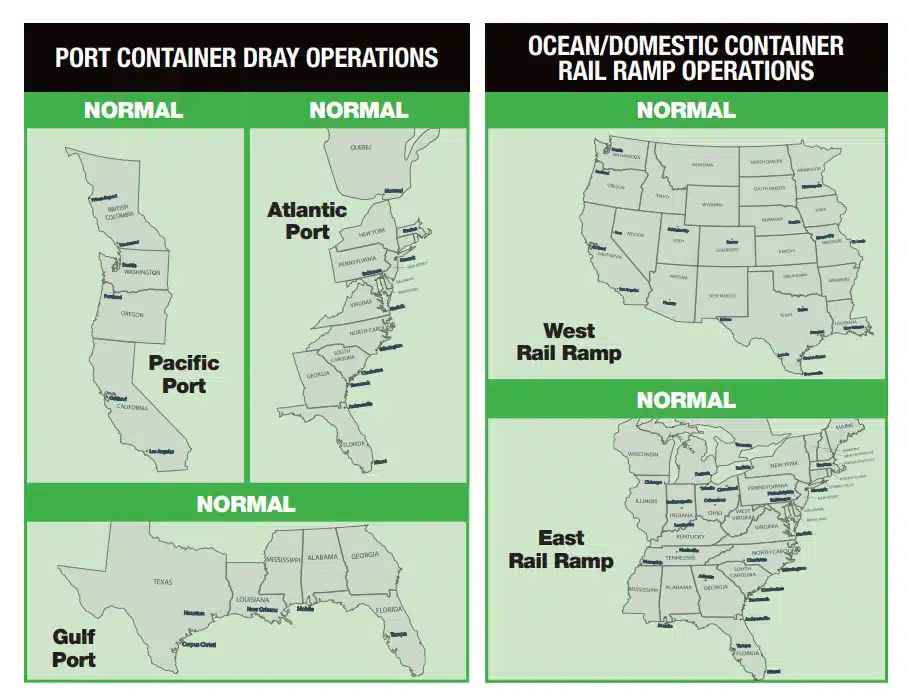
“With volume decreases, port, terminal, and ocean carrier operations remain at normal levels and should remain so through November,” said ITS Logistics Vice President of Global Supply Chain Paul Brashier. “However, there are some items we are keeping a close eye on that could drastically change the landscape in North American port and ramp operations.”
The firm reported that U.S. container imports totaled 2,306,687 Twenty-foot Equivalent Units (TEUs) for the month of October, down 7.5% compared to 2024. While the month-over-month decrease was a marginal 0.1%, the decrease “represents a divergence from typical seasonal trends, reflecting continued shipper hesitancy and a reliance on frontloaded inventory.”
Despite overall decline, China-origin imports grew for the time since August, leading modest volume gains from top U.S. trading partners with a 5.4% month-over-month increase, according to the report. “The past several months have seen a turbulent series of trade discussions between [POTUS 47] and President Xi Jinping, which recently concluded with [POTUS 47] agreeing to cut fentanyl-linked tariffs on Beijing, bringing overall duties on Chinese goods to 47%. And on Monday, both the U.S. and China announced a one-year suspension of port call fees, a move that many argued would not only increase import costs but severely impact secondary ports across the country.”
Tariff uncertainty, ITS Logistics reports, continues to be a primary driver of depressed import activity, according to industry analysts. On Nov. 5, the Supreme Court heard the first oral arguments in the POTUS 47 Administration’s tariffs case, marking a “new and contentious” chapter. “If the Supreme Court finds [POTUS 47’s] tariffs were enacted illegally, it [will] offer immediate relief for shippers while also opening the door for challenges and questions related to refunding the roughly $1 trillion dollars paid by importers since April. The administration says it is already exploring alternative routes for enforcing import duties in the event the ruling is overturned. For now, both shippers and consumers remain cautious and purposeful in their holiday spending. Holiday shoppers are expecting to spend 10% less than last year, per Deloitte’s 2025 Holiday Retail Survey.”
“Outside the ports, the trucking market is enduring its own legislative limbo as states react to evolving legislation surrounding non-domiciled drivers and English language proficiency (ELP) requirements,” ITS Logistics reported. “Following the Federal Motor Carrier Safety Administration’s (FMCSA) September announcement freezing the issuance and renewal of non-domiciled CDLs, state agencies, shippers, carriers, and intermediaries have scrambled to understand expectations in remaining compliant, as well as how the ruling would impact overall capacity in the market. This week, however, an Appeals Court has temporarily blocked the enforcement of this ruling, citing a failure to follow proper procedure. With the administrative stay in place indefinitely, state agencies may continue issuing and renewing non-domiciled commercial driver’s licenses to non-citizens. The ruling does not, however, pause enforcement of renewed English language proficiency (ELP) requirements, which have been heavily enforced through roadside compliance checks since July.”
“It is estimated that as many as 600,000 drivers could be removed from the U.S. driver ecosystem due to non-domiciled drivers and ELP enforcement,” Brashier said. “This, in addition to the acceleration of trucking companies exiting the market, could create trucking capacity issues for most shippers. It is a situation we are monitoring closely.”
ITS Logistics each month releases the ITS Logistics U.S. Port/Rail Ramp Freight Index, which forecasts port container and dray operations for the Pacific, Atlantic and Gulf regions. Ocean and domestic container rail ramp operations are also highlighted in the index for both the West Inland and East Inland regions.




