Cautious consumers and a changing regulatory environment are bringing uncertainty into the peak holiday season, according to ITS Logistics’ November Supply Chain Report.
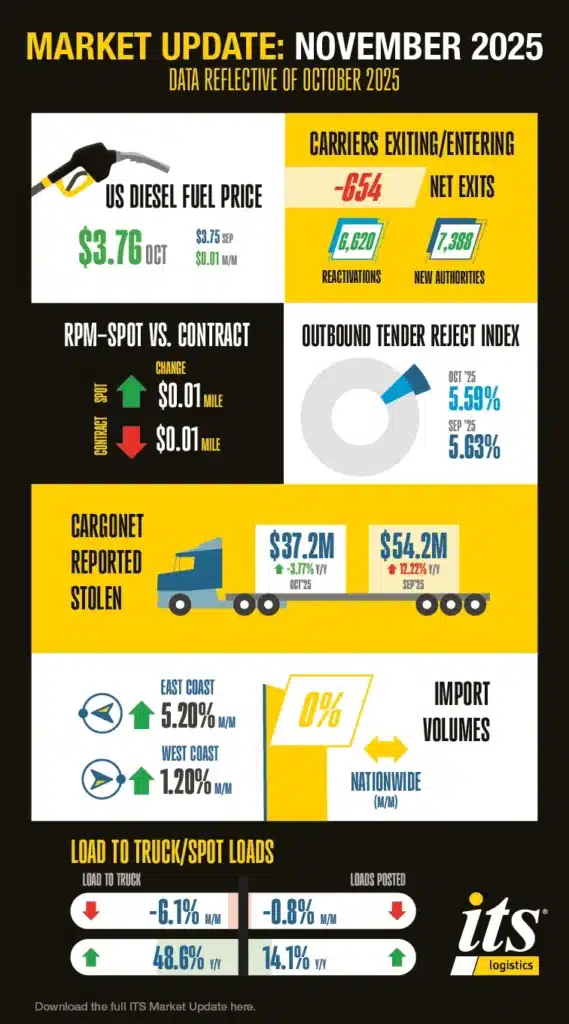
“This month, the report reflects a further softening of demand and declining spot rate volatility as the industry adapts to new standards for non-domiciled driver compliance,” ITS Logistics, a Nevada-based third-party logistics (3PL) firm, reported Nov. 28. “At the ports, container volumes broke from traditional month-over-month growth, signaling slowing momentum despite recent breakthroughs in U.S.-China trade negotiations. Macroeconomic conditions are somewhat clouded by delayed federal reporting, but signs of persistent inflation and continued job loss have created a cautious consumer as we enter the height of the holiday season.”
For third-quarter 2025, the U.S. Bank National Shipment Index reported a 2.9% decrease in shipping volumes, undoing the previous quarter’s gains, and an increase in shipment spend, with some regions seeing double-digit gains, according to ITS Logistics. “Analysts report shippers are paying more to move less, due largely to ongoing capacity exits driving up market pricing,” the firm noted. “While contract rates are up, spot rates have decreased slightly, following several weeks of regional volatility driven by increased scrutiny over non-domiciled licensing and English language proficiency.”
A U.S. Court of Appeals for the District of Columbia Circuit on Nov. 10 issued an administrative stay on the Federal Motor Carrier Safety Administration’s (FMCSA) “interim final rule tightening regulations on non-domiciled commercial licenses, citing failure to follow proper process and lack of evidence,” according to ITS Logistics. “With this stay in place, all states are permitted to continue issuing and renewing CDLs to non-citizens—however, it appears an industry-wide change has already been set in motion. California announced that it will be cancelling 17,000 commercial licenses for failing to comply with pre-existing regulations, while Nevada plans to permanently phase out non-domiciled and limited-term licenses. Private-sector freight technology platforms are implementing screening tools for non-domiciled license holders, emphasizing the need for more thorough verification and risk mitigation.”

“These changes in license issuance, carrier vetting, and ongoing roadside driver checks signal a major refocus on compliance,” ITS Logistics Chief Commercial Officer Josh Allen said. “The federal government has made it clear that it intends to hold carriers and shippers accountable for hiring unqualified drivers, increasing the need for more stringent review of who is moving freight.”
According to Descartes, at the ports, U.S. container imports totaled 2,306,687 TEUs (Twenty-foot Equivalent Units) in October, ITS Logistics reported. This volume is 0.1% below September 2025, which the 3Pl firm said is “breaking from the month-over-month gains traditionally seen at the outset of quarter four and swiftly narrowing year-to-date growth margins.” Despite this overall decline, it noted, China-origin imports grew for the first time since August, leading U.S. trading partners with 5.4% month-over-month gains. “This has followed a series of trade discussions between the countries which, while turbulent, led to a one-year suspension of port call fees, preventing further damage to secondary ports across the country,” ITS Logistics said. “Total U.S.-imposed tariffs on Beijing have also been reduced to a cumulative 47%.”
According to ITS Logistics, the “prolonged government shutdown disrupted standard data collection in the month of October, clouding the Federal Reserve’s visibility into economic health.” Still, it said, “inflation concerns and labor market troubles contributed to a decline in consumer confidence for October.” Despite this, “core retail spending is still up for the holiday, increasing 0.6% for the month of October and 4.89% year-over-year, per the National Retail Federation,” ITS Logistics reported. “Overall holiday spending is expected to top $1 trillion for the first time. However, consumer research points toward a more cautious consumer, anticipating that individual spending will decrease by 10%.”
Separately, ITS Logistics recently released its November US Port/Rail Ramp Freight Index, which “confirms a continued decline of both import and export volumes, which, while hindering overall economic activity, has allowed for port and rail congestion to alleviate.”
Further Reading:
- ITS Logistics Issues October US Port/Rail Ramp Freight Index
- ITS Logistics Releases September Supply Chain Report
- ITS Logistics Publishes September US Port/Rail Ramp Freight Index
- ITS Logistics Issues August Supply Chain Report
- ITS Logistics Releases August US Port/Rail Ramp Freight Index
- ITS Logistics Publishes July Supply Chain Report
- ITS Logistics Issues July US Port/Rail Ramp Freight Index