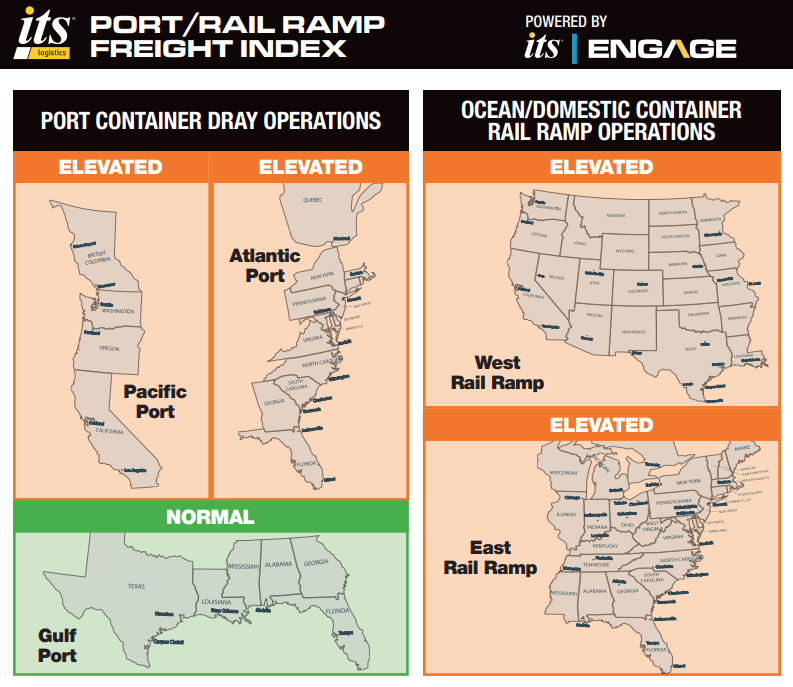
“Lunar New Year peak activity may materialize as a non-traditional, post-holiday volume increase,” said Paul Brashier, Vice President of Global Supply Chain for ITS Logistics. “These volumes, combined with adverse weather throughout North America, evolving geopolitical tensions, cargo theft, and trucking capacity exits, are escalating all regions to elevated concern.”
Tariff policy is once again top of mind for shippers following the US Supreme Court’s February ruling against POTUS 47’s International Emergency Economic Powers Act (IEEPA) tariffs, according to the report. Immediately following the ruling, POTUS 47 announced he would be implementing a blanket 10% tariff under Section 122 of the 1974 Trade Act, which allows the President to enact “temporary import surcharges” without Congressional approval for up to 150 days. The new so-called global tariffs went into effect on February 24. In an interview with CNBC on Wednesday, Treasury Secretary Scott Bessent confirmed that the United States “is expected to increase the tariff rate to 15% this week.” Per the New York Times, “key trading partners like the European Union have expressed frustration with the regulatory shuffle, claiming the new blanket rate violates agreements made during last year’s extensive negotiations.”
“While this may not have an immediate impact on inbound planned volumes, it could change sourcing strategies and create bottlenecks in certain origin markets,” Brashier said.
“Compounding these concerns are escalating tensions in Middle Eastern maritime corridors following US and Israeli strikes on Iran, which could further disrupt global shipping networks,” according to the report. “Attacks against ships traveling through the Strait of Hormuz have driven major ocean carriers to immediately reroute vessels around the southern tip of Africa, extending travel time and creating cascading supply chain disruptions. Maritime insurance carriers have also begun canceling war-risk coverage and increasing premiums for the region. [POTUS 47] has offered early reassurances that the US will provide political risk insurance and potential naval protection for the sake of protecting this strategically critical corridor that serves as a chokepoint for 20% of the world’s crude oil supply.”
The Chairman of the Suez Canal Authority (SCA) has stated that, as of Tuesday, “traffic through the canal and adjoining Red Sea is moving normally.” However, industry experts speaking this week at the Journal of Commerce’s TPM26 conference stressed that the coming days “will be critical to understanding whether Houthi military operations in the region will lead to wider shipping disruptions and increased costs.”
With the exception of these affected routes, ocean container booking costs “remain well below normal levels in both the spot and contract markets,” according to the report. The Journal of Commerce reports that current rates and trend forecasting are “causing shippers and ocean carriers to delay signing contracts, anticipating further rate decreases.”
“Against the backdrop of renewed geopolitical uncertainty, container volumes for February were beginning to show signs of stabilization,” ITS Logistics reported. “US container imports totaled 2,318,722 twenty-foot equivalent units (TEUs) in January, up 4.1% month-over-month but down 6.8% compared to 2025. The trends indicate a typical seasonal rebound from the holiday slowdown but still reflect relatively flat overall demand. Imports from China increased 9.3% month-over-month in January but remained down 22.7% compared to the same period last year, per Descartes. At the same time, sourcing diversification across Southeast Asia accelerated, with imports from India rising 22%, Vietnam increasing 4.8%, and Thailand climbing 8.6% as companies adjusted procurement strategies to mitigate tariff exposure in China. With the IEEPA framework now replaced by uniform tariff rates, it is yet to be seen whether this diversification will continue.”
Outside of the ports, “rail theft reemerges as a top concern in freight fraud conversations.” Major rail corridors near Los Angeles, Chicago, and Memphis have been identified as high-risk locations for container tampering on rail, as organized crime groups increasingly target intermodal freight moving inland on isolated spans of track, according to a report from BSI Consulting.
“Driver regulation efforts continue with several legislative developments moving through state and federal legislatures,” according to the report. The proposed Dalilah’s Law, a Congressional bill which would codify many guidelines within the Federal Motor Carrier Safety Administration’s (FMCSA) Final Ruling issued in February, “would restrict commercial license eligibility to US citizens, lawful permanent residents, and a narrow set of visa holders.” The bill would also require all CDL tests to be administered in English, with a mandatory recertification process for all license holders to be completed within 180 days of the bill’s passing. “Industry analysts forecast that—while actual estimates and timelines vary—the removal of affected drivers from the capacity pool will likely place upward pressure on rates,” according to the ITS Logistics report.
“Between the pressures of capacity exits, rising operating costs, and market volatility, shippers should be prepared for inland capacity cost increases during this RFP cycle, especially from smaller capacity providers,” said Brashier.
ITS Logistics each month releases the ITS Logistics U.S. Port/Rail Ramp Freight Index, which forecasts port container and dray operations for the Pacific, Atlantic and Gulf regions. Ocean and domestic container rail ramp operations are also highlighted in the index for both the West Inland and East Inland regions.