Observations on the TD Cowen/Jason Seidl article, “If All Else Fail, Attempt to Merge.”
First, if the railroads lost only 1% of rail traffic between 2014 and 2024 (excluding coal traffic), I would say that is very good news. When you think of all the chaos and confusion (natural and man-made disasters) over the same period, the railroads still look pretty good. In other words, have the railroads finally hit bottom?
Second, technology is not an end in and of itself. It is a tool and only as good as the person(s) using it. My favorite new technology is the order kiosks at McDonalds. They reduce labor costs, improve order accuracy (and the customer experience), and facilitate a POS (point of sale) supply chain management system. Moreover, once you understand how they work, they are great for customers like me. The machine logic is counter-intuitive in my opinion, but once you figure out how the machines “think,” they are great to use.
Third, can the railroads achieve real intermodal growth with current operations? We made intermodal work so well on the Santa Fe because we had so little carload business and virtually no coal business to get in the way. As I recall, our largest carload customers at the time were the grain shippers in Kansas and Oklahoma.
First, we formed the Intermodal Business Unit and then the Automotive Business Unit. Both entities controlled their own marketing, operations and terminals. Each one had its own P&L statement, so we knew exactly how we were doing. In addition, each group had its own standalone customer service team, which proactively managed each business unit’s on-time performance.
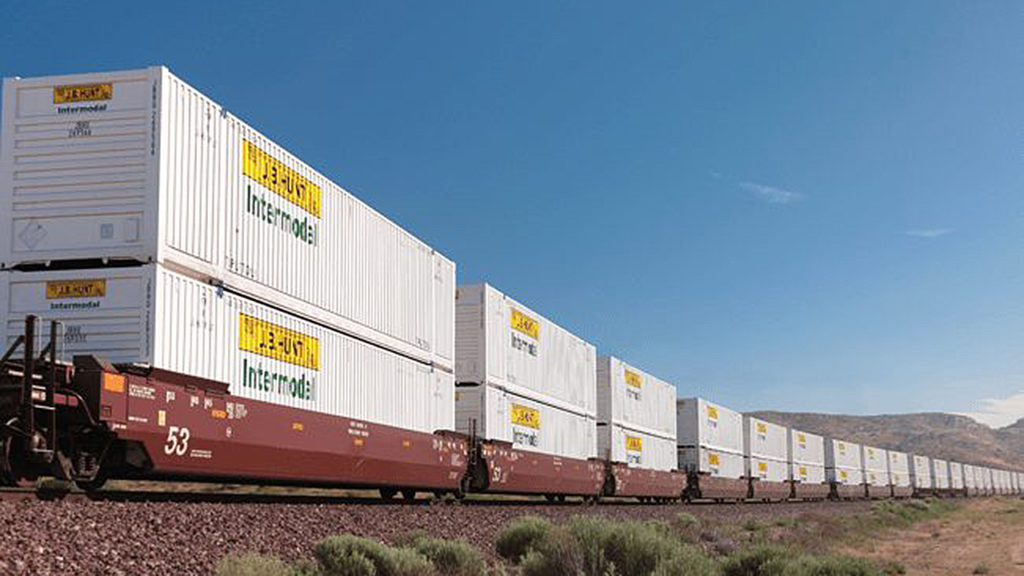
In today’s BNSF, J.B. Hunt Transport is for all practical purposes its own standalone business unit. Trucking salespersons are ten times better than the typical railroader at finding new business. These people live in an arena of pure competition (i.e. no captive shippers here). They already know where all the freight is. Do railroaders know?
As an aside, here is a wild idea. Try outsourcing the carload transload business to a new J.B. Hunt/BNSF Joint Venture.
Then, how much convertible truck traffic is there? Bob Costello, Chief Economist for American Trucking Associations (ATA), said that in the for-hire over-the-road truckload segment, the average length of haul is holding steady at 450 to 500 miles—not the best for intermodal conversion.
Here is a link to an excellent article on the subject of length of haul (originally published in February 2024 for the digital issue of Stop Watch magazine, a publication of the NATSO Foundation), “A Look at Shortening Length of Hauls – NATSO,” which includes this quote: “In aggregate, the rate is coming down at the highest end of the for-hire market. You can see the push to regionalize freight.”
How Much of This Traffic is Convertible to Rail?
In 2024, intermodal represented 51% of J.B. Hunt Transport’s annual revenues (source: J.B. Hunt Transport Services, Inc. Q4 2024 Results Online Presentation). Truckload represented only 5%, with Dedicated Contract Services (DCS) at 27%. So, it appears that JBHT has already picked most, if not all, the low-hanging intermodal fruit. DCS represents 27% of the total, and that is not convertible due to its high service requirements. Reportedly, a significant portion of DCS revenue growth also comes from shippers converting their private fleets to J.B. Hunt DCS management.
In 2024, J.B. Hunt’s intermodal average length of haul was 1,693 miles vs. 1,673 in 2023. Basically, this is medium- to long-haul traffic, probably in lanes with good to very good train service. In the same period, by way of comparison JBHT’s truckload sector’s average length of haul was 629 miles in 2024 vs. 652 in 2023. This is a pretty good number for larger TL carriers as it reflects approximately the outer limit of how far one driver can drive in a single day.
According to the 2024 J.B. Hunt Transport Annual Report, “Quantum, a J.B. Hunt and BNSF Service™, is a breakthrough intermodal service aimed at addressing service-sensitive freight that might otherwise be moved by traditional over-the-road transport. The service delivers 95%-plus on-time delivery rates and delivery times around a day faster than traditional intermodal service. We launched this new ‘high touch’ service in 2023 and have had great feedback from customers.”
(Can this level of labor intensity be sustained and how much of this labor burden can be replaced with technology and the use of artificial intelligence?)
In 2024, Walmart sold its intermodal assets to JBHT and exited the business. Wonder why? Walmart Inc. has claimed the top spot on Transport Topics’ 2024 Top 100 Private Carriers list, surpassing PepsiCo Inc. and becoming the largest private motor carrier in North America. This achievement comes as Walmart expanded its fleet to 12,663 power units—an increase of about 1,300 units from the previous year—overtaking PepsiCo, which held the top position for 14 years. By way of comparison, Walmart now has a fleet of close to 90,000 trailers, while JBHT operates a fleet of more than 121,000 domestic containers.
According to the ATA’s 2020 Truck Trends data, out of the more than 1.8 million carriers operating in the U.S., some 44% are private carriers. I would argue that, given the very high service requirements of most if not all private fleets, this business is definitely out of bounds for intermodal conversion.
So, as someone with more than 40 years of combined rail, trucking and intermodal experience, I would respectfully argue that the railroads’ enthusiasm for additional truck conversions may be a case of “irrational exuberance.”
James A. Giblin has more than 40 years’ experience in rail, truck and intermodal freight transportation, warehousing and logistics, much of it in the greater Chicago area. He has lived in the Chicago area most of his adult life and is intimately familiar with the region’s freight and passenger rail infrastructure. For six years he is proud to say, “He made his run and made his pay on the Atchison, Topeka & Santa Fe.” In recent years, his professional experience has expanded and diversified to include numerous public sector clients and projects in communities and municipalities across Chicago’s south suburbs. He submitted written testimony as regional rail industry expert in favor of CN/EJ&E merger to the Surface Transportation Board and testified at the STB’s September 2008 Chicago hearing in favor of transaction. Jim is a former multi-year Chair of the Education Committee of the Traffic Club of Chicago. The opinions expressed here are his own, not those of Railway Age.