
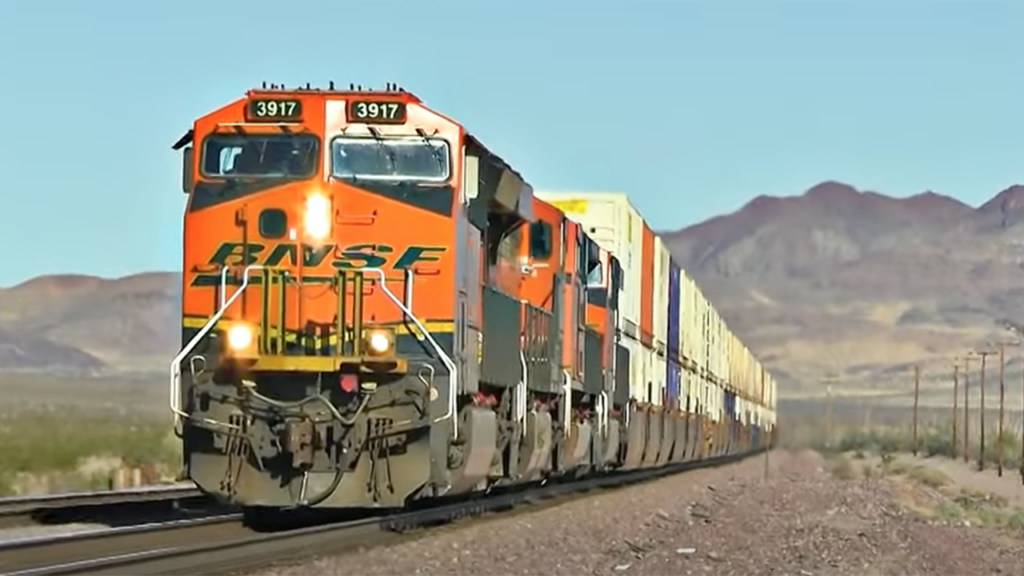
The first small wave of container ships was arriving at U.S. West Coast ports as this was written in late April, bearing goods that will be assessed import tariff duties. What’s this going to result in as a commercial hit to the rail intermodal market segment? That’s my focus.
How might railroad shippers and railroad investors think about the economic impact that just the tariffs on Chinese imports will have, just in this western geography case, on BNSF and Union Pacific? The question is asked, since there has not been much reported about often-forward-looking UP and BNSF projections.
Interestingly, there doesn’t seem to be much focus on the railroad plays in the general (non-trade) media. In my opinion after multiple reviews, I determined that both Western Class I’s have side-stepped the Western port issue in venues where they deflected questions to instead describe their available movement capacity. That’s curious behavior for C-suite executives who talk a great deal about “forward looking” scenarios.
Some of what is shown here is speculative because the POTUS 47 tariff announcements appear random and highly variant. For Chinese-sourced goods, it’s difficult to determine the probable business flow outcome. This is my attempt to probe the possible impacts to the rail sector. For this probing, I’m also relying on my independent economic assessment of what’s being suggested as a range of impacts upon the overall economy and both the long-distance truck drayage sectors where there so far has been more analysis.
Examining related competitor forces in other modes can be a useful analytic approach when the rail industry is rather tight fisted with its own data and market research. For background on the tariffs and the rail industry sources, readers might start with a review of Railway Age’s previous report reflecting FTR Transportation Intelligence Chairman Eric Starks’ views from the Rail Equipment Finance 2025 conference.
Topics
- My baseline of what intermodal traffic is most likely to be impacted by tariffs on Chinese goods.
- Review of forecasts by various experts. The potential China-sourced container volume hit is so high that there is a consensus as to the logistics impact being very serious.
- No logistics expert disagrees so far on the record.
- Suggestions, with metrics, on what the short-term Western trade lane impact will be this summer.
- A short checklist of who on the ground will get harmed by the successive waves of less cargo. Jobs at risk now.
- My understanding of what this might mean to BNSF and UP, if the White House holds to the tariff penalties. Why are they so far remaining silent as to forward-looking statements?
- Is a large scale rapid overseas manufacturing origin shift even possible, while maintaining quality control?
- Who’s working the railroad halls for a possible Plan B or Plan C business response? Economics is about alternatives when resources and choices are in short supply.
Let’s highlight the intermodal rail baseline. This graph is U.S. traffic as shown over a longer continuous period by consultant Ron Sucik:

Previous decades had shown very high annual growth rate years where international containers saw gains of more than seven to eight percentage points. Domestic intermodal grows at a rate more related to annual U.S. industrial production or GDP. However, the overall growth of rail intermodal clearly subsided after 2018 and hasn’t fully recovered to that last “good year,” even with growth spikes during 2024. As of early March, at REF 2025, this was the best forecast that expert Ron Sucik could estimate, as there in retrospect was almost nothing known about the dimensions that unpredictable, chaotic POTUS 47 would release and then change at will.
Rather than focus just upon the national outlook for intermodal, Sucik focused instead on what his various sources were suggesting might happen in the Los Angeles/Long Beach strategic twin ports area. He networked with colleagues who have daily boots on the ground where the containers shift from ships to trucks to rail. Lacking intel as to what POTUS 47 might finally suggest as his national emergency tariffs toward China in particular, this was Sucik’s forecast on March 3. I conclude with my prudent judgment.


Following are conservative forecasrs for domestic and international intermodal units during 2025—about a 4% growth rate. At the time, I might have countered with my colleague at about 2% domestic rate growth and a –5% contraction for West Coast intermodal—just to establish a debate as the contrarian I am, and to challenge the logic but still uncertain.
Eric Starks’s outlook for intermodal on March 3 reflected the uncertainty his FTR team had documented heading into t2Q2025 Here are several of his “what is going on” reflections as a contrast intel probe. I’ve marked it up a bit to emphasize the big open questions. As a reminder, Starks placed the uncertain aspect of how the overall U.S. economy is going to perform. Again, lots of uncertainty. His bold statement, “This is nuts! I feel like I am in a bad movie,” nevertheless got the audience’s attention at REF 2025.

As of late April, there were several financial and economics analysts talking recession, given the events 2024. Few then spoke about tariffs in the three-digit range.
Meanwhile, what did BNSF and UP say in April about their intermodal “forward looking” 2025 possible traffic volume hits? Hardly anything! In fact, when queried, both railroads’ senior officers appeared to deflect the traffic-hit questions by stating they had plenty of capacity. To me, they avoided the actual threat question. No hint of traffic volume or potential revenue and profit loss was stated—unless it’s in their quarterly financial statements as footnotes.

Moving on, 50 days or so later, after POTUS 47 threatened multiple times, what are various experts suggesting that the Western trade lane traffic impact will be as summer approaches? My analytical experience suggests that when you can’t peel open the intel from inside your modal sector resources, one shifts to parallel modal sources. Trust me, this outward competitive focus works, particularly since a lot of the data-driven choices on traffic shipped (or not shipped) is going to be made by receivers (who place or cancel orders), shippers who decide to stay in the game as suppliers even under margin loss, and the maritime carriers who must move containers the longest distance at their own financial risks.
There are several railway carriers watching experts who are picking up insight, like Bascome Majors (Susquehanna Financial Group) and Rick Paterson (Loop Capital), both of whom I follow and respect, and Lawrence Gross and IANA, who continue their monthly database intermodal probing. I also regularly communicate with colleagues like Chris Rooney (Vanness Company), and journalists like Ari Ashe (Journal of Commerce), David Nahass (Railroad Financial Corp. and Railway Age Financial Editor), , and Campbell University Associate Professor Of History Sal Mercogliano Ph.D., who also are probing the rail/maritime business linkage challenges. My analytical process is to treat each of them as a deep in the library “stacks” resources of events, data bits and bytes, and footnotes as I probe for my own interpretation.
Here are the alert signs I’ve determined are important indicators, using their intelligence reporting as a forecast basis. I’m responsible for the interpretation, but grateful for their contributions.
Here is a West Coast port impact assessment on trucks from my remote DAT.com contact Dean Croke posted on LinkedIn (a public source when released) on April 27. My synopsis:

My interpretation:
- For trucking companies, the message is clear: Diversification of routes and client bases may be crucial for a lot of truck drivers (carriers) survival in the coming months.
- Carriers that have traditionally relied on the steady stream of freight from Southern California may need to look elsewhere to keep their trucks loaded and their businesses profitable.
- Outbound truckload volumes from Los Angeles are now already running below every year in the past five, except for 2020. April 2020 was in the middle of a nationwide COVID lockdown that disrupted production and froze inventory in place.
My antenna went up because unlike trucks, railroads are pretty much stuck in place with the sunk costs of their track structure. Looking elsewhere won’t be viable for BNSF or UP.

Dean’s alert message was also reported by Lori Ann LaRocco, CNBC trade analyst and author of such books as “Trade War: Containers Don’t Lie, Navigating the Bluster.” She used the vision of the oncoming succession of waves of declining maritime traffic volumes landing at the LA port complexes. Each wave is likely to be a higher hit. Good analogy.
The data reporting group controlled by Craig Fuller (FreightWaves) also has issued several reports warning of the oncoming arriving container traffic impacts upon port interchange regions that require truckers for drayage and inland moves. One of his reporters, John Paul Hampstead, also passed along notable technical comments with graphics. Here’s my takeway:

Looking at regional Port of LA truck traffic with the tool SONAR™ tool, FreightWaves shows a picture of trending truck traffic decline already evident in the market:

I note that railroads don’t have such a market geography tool. Neither does the FRA or the STB. We are thus more blind to immediate localized traffic changes by rail freight. Railroad traffic challenges require a good more logic for assessing changes afoot. Uncertainty breeds such speculative thinking as to outcomes one normally finds “predictable” within reasonable bounds.

From the above graphs I interpret that the long-distance trucking of landed import containers has not benefited as much as the contract-rate rail intermodal volume service. During 2025’s first quarter, rail intermodal out of LA may not have been as seriously affected, but it was hard to tell. So, I speculate.
FreightWaves reported April 23 that “year over year trucking activity out of the Los Angeles market was down 23% [and] will likely drop to 50% in the coming weeks if there isn’t trade war resolution.”
Port of Los Angeles Executive Director Gene Seroka said April 24: “It’s my prediction that in two weeks’ time, arrivals will drop by 35% … as essentially all shipments out of China for major retailers and manufacturers have ceased,
and cargo coming out of Southeast Asia locations is much softer than normal.” Earlier in March his sense was more in the 10% or so range. No deflection of the question Bravo sir!
How much might the Port (and BNSF and Union Pacific) actually know about what each vessel may unload a few weeks ahead of time? It’s part of telematics like when a departing foreign aircraft sends ahead electronically a manifest of who and what is onboard. Some ports have such a supply chain unloading database, sharing tools already in hand as soon as a vessel departs the final overseas port. Translated, either BNSF or UP (or both) might have access to such advanced manifests to help plan their train and crew resources far ahead of time. But I can’t find any such disclosure in my assessment of railroad data that’s been published to date. Granted, I might have missed such a disclosure.
Let me cut off the traffic change reporting with this observation from Rick Paterson on April 27. He opined that the Port of Los Angeles, based on data from the Port’s SIGNAL, Powered by Wabtec Port Optimizer™ website, was projecting an 11% increase in inbound containers in the week ending May 3, compared to the same week in 2024, followed by year-over-year declines of 19% and 22% in the two following weeks. Current data (as of May 22) shows TEU volume crashing during Week 22, then recovering Week 23:

It can take 20 to 30 days for a container ship to depart from China and reach U.S. West Coast ports. They sail across the Pacific using the “geographic great circle route.” It’s maybe another 5 days 10 to reach inland Chicago or Fort Worth/Dallas markets, delaying the noticeable job losses for another week or two.
With fewer Port unloadings and fewer ship arrivals due to cancelled sailings, here will be the first U.S. worker job losses or hours-worked hits, plus inventory pricing and availability hits:
- Fewer stevedores at the LA/Long Beach docks.
- Fewer hours worked.
- Less on-dock container shuttling.
- Less regional trucking highway drayage to receivers or warehouses.
- Less demand for drayage to inland or adjacent rail terminals.
- Less rail employment for loading/unloading stack trains.
- Fewer train starts for long-distance crews.
- Severe parts inventory on hand for repairing equipment already long in providing functional mechanical services.
- The uncertainty of how long stock on hand at retail stores will hold out until replacement goods can be substituted.
Ignoring for now the impact of extreme price inflation from the POTUS 47 MAGA “solution,” is there really a positive economic cost/benefit out of this disruption? Where is the commercial impact calculation? This is not a reality TV show. What’s this actually going to mean to BNSF and UP, if the White House holds to the China tariff penalties?
Here is my best judgment amidst the geo-political uncertainty—and an apparent lack of trust among the protagonists so far. April 27 to about July 9:
- A potential railroad impact of between 20% low side overall IPO container volume loss.
- Mid-range railroad volume loss in the 30% to 45% range, slowly ramping up if the “positioning” continues.
- In an extreme case, China-U.S. landed and cleared imports for rail-haul inland drops in some weeks by as much as the 60% range.
- Each scenario ramping up (sometimes down) with succeeding weekly waves.
- Even if a “truce” with China is extended, because of the supply chain distant re-engagement timeline for suppliers/manufacturers, it might take several months for manufacturers to ramp up—if they trust us as a nation of consumers.
- There will be less-severe negative volume drop at ports handling cargo from other nations in negotiations with POTUS—at far lower tariff assessment levels than China.
If China and the U.S. only reach a partially negotiated settlement, or none at all, I’d predict a year-over-year worst business case outcome will hit Western railroad intermodal volumes hard. Traffic would eventually settle into a much lower volume pattern. Yet, it’s almost impossible to reasonably speculate, given the high-tension, uncertain environment.
Worst case, the long-term hit might be in 33% to 50% reduction of Western intermodal volumes, maybe 15% 25% hit if there is a rapid shift to resourcing origins to other Asia trade partners. However, there would be uncertainty as to the rapid shifting capabilities under purchasing quality controls.
Back on the U.S. ground, there would be strategic rail impacts that might include some of the following events:
- Some “abandon-in-place” fixed warehouses, port docks and inland port terminals, and partial loss of productive use in many sunk-cost rail infrastructure investments made over the past two to four decades by BNSF and the Union Pacific.
- Lost asset use will then become a significant balance sheet restructuring problem with a cost.
- The likely outcome is a follow-on three-to-five-year re-sourcing by U.S. buyers away from China, but not necessarily to a new U.S. manufacturing site for local U.S. workers. That wished-for outcome might not be true.
Is a large-scale overseas manufacturing origin shift possible on an engineering and site redeployment basis? That might be a risky assumption. Already, U.S. buyers have been rushing to try shifting more of their product sourcing to Vietnam, Thailand, India, Malaysia and Indonesia, among other countries. They want that shift to occur before POTUS 47’s 90-day pause on reciprocal tariffs ends, Jason Miller recently posted. Miller teaches supply chain at Michigan State University’s Eli Broad College of Business. I have followed him on LinkedIn during the past two years. It’s like being in a live graduate school study class when he shares materials.
“No way we can make up for the 30% to 60% lost volumes from China [via other countries] due to the tariffs,” said Miller. “This bodes quite ill for local employment around the most affected ports, as fewer imports equal fewer drayage drivers and warehouse workers, coupled with knock-on effects from less activity in general (e.g., local restaurants seeing less business). Unless the 145% China tariffs are dropped very soon, I don’t see how this scenario is avoided.”
On that note, are railroad strategic planners working on a Plan B or even a Plan C, to respond to possible worse-case 2025-2027 trade loss outcome? If you’re a corporate strategic planner, you need to show management and the board what the tough options might become. Economics is all about options analysis, because a least desirable backup response might become necessary.
Railroads will not have a lot of control over the outcome. They must primarily be reactive. Why? Because today’s modern railroad freight traffic is based on a “derived demand” business model. Cargo doesn’t normally increase over a railroad right-of-way unless there is a receiver need and a supplier connection—presumably, a new link. Railroads don’t invest in (build) new track links on a whim. Nothing in this chaotic tariff period suggests where the new “Build it in America” rail links might be needed.
Railroads are conservative when asked to build out new infrastructure, or even buy new freight cars to haul the containers. If there is no geo-political economic resolution about China traffic by June, then I predict the Class I’s will not get involved in purchasing, or contracting for use, new intermodal cars, or to purchase or lease diesel locomotives to support this maritime-related business. Orders for such moving equipment that may be on the 2025-2026 books will be cancelled, or at minimum, deferred. More job disruption here.
Partnership or sole-provider intermodal terminal projects already in the public pipeline to support rail intermodal at the ports and at inland locations like Chicago or Barstow will “become silent.” They’re too risky until there is a very clear tactical settlement, and “trust” is restored. Sadly, I don’t have much experience assessing the role of reestablishing violated business trust. Who among us does? Please, speak out.
Yet, railroaders should not panic. Even an extreme loss of containers with Chinese goods will not necessarily and directly bankrupt the two large and financially strong Western railroads. But there would be pain and certainly a pro forma economic harm to investors, even if there eventually might be a geographic manufacturing and logistics solution. Global trade economist Lars Jensen recently reported that Chinese manufacturers were scaling down operations and sending people home as orders from the U.S. have dwindled due to the tariffs. Similar alerts were issued by Lori Ann LaRocco at CNBC. One of her stories noted how toys, sporting goods and low-cost Dollar Store-type goods are most affected. Those goods often get transloaded from marine international containers to domestic larger-cubic-capacity containers operated by J.B. Hunt and others as intermodal moves across the country.

Contributing Editor Jim’s M.A. thesis at the University of Chicago in 1968 was on the just-emerging intermodal technology and maritime vs. rail competition. He practiced strategic planning in the Chicago region for seven years before joining USRA to help create the Consolidated Rail Plan. Blaze spent 21years directing strategic planning assessments for Conrail’s senior management. This included market assessments, M&A and intermodal. He served on the Board of Directors for Conrail Mercury. Blaze then spent 17 years working for Dr. Allan M Zarembski to support economic analysis of Zeta Tech Associates rail engineering customers. He has taught classes on intermodal/maritime transport at Penn State, the Merchant Marine Academy, the Israel Technology college in Haifa, among others. Intermodal strategic business assignments included work overseas in Mongolia, Nigeria, Mali and Senegal, Brazil, South Africa, Germany, France, Switzerland and England. Semi-retired since 2015, he contributes his broader views for Railway Age readers, “networking with a wide range of smarter people than I, and with a thirst for learning.”




