Port of Montreal
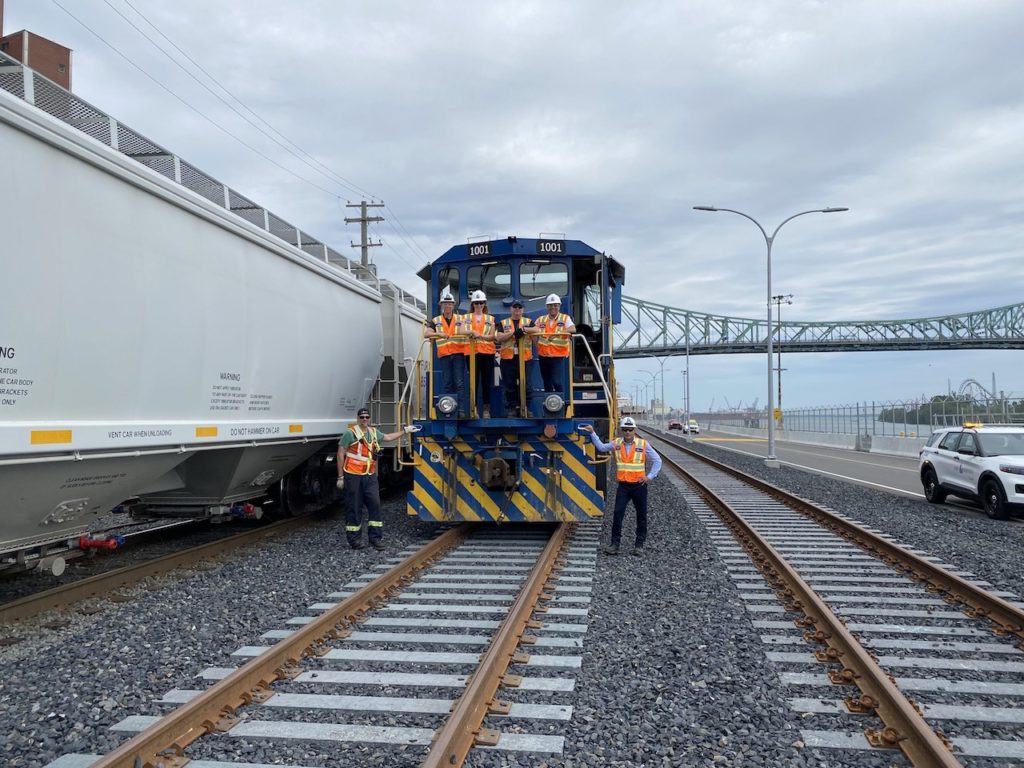
MPA this week announced that it has completed its extensive project to optimize rail capacity, a “flagship project to improve the performance and fluidity of its logistics services.”
Phased in more than three years at a total cost of $62.4 million, the project extends from Bourbonnière Avenue to Panet Street, near the Jacques-Cartier Bridge, “signaling a major increase in the Port of Montreal’s rail capacity.”
The project features:
- Installation of two new tracks totaling 6 kilometers (3.7 miles) of additional track and six switches to serve the 14 terminals.
- Construction of retaining walls totaling more than one kilometer (0.6 miles) in length.
- Relocation of the Port Road and all related infrastructure (sewer, water supply, power and telecom networks).
The rail capacity optimization project, which was supported by the governments of Canada ($18.4 million) and Quebec ($18.3 million), called on several teams from the MPA and partner companies, including civil engineering, environment, port land use planning, electricity, telecommunications and rail teams. Several measures were also identified to improve the project’s environmental performance. For example, excavated soil was used for backfill; the new Port Road consists of recycled paving and the composite railroad sleepers are made from recycled plastic. Sectoral studies on noise, dust, traffic and the impact on flora and fauna were also conducted before the project began.
“The rail capacity optimization project illustrates how committed we are to maintaining the quality and reliability of the Port of Montreal’s services at the hub of Greater Montreal’s logistics ecosystem, for the benefit of businesses and the population of Quebec, Ontario and the rest of Canada,” said MPA President and CEO Julie Gascon. “Thanks to these significant improvements, we can not only increase our efficiency, but also substantially contribute to the local and regional economy.”
The Port of Montreal stands out as the “Montreal Model” based on its “seamless intermodal transfers that make it possible to reach a pool of 110 million consumers,” MPA noted. Every year, the Port of Montreal’s rail network moves 2,500 kilometers (1,553 miles) of rail cars. About 45% of the Port’s cargo is carried by rail at a rate of 60 to 80 trains per week. The project, MPA says, “aims to strengthen and optimize this strategic infrastructure at the hub of Greater Montreal’s supply chain.”
POLB
A comprehensive POLB digital platform being designed to help speed cargo deliveries across the nation, the Supply Chain Information Highway, is getting an infusion of funding from Gov. Gavin Newsom’s administration, the Port announced July 11.
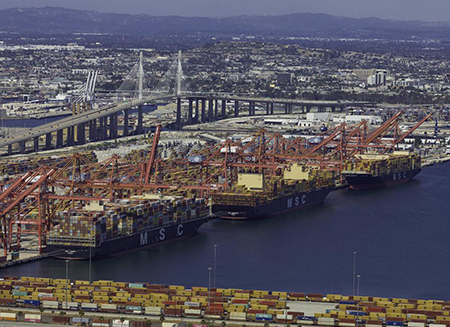
The Governor’s Office of Business and Economic Development (GO-Biz) announced a $7.875 million grant for the Port’s data system. Funding, POLB says, is expected to help build out a variety of functions, including export and rail cargo visibility, user authentication and data security, the exchange of data between foreign ports, truck appointments and a number of future project enhancements that will enhance operational efficiency and customer service.
The Supply Chain Information Highway, POLB says, “will enable stakeholders to make scheduling, planning and operational decisions prior to cargo arrival, making the delivery of goods more efficient and cost effective.” The cloud-based system is anticipated to be compatible with similar data-sharing platforms across the maritime logistics industry, including at major California ports, “supporting improved supply chain resilience, goods movement efficiency, emissions reductions, and economic competitiveness.”
“With six marine terminals at the Port of Long Beach now connecting to a beta version of the Supply Chain Information Highway, we’ve entered a crucial phase of development,” said POLB CEO Mario Cordero. “We are grateful to the State of California and GO-Biz for their continued leadership in supporting data modernization to bolster goods movement. This funding will be important as we roll out these new enhancements to increase cargo velocity and tighten coordination across modes of transportation.”
The Port of Long Beach has partnered with St. Louis-based UNCOMN to create the Supply Chain Information Highway. UNCOMN is collaborating with Amazon Web Services to provide cloud services and cloud hosting for the data.
According to POLB, development is focusing on three operational platforms in 2024:
- “A Container Track and Trace feature to access up-to-date information about the status of containers moving through the Port of Long Beach.
- “The Port Operations Dashboard, where users can review Port of Long Beach operational metrics. The dashboard can be viewed at www.polb.com/operations.
- “The Beneficial Cargo Owner Dashboard, where BCOs can access more detailed information about their containers including if they have arrived or departed, and which Port terminal they are at.”