

Port of Los Angeles
More than 900 industry and community representatives gathered for the 11th annual State of the Port (watch below), where Port of Los Angeles Executive Director Gene Seroka outlined his vision for the future, highlighting “Build Bigger and Build Smarter” investment priorities.
Hosted by the Pacific Merchant Shipping Association since 2016, ticket proceeds from the event have now raised more than $350,000 for local non-profit organizations. This year’s recipients were EXP and the Toberman Neighborhood Center in San Pedro.
Seroka announced the Port handled 10.2 million container units in 2025, the third best in the Port’s 118-year history and the third time exceeding 10 million Twenty-Foot Equivalent Units (TEUs). He credited that success and the Port’s 26th consecutive year as the nation’s busiest port to the hard work of the larger Port community and its many stakeholders.
“Every record set and every bar raised is a direct result of the dedication and commitment of the people who make this Port work,” Seroka told attendees gathered at AltaSea at the Port of Los Angeles. “Cargo remains the lifeblood of the U.S. economy. American farmers, manufacturers, retailers and consumers all depend on how well we move that cargo.”
In anticipation of future cargo demand, Seroka laid out the Port’s investment priorities for 2026 and beyond. His “Build Bigger and Build Smarter” framework outlined key Port investments in infrastructure, technology, community and the environment.
On the theme of “Building Bigger,” Seroka highlighted several of the Port’s signature infrastructure projects in anticipation of future cargo volume increases. Among these is the proposed Pier 500 Marine Container Terminal, an expansion that would significantly increase the Port’s overall cargo capacity. A Request for Proposals (RFP) was issued by the Port in October to evaluate interest and feasibility of the proposed project.
“Pier 500 would be the first new container terminal to be developed at the Port in a generation,” Seroka said. “We envision it to be the greenest, cleanest terminal in the world. It will be an investment in our workforce, sustainability, resilience and innovation—keeping us ready for the opportunities of tomorrow.”
Other infrastructure projects highlighted by Seroka include the Maritime Support Facility, a dedicated hub on Terminal Island for chassis parking and container pick-up and drop-off; an expansion at Fenix Marine Services Terminal on Pier 300; and proposed wharf and rail upgrades at LA TiL Container Terminal in the West Basin.
Expanding the Port’s growing cruise business is also a priority, according to Seroka. Last year, the Port had a record 1.6 million passengers on 241 cruise calls, and more growth is expected in the future.
Seroka announced that Pacific Cruise Terminals, a joint venture between Carrix, Inc. and JLC Infrastructure, has been selected to transform the Outer Harbor with a new world-class Cruise Center.
“Carrix is one of North America’s leading cruise terminal operators with a great track record developing large-scale infrastructure projects,” Seroka said. “Together, we’ll establish Los Angeles as the primary West Coast gateway for cruising and strengthen our position for decades to come.”
Speaking to the need to “Build Smarter,” Seroka reiterated the benefits of the Port’s continued investment in technology like the Port Optimizer™, Signal and Universal Truck Appointment System, all of which have helped Port partners better predict and manage cargo flow at the Port. An $8 million California GO-Biz grant will extend the Port’s truck appointment system to terminals in neighboring Long Beach, as well as support enhanced data-sharing among five major container ports in the state.
Investment in the LA Waterfront continues on multiple fronts. The grand opening of West Harbor retail and dining center is slated for this summer, and groundbreaking on the Avalon Pedestrian Bridge is set for February. The latter will link the Wilmington community directly to the new Wilmington Waterfront Promenade.
The Port is also in the midst of preparations to host sailing events for the 2028 Olympics.
“The Port and our communities will be front and center on the world stage,” Seroka said as he thanked the LA 28 Olympic Committee for seeing the value of the Harbor Community as a global venue. “This is an investment in global visibility, local pride and showing the world what this Port—and our City—can achieve.”
Seroka also noted that the Port’s latest emissions report showed that it had achieved the lowest emissions ever on a per-TEU basis of any port in the world. Upcoming projects are expected to help further those gains, including a Collaborative Agreement with the South Coast Air Quality Management District to develop zero-emissions infrastructure. A $412 million EPA Clean Ports grant announced last year—coupled with $230 million in non-federal funding—will also bring more zero-emission equipment to Port terminals in the future, according to Seroka.
“All this environmental work—the record-low emissions, the groundbreaking agreement with AQMD, the projects on our terminals—is an essential part of our collective DNA,” Seroka told the crowd. “No other port complex in the world is tackling these challenges at this pace and with this level of success. I thank all of you for being the partners to make this happen.”
During the event, Seroka honored those involved in responding to a major ship fire at the Port in November, applauding the “heroic and extraordinary” efforts of the Los Angeles City Fire Department, U.S. Coast Guard, Los Angeles Police Department, ILWU Local 13, 63 and 94, Los Angeles Port Police, Yusen Terminals, Inc. and the crew of the Ocean Network Express Henry Hudson. He noted that their quick response prevented any fatalities or injuries, kept air emission and water pollution below danger thresholds, and allowed Port terminals to be back and fully operational within 24 hours.
Port of Montreal
The MPA on Jan. 23 released the Port of Montreal’s preliminary results for 2025 during a speech by its President and CEO, Julie Gascon, to members of the Chamber of Commerce of Metropolitan Montreal (CCMM).
“In an economic and geopolitical climate marked by uncertainty and the reorganization of global trade,” the Port of Montreal handled 34.3 million metric tons of cargo in 2025. The containerized sector experienced a 3.6% increase in the number of containers, a rate higher than projected global trade growth for 2025, which had been estimated at between 2% and 3% by international organizations. This growth, MPA says, “attests to how the logistics ecosystem can capture new trade flows and quickly adapt to changes in international trade.” The Port of Montreal also remains balanced in terms of trade, with comparable import and export volume—a key indicator of the stability and diversification of its activities.
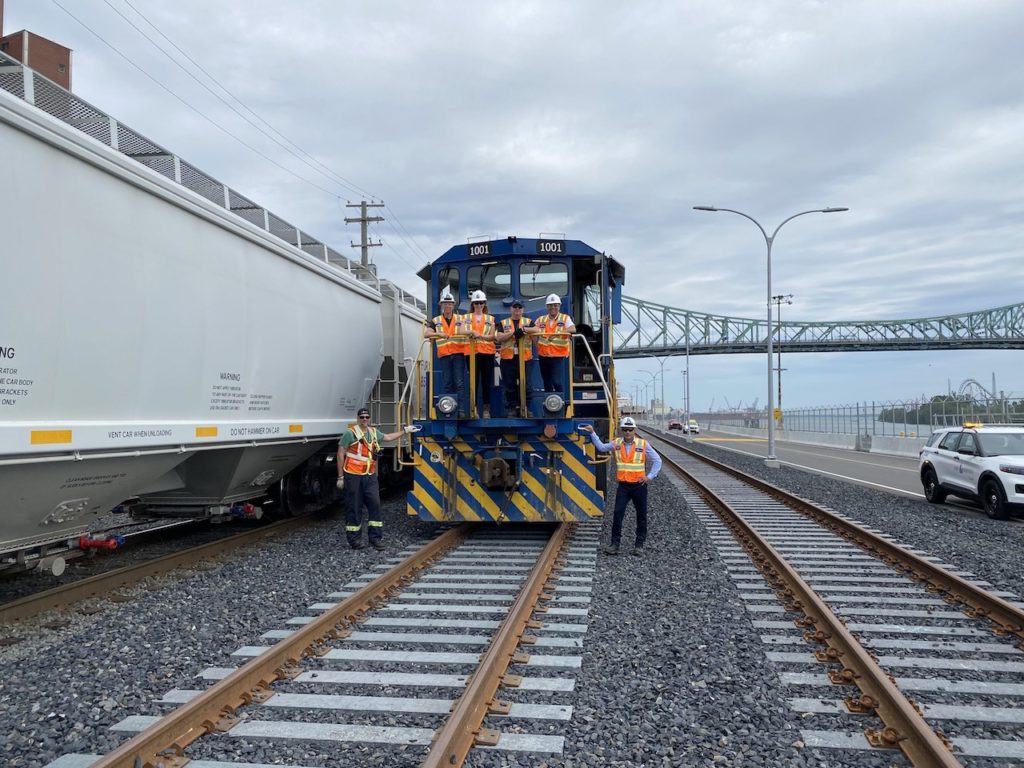
There was a decline in dry bulk (-6%), attributable to weather conditions that affected harvests, following record years in 2024 and 2023. Liquid bulk also dropped by 1.6%, linked to the decrease in energy demand.
The 2025 cruise season ended on Nov. 1 with 61,000 passenger cruise days, along with nearly 15,000 crew members who visited Montreal.
The 2025 results, MTA says, “reaffirm Montreal’s central role as a port city, where international connectivity represents a clear strategic advantage for both the Québec and Canadian economies.” Trade with the Mediterranean region increased by 1.5%, driven in particular by a 44% surge in trade with Morocco. Imports of fruit from Morocco rose by 137%, while exports of lentils to this market jumped by 154%.
Trade with Africa also increased by 39%, with tonnage doubling with Côte d’Ivoire and Benin and growing 53% with Nigeria. The Port also continued strengthening its ties with key markets such as India and China, “confirming its role as a preferred gateway to Europe, Asia and emerging markets,” Gascon noted.
Against a backdrop of export market diversification, the Port of Montreal’s Contrecœur expansion project, recognized as a project of national interest, achieved several milestones in 2025, according to the MPA, which signed a joint development agreement with DP World Canada, launched preparatory work, and initiated environmental compensation measures.
This expansion, which aims to add 1.15 million containers to the Port of Montreal’s handling capacity, “is in line with the federal government’s goal of doubling Canadian exports outside the United States,” Gascon noted.
“The 2025 results clearly show that diversification is no longer an option, but a necessity. Montreal is a destination port city, profoundly connected to the world, whose strategic infrastructure links the people and businesses of Quebec and Canada to international markets. This openness is one of our greatest strengths. By investing today in our capabilities, especially through the expansion project in Contrecœur, we are strengthening the resilience of our supply chains, supporting businesses in their diversification efforts, and contributing directly to Canada’s economic sovereignty in an increasingly complex geopolitical context,” said Gascon.
The preliminary results presented will be audited and officially released in full this May at the MPA’s annual meeting.




