Intermodal Briefs: ITS Logistics, Port of Long Beach, SC Ports

ITS Logistics
ITS Logistics on May 15 confirmed its “previous projections of a steep import drop-off following tariff increases on Chinese goods.”
Additionally, it said, “rail ramps in key regions are experiencing operational stress as shippers redirect front-loaded inventory to interior point intermodal (IPI) routing, all while cargo theft at rail interchange points shows distressing trends for shippers and providers in 2025.”
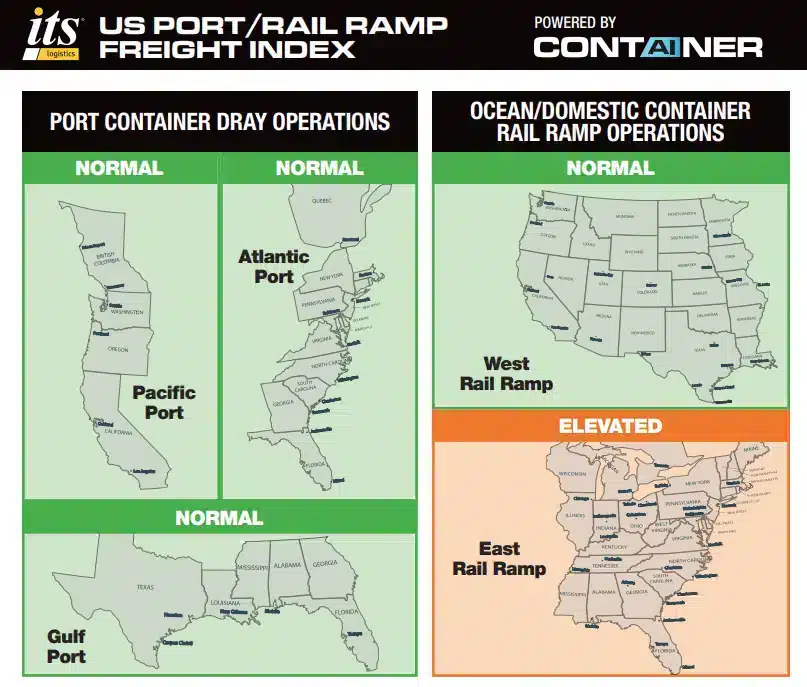
These findings are part of the Nevada-based third-party logistics (3PL) firm’s US Port/Rail Ramp Freight Index for May. Each month, ITS Logistics releases an index forecasting port container and dray operations for the Pacific, Atlantic and Gulf regions. Ocean and domestic container rail ramp operations are also highlighted in the index for both the West and East inland regions.
On Monday, May 12, trade officials announced that the U.S. and China agreed to a temporary tariff reduction, with the U.S. lowering tariffs from 145% to 30% and China lowering its tariffs on U.S. goods to 10% from 125%. With the new rates officially in place for the next 90 days, ITS Logistics says, “shippers are eager to restart imports, replenish inventories, and prepare for upcoming holiday seasons. The sudden surge in demand and uncertainty surrounding long-term availability of Chinese imports has the potential to spur another frontloading event that drives an early start to peak season for businesses in key industries like retail.”
“I have clients with thousands of containers pre-loaded in China that is ready to come in,” said Paul Brashier, Vice President of Global Supply Chain at ITS Logistics. Over the next four to six weeks, Brashier says he expects a surge of containers, calling the 90-day pause “the pivotal moment for supply chain planning out of China.”
“Shippers should be prepared to increase trucking and equipment capacity immediately to ensure they can withstand volatility and get their goods to market on time,” continued Brashier.
Adding to emerging market challenges, ITS Logistics says, industry experts are reporting a surge in cargo theft. “Criminal networks in the U.S. and internationally are exploiting weaknesses in current supply chain systems, as well as technology intended to improve overall efficiency, to steal freight.” CNBC recently reported industry-wide losses estimated to be close to $1 billion or more a year. A leader in fraud prevention solutions, Highway, cited in its quarterly Freight Fraud Index that the company blocked more than 914,000 fraud attempts in 2024, and more than 400,000 were blocked in Q1 of 2025 alone. Additionally, the Association of American Railroads (AAR) data showed a 40% year-over-year increase in container theft incidents in 2024. In the months preceding the April tariff announcement, shippers turned to IPI to move front-loaded goods away from congested ports— only to create new chokepoints at inland rail ramps, where cargo theft is now surging. “This is occurring as industry stakeholders demand federal intervention as the current freight fraud crisis escalates, leaving vulnerable supply chains at risk,” ITS Logistics noted.
“Using IPI offers more storage elasticity and allows shippers to avoid 3PL storage fees on front-loaded inventories,” Brashier explained. “However, chassis availability and congested ramp operations are becoming more frequent, and theft at interchanges between rail providers is a serious ongoing concern.”
Amid industry professionals seeking ways to best navigate the current supply chain disruptions, ITS “advises companies to prepare for an early kick-off to peak season that lasts through Q3. Additionally, as the supply chain industry enters Q4, “tax policy, deregulation, and federal reserve policy could spur economic growth that drives higher year-over-year (YOY) volumes.”
Port of Long Beach
Following its “strongest April on record” and 11 consecutive months of cargo increases, the Port of Long Beach says it is preparing for a “double-digit decline for shipments in May due to tariffs—and retaliatory tariffs—that were paused earlier this month.”
Dockworkers and terminal operators moved 867,493 twenty-foot equivalent units (TEUs) in April, up 15.6% from the same month last year and surpassing the previous record set in April 2022 by 5.7%. Imports rose 15.1% to 419,828 TEUs and exports decreased 4.5% to 93,842 TEUs. Empty containers moving through the Port jumped 23% to 353,824 TEUs.

“After moving the most containerized cargo of any American port in the first quarter of 2025, we are now anticipating a more than 10% drop-off in imports in May—and the effects will be felt beyond the docks,” said Port of Long Beach CEO Mario Cordero. “Soon, consumers could find fewer choices and higher prices on store shelves and the job market could see impacts, given the continuing uncertainty.”
“Even as the biggest tariffs were paused, we still should brace for the effects of tariffs following 11 straight months of cargo growth,” said Long Beach Harbor Commission President Bonnie Lowenthal. “As we monitor these dynamic changes in trade, the Port of Long Beach will continue to invest in rail and terminal improvements that will allow us to move cargo efficiently, safely and sustainably.”
The Port has moved 3,403,069 TEUs during the first four months of 2025, a 23.6% increase from the same period in 2024.
Complete cargo numbers are available here.
SC Ports
SC Ports on May 15 said it “remains focused on providing highly productive, reliable port service to support companies’ supply chains throughout the Southeast and beyond.”
“As carriers and shippers navigate current market conditions, customers can count on SC Ports and our broader port community to deliver quality port service,” SC Ports President and CEO Barbara Melvin said. “We excel at quickly working ships and moving goods through our terminals. We have available chassis, trucking capacity and rail connections to further speed goods to market.”

Charleston’s 52-foot harbor depth, SC Ports says, “further expedites logistics, and new carrier services at the Port of Charleston provide shippers with much-needed flexibility and access to key markets.”
“SC Ports’ ocean carrier services are diverse and span various trade lanes, which can help mitigate disruptions in region-specific supply chains,” Melvin said. “With 29 weekly services at the Port of Charleston, and critical first-in calls from key markets in Asia and Europe, imports and exports swiftly flow between the U.S. Southeast and international markets.”
In April, the Port of Charleston handled 215,804 TEUs and 118,215 pier containers, which is flat compared to the year prior, SC Ports reported. Container volumes remained relatively consistent in April, following two months of container growth.
Vehicle imports and exports at the Port of Charleston totaled 12,339 in April, representing a 32% decrease from last year.
Railed cargo, SC Ports says, “continues to be a bright spot,” with both Inland Ports Greer and Dillon handling strong volumes in recent months.
Inland Port Greer achieved a record April with 18,394 rail moves, representing 14% growth from last April. Greer’s recent expansion increases cargo capacity by 50%, enabling the rail-served inland port to handle 300,000 rail lifts to support growing customer demand in the region.
Inland Port Dillon handled 4,213 rail moves in April. This is down 11% year-over-year but breaks 4,000 rail moves for the first time this fiscal year.
SC Ports says it is on track to move more goods via rail when SC Ports opens the near-port Navy Base Intermodal Facility (NBIF). Construction is progressing well at the cargo yard, which will be rail-served by both CSX and Norfolk Southern (NS). This, SC Ports says, will provide direct connections to Inland Ports Greer and Dillon, and “further enhances South Carolina’s rail access to key markets like Atlanta, Memphis, Nashville, Louisville and beyond.”
“We are proactively investing in our port terminals and rail infrastructure to support the growth occurring in the Southeast for the long-term,” Melvin said. “As volumes fluctuate in the short term, we are committed to providing fluidity for companies’ supply chains.”