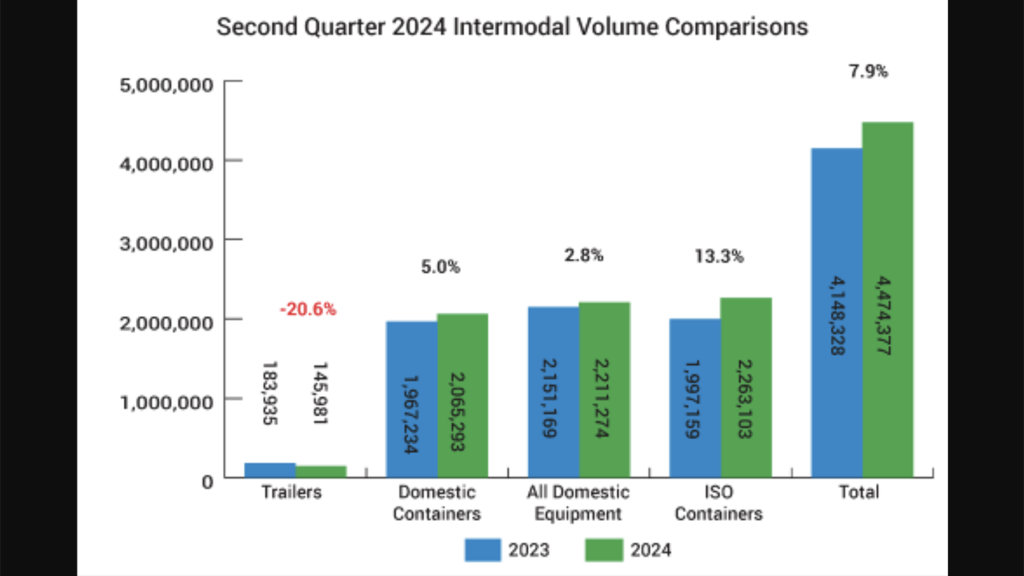
Total Intermodal volume for second-quarter 2024 was up 7.9% from the prior-year period, according to IANA’s (Intermodal Association of North America) latest report. It was the third consecutive quarter of year-over-year growth, coming on the heels of an 8.8% upturn in first-quarter 2024.
“U.S. businesses navigated a complex environment in the second quarter,” IANA said in Intermodal Quarterly, released July 29 (download below). “Higher interest rates and lingering service-sector inflation were headwinds, along with a slowdown in retail sales and sluggish industrial activity. At the same time, U.S. consumption stayed strong, the labor market remained consistent, and the core inflation rate made meaningful improvements.”
For the three-months ending June 30, 2024, the international container segment added 13.3%, and domestic containers improved 5%, IANA reported. Also, while the trailer segment “continued its decline,” falling 20.6%, overall loadings reached nearly 4.5 million in the second quarter, which the association said was “the best since the third quarter of 2022.”
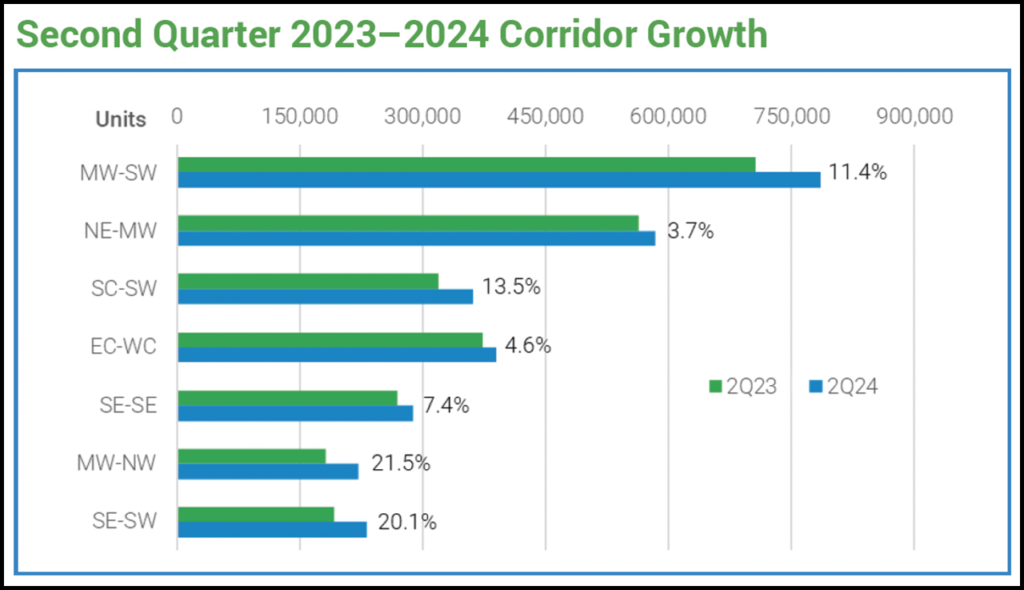
The seven highest-density trade corridors, which collectively handled more than 60% of total volume, were all up in the second quarter, according to IANA (see chart below). The Midwest-Northwest gained 21.5% followed by the Southeast-Southwest at 20.1%. The South Central-Southwest posted 13.5%, and the Midwest-Southwest realized 11.4%. The Intra-Southeast, Trans-Canada and Northeast-Midwest came in at 7.4%, 4.6% and 3.7%, respectively.
Intermodal loads handled by IMCs (Intermodal Marketing Companies) were up 6.3% year-over-year after eight consecutive quarters of losses, according to the association. Trucking volume handled by these same IMCs climbed 5.1%, “a second consecutive volume gain for highway traffic after five straight quarters of lower highway loadings,” it noted. Combined, total volume for IMCs rose 5.5% from second-quarter 2023.
IANA reported that overall intermodal loadings “are moving up in the typical seasonal pattern, progressing to a peak in August or September, before tapering off during the remaining months of the year.” This year’s “upward momentum,” the association said, has been driven primarily by “a surge in imports on the West Coast, which drove increased international container traffic.”
Concluded Joni Casey, who will retire at the end of this year as IANA President and CEO: “International volume provided the biggest lift for intermodal in the second quarter. Domestic containers played a supporting role, especially important as the decline in TOFC moves continued. Federal reserve actions over the next three months will help determine whether the industry can continue this progress.”
2024 Outlook
“With containerized imports on the rise, especially on the U.S. West Coast, the outlook for international containers moving by rail is forecast to move up 13.8% for full-year 2024, notwithstanding the tougher comparisons that lie ahead,” IANA reported. “Transload volume from those imports and steady production volume will be an opportunity, albeit limited by excess trucking capacity, for domestic intermodal providers. Domestic container gains are expected at just 3.5%, while the trailer segment is forecast to contract 19.3%. All combined, total North American intermodal volume is anticipated to advance 5.2% for full-year 2024.”
According to the association, a potential slowdown in consumer spending “complicates this picture.” Signs for that include “lower real disposable income growth, rising credit card debt, less discretionary spending, and a reduction in the personal savings rate,” it said. “Additionally, wage growth has leveled off, and unemployment has picked up slightly. There is a silver lining to a weaker consumer and a softening labor market. It could be the final step in moderating inflation, in line with the Federal Reserve’s goal of 2%. Manufacturers are eagerly awaiting an interest rate cut to stimulate economic activity and business investment, which would likely boost new orders after roughly two years of sluggish activity. Lower interest rates would also have profound effects on consumers in the form of lower mortgage rates and car payments, laying the groundwork for domestic intermodal growth.”