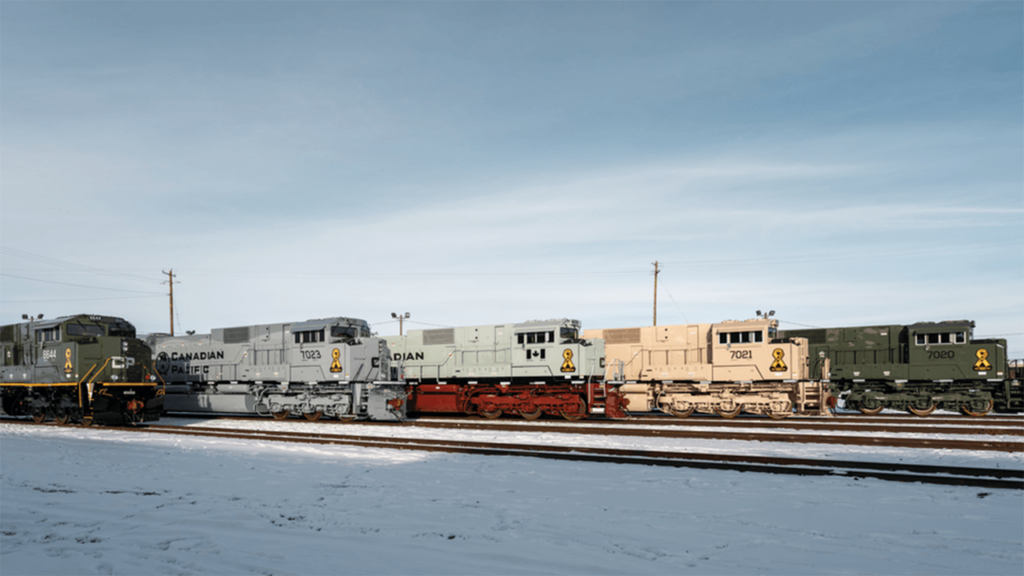
Between 16% and 25% of the U.S. railroad industry workforce consists of military veterans, with most Class I’s reporting that up to 20% or more of their employees have served in the armed forces. Veterans are highly valued in the industry for their discipline, safety focus, and skill sets.
Canadian Pacific Kansas City President and CEO Keith Creel brought a military background to his railroading career as a commissioned officer in the U.S. Army, having served his country in the Persian Gulf War in Saudi Arabia. He’s carried that service forward. For example, rather noteworthy is the expansion of Canadian Pacific’s “Spin For A Veteran” program to assist homeless veterans. Keith established this fundraiser in 2017 in Calgary and expanded it to Kansas City in 2023.
When Railway Age named him 2021 Railroader of the Year, Keith and I spoke about his military service. “How does your experience translate to your railroading career?” I asked.
“The military was my segue into the railway,” Keith said. “The leadership lessons I learned in the military date back to the Persian Gulf War. I was a very young lieutenant, early 20s, a commissioned officer in an actual war zone. I learned very quickly that to be a leader, you’ve got to earn respect, and to earn respect, you’ve got to treat people with respect. So that’s a very valuable lesson I carried from my military days into my railway days, leading by example, treating people with respect, making sure they understand that, yes, we have a job to do and, yes, we all have to be accountable. But at the end of the day, as human beings, we care about each other. I care about them, they care about me, and that creates the emotional commitment, the emotional connection.
“It’s so necessary in our industry, because our industry requires so much of all of us. It’s an industry where you have to sacrifice often; it’s an industry that never sleeps. Our families depend upon it; the backbone of our economy depends upon it. It’s a great blend, and it’s also a great honor to serve. So, the two married very well for me; they resonate well with my values. And that sense of service is something that, obviously, was required then. It’s something required today, working through people and with people, leading people to accomplish something they otherwise couldn’t accomplish alone or individually. But doing it collectively is something that really motivates me and something good in the railway industry; you get ample opportunity to engage in that.”

Five years later, here’s Keith on the cover of GI Jobs, whose sole purpose is to assist veterans with transitioning into civilian life and establish a career. Annually, GI Jobs publishes “CEOs Who Are Veterans,” which “recognizes military veterans now leading some of the most respected companies in America—many of which have earned the Military Friendly® designation. While not all hold the CEO title—some are presidents and chairmen—all share a common bond: military service shaped their leadership, resilience and commitment to purpose. This is not an exclusive list, but a snapshot of veteran leaders who continue to serve, only now in boardrooms and executive suites. They are creating opportunities for other veterans, military spouses and the broader workforce. Their career paths reflect a wide range of industries and experiences, but each one reminds us that the values instilled in uniform—integrity, accountability, discipline, adaptability and mission focus—translate powerfully into corporate leadership.”
Here’s the article, in full:
GI Jobs, March 2026 Issue: “2026 CEOs Who Served: These Veterans Are Shaping the Future of Business. CPKC CEO Keith Creel’s journey from military service to the top of the rail industry reflects a path shared by many leaders on this year’s list.
“Keith Creel’s path to the top of the North American rail industry began far from the corner office.
“In 1992, the U.S. Army veteran started his railroad career as an intermodal ramp manager for Burlington Northern Railway in Birmingham, Ala. It was a hands-on operational role—coordinating trains, cargo and crews in one of the most demanding sectors of transportation. Over the next three decades, Creel steadily climbed the ranks of the industry, taking on increasingly complex leadership roles across multiple railroads. Along the way, he developed a reputation for operational discipline, strategic thinking and an ability to lead large teams through constant change.
“Today, Creel serves as president and CEO of CPKC, the first and only single-line railroad connecting Canada, the United States and Mexico. He assumed the role in April 2023 following the historic combination of Canadian Pacific and Kansas City Southern, creating a rail network that stretches across North America and links major industrial and agricultural markets with key ports and supply chains.
“Creel had already made history before that milestone. In 2017, he became the 17th leader of Canadian Pacific since the railroad’s founding in 1881. Under his leadership, the company achieved industry-leading safety performance and introduced new ways to move freight more efficiently across the continent, strengthening the connections between businesses, communities and global markets.
“His rise through the industry—from frontline operations manager to the top executive of one of North America’s most important transportation networks—reflects a career built on discipline, accountability and a clear sense of mission. Those qualities were forged long before he entered the rail business.
“Those principles—clear vision, decisive leadership and accountability—translate naturally to an industry where timing, coordination and teamwork are essential. Running a modern railroad requires the ability to manage thousands of employees, vast infrastructure networks and complex logistics operations that move goods across continents. For Creel, the leadership lessons learned in uniform continue to guide how he approaches those challenges.
“Throughout his career, he has held key leadership positions across the rail industry. Before joining Canadian Pacific in 2013 as president and chief operating officer, Creel served as executive vice president and chief operating officer at [CN], where he also held senior leadership roles overseeing operations in both eastern and western regions. Earlier in his career, he worked with several other major railroads, including Grand Trunk Western and Illinois Central, gaining experience in everything from train operations to regional management.
“His leadership has earned widespread recognition in the transportation industry. He has been named Railroader of the Year by Railway Age in 2021, followed by co-Railroader of the Year honors in 2022 [with the late Pat Ottensmeyer of Kansas City Southern]; Railroad Innovator by Progressive Railroading in both 2014 and 2024 and In 2021, The Globe and Mail’s Report on Business Magazine named him CEO of the Year and Strategist of the Year.
“Yet Creel’s story is not just about one executive’s rise to the top of a major industry. It also reflects a broader pattern seen throughout the 2026 CEOs Who Served list.
Each year, the list recognizes corporate leaders who once wore the uniform of the United States military. They now serve as CEOs, presidents, chairmen and other senior executives leading organizations across industries ranging from transportation and manufacturing to technology, healthcare and finance.
“Like Creel, many of these leaders began their careers in operational roles far from the executive suite. Their military service instilled habits that later proved essential in business: discipline, mission focus, teamwork and the ability to make decisions under pressure. Whether managing global supply chains, building innovative companies or leading thousands of employees, they continue to draw on lessons first learned in uniform.
“For service members preparing for their own transition to civilian careers, the leaders featured on this year’s list offer inspiring examples of what is possible after military service. Their paths differ, but they share a common foundation: leadership skills developed in the armed forces that helped carry them to the highest levels of corporate America.
“Keith Creel’s journey from Army officer and Gulf War veteran to the leader of a continent-spanning railroad offers a compelling example of that trajectory.
“He is one of many veterans whose leadership continues to shape the future of American business.”
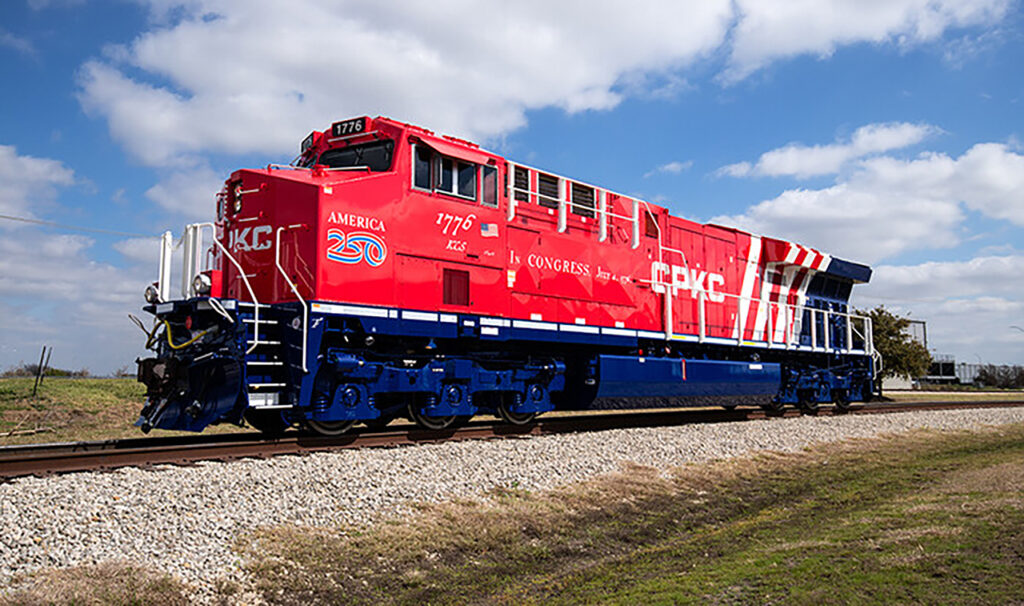
Now, some have suggested that CPKC—led by a U.S. military veteran—is not a U.S. railroad. That’s utter nonsense. Let’s be very clear: CPKC may be based in Calgary, but it has long, deep U.S. roots—like Keith Creel himself. From the early days of railroading with the Delaware & Hudson, Arthur E. Stilwell’s 1887 founding of KCS antecedent Kansas City Suburban Belt Railway and long-time CP U.S. subsidiary Soo Line, all the way to the 19 U.S. states it touches in the “Lower 48,” CPKC is uniquely U.S.—and uniquely Canadian and uniquely Mexican.
CPKC employees, like those of all the railroads, are a blend of North American men and women from numerous ethnic, racial and social backgrounds. They all have two things in common: They’re railroaders, and human beings.
Thank you all for your service.