
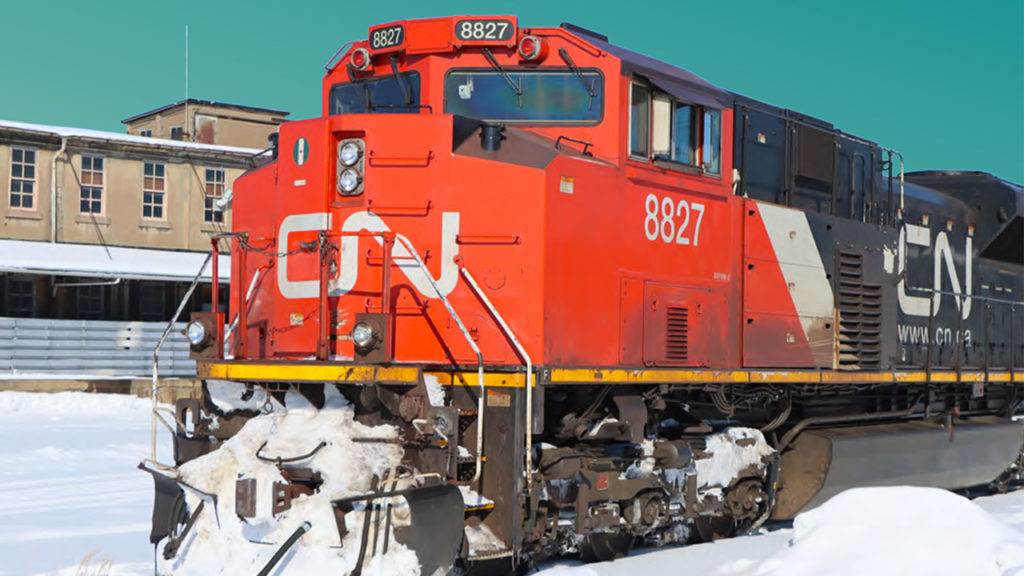
The big winter weather challenge has now come and gone in the form of last week’s polar vortex. The Eastern railroads got doubly lucky as they also had to contend with Winter Storm Enzo, a rare southeastern snowstorm, which arrived Jan. 20.
We’ve summarized some of the week’s data in the table below, but of course there’s more information and context in the body of the report. Except for volumes, the numbers in the table show the sequential change from the prior week. If we use Union Pacific as an example, in the week ending January 24 the velocity hit from the polar vortex was 2%, including a 3.7% slowdown in its manifest business and only a modest deceleration in intermodal (–0.3%). Terminal dwell increased by 10%, including a 13% average increase at Union Pacific’s seven reported hump yards. The number of slow-to-move cars (48-hour delays) increased by 31% (from 2,747 to 3,587). Trains holding for crews improved sequentially: down 14% (from seven to six per day) while the cold snap increased delays due to power and all other reasons. The impact was also felt in terms of carload volumes, which fell 3.4% Y/Y last week. Intermodal is still running strong, up 18%, although this represents a deceleration from 25% Y/Y growth over the prior three weeks.
Regarding the other railroads, note the hit the Eastern rails took in terms of carload volumes, down 15.5% at CSX and 13.4% at Norfolk Southern, and double-digit dwell increases at CN and CPKC. But NS demonstrated some more resiliency in the form of the smallest impact on average train speeds.

Weather Impact for Week Ending Jan. 24
In general, the hit the railroads took was modest compared to prior polar vortexes in 2014, 2019 and 2021, for a couple of reasons. First, and most important, the industry entered the cold snap in good shape with sufficient critical resources and decent fluidity. The better they go in, the better they come out. Second, the polar vortex simply wasn’t as bad as advertised. In a railroad context we define a polar vortex as a period of extreme cold sufficient to trigger the widespread shortening in train length, due to the impact on air braking systems, which in turn creates a capacity crunch. That just didn’t happen, so while the weather system was, technically, a polar vortex, it was really an arctic blast in a rail context. Regardless of what we call it, it’s history now and bullet dodged.
Western Intermodal
Here are the updated Western intermodal charts, where you can also see the sequential deceleration in intermodal loads (red columns).






