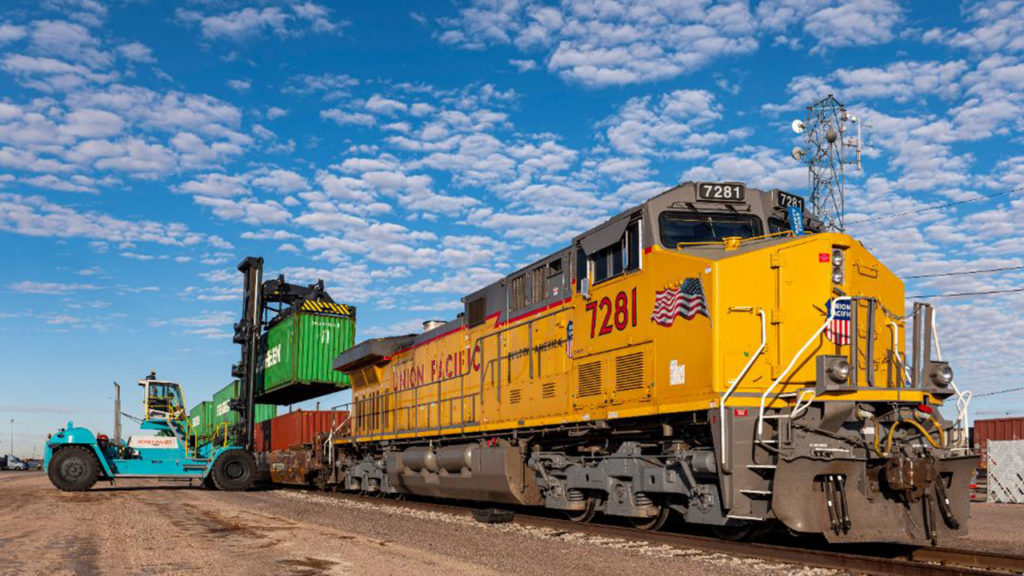
The past couple of weeks you may have noticed that BNSF and Union Pacific have been running an increasingly tight ship as they shake off the last vestiges of winter and some subsequent flooding in Arkansas, Missouri, Tennessee and Mississippi. Highlights include:
- Current velocity at a 14-week high at BNSF and 11-week high at Union Pacific.
- Terminal dwell just hit a seven-month low at BNSF and three-month low at Union Pacific, and within this the hump yards are at or near multi-month lows.
- Operating inventory is getting noticeably leaner, with BNSF dropping cars on line 4.2% over the past four weeks to a four-year low, while Union Pacific is at a three-month low while carrying good momentum.
- In terms of breadth of fluidity, the proportion of the cars on the network that are slow to move is sitting at the low end of their respective multi-year ranges.
- No issues with critical resource availability, with daily trains holding for crews and power all in the single-digits.
It can never be perfect, of course, and we’d like to see better velocity in UP’s manifest network, for example, but these two railroads, which represent 44% of the industry in terms of volumes, are in increasingly good shape. That’s before we pencil in further network acceleration from the China “air pocket” in volumes that’s now entering San Pedro Bay.
Ideally you want to feed higher volumes into efficiently running networks, converting them to earnings at a high rate, but unfortunately we’ll soon be playing defense on volumes, given high tariffs and higher uncertainty. While we wait for more clarity on trade policy, the Western railroads can still use improving service levels to bolster customer confidence and competitiveness with truck. Remember the big picture here: 14 meltdowns since 2013 and the industry is engaged in a giant customer confidence restoration project to try to win back some share of wallet vs. trucks. CSX recently let the team down, but if the two biggest dogs in the space can extend and improve their service track records through 2025, that wouldn’t be a bad outcome and consolation prize in the event tariffs thwart volume growth over the balance of the year. Never let a crisis go to waste.
CSX Rebound, Week 2: Operating Inventory Starts to Correct Lower

In the week ending April 25, CSX booked a second week of progress fighting back from a trough in network efficiency in early April, including a 33-month low in average train speed. The two primary inhibitors to a full recovery are the reroutes around the closed Howard Street Tunnel in Baltimore, which likely won’t reopen until Q4, and the working down of operating car inventory to declutter the network. The latter requires some help from customers, who own or lease most of the cars, but it’s at least something CSX can influence and make progress on while we wait for the tunnel.
We got the inflection in operating car inventory last week; falling by 2,348 to 136,653, or 1.7%, compared to the prior week. We’re still ~10,000 cars too high, but 2,348 is a nice chunk to get the ball rolling.