
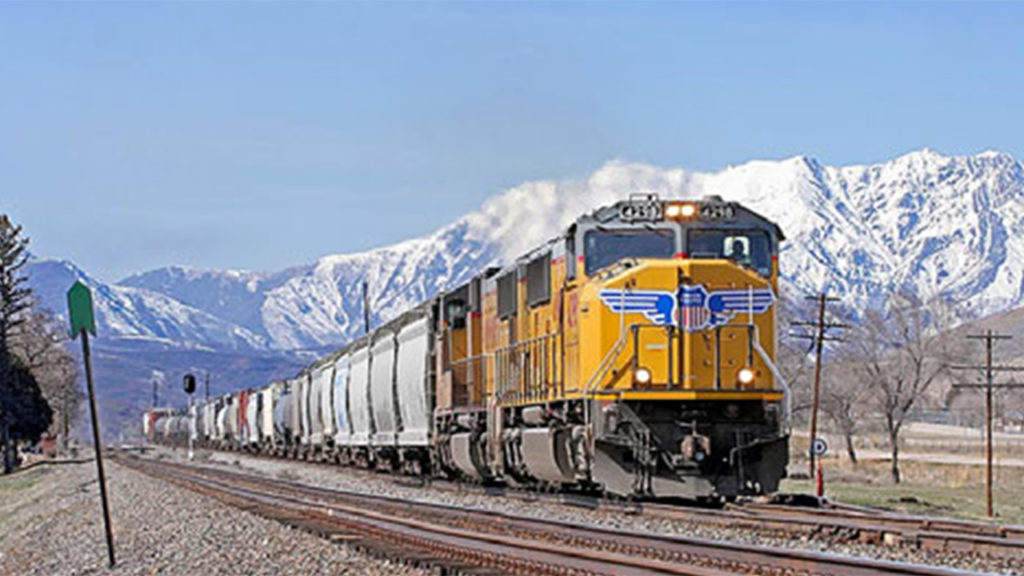
Union Pacific’s third-quarter 2024 financial results showed growth and improvement occurring across several metrics.
Compared to the prior-year period, third-quarter net income of $1.7 billion or $2.75 per diluted share, vs. $1.5 billion or $2.51 per diluted share, rose 9%, with EPS up 10%. Operating income was $2.4 billion, up 11%. Operating revenue of $6.1 billion grew 3%, driven by increased volume and core pricing gains, partially offset by business mix and reduced fuel surcharge revenue. Freight revenue excluding fuel surcharge revenue grew 5% as revenue carloads grew 6%. The operating ratio was 60.3%, an improvement of 310 basis points. Lower quarterly fuel prices positively impacted the operating ratio 120 basis points.

In terms of operating performance, the railroad noted it realized “solid service and operational officiency gains while handling volume growth” and set a quarterly record for workforce productivity. Union Pacific’s year-to-date reportable personal injury and reportable derailment rates both improved. Quarterly freight car velocity improved 5% to 210 daily car-miles. Quarterly locomotive productivity improved 5% to 135 gross ton-miles (GTMs) per horsepower day. Quarterly workforce productivity improved 12% to 1,102 car-miles per employee. The fuel consumption rate increased 1% to 1.058, measured in gallons of fuel per thousand GTMs.


“Our third quarter results demonstrate the success of our strategy,” said Union Pacific CEO Jim Vena. “Improved safety and service performance supported solid revenue growth that we converted into double-digit improvement in third quarter operating income and earnings per share. The entire Union Pacific team is focused on delivering for our customers and shareholders, and is energized to build on these accomplishments to drive sustainable long-term success.”


Union Pacific said it expects its fourth-quarter results to be “consistent sequentially from the third quarter while improving year-over-year vs. the fourth-quarter 2023. The Class I affirmed its 2024 guidance, saying that the profitability outlook “continues positive momentum with a strong service product, improving network efficiency and solid pricing. The company will conduct share repurchases of approximately $1.5 billion in 2024 and expects pricing dollars in excess of inflation dollars. There will be no change to its long-term capital allocation strategy, based on a $3.4 billion capital plan.

“We Have Very Clear Focus”
Railway Age Editor-in-Chief William C. Vantuono chatted with Jim Vena following Union Pacific’s third-quarter earnings call:
RAILWAY AGE: Right across the board, everything is everything is looking up. The financial metrics are looking up. The operating ratio is down, the safety metrics are improving. Everything looks good, despite some tough times, though, with weather related stuff. What does that tell you?
JIM VENA: That tells me the fundamentals of who we are and what we’re trying to are working. We talk about safety, service and operational excellence. That’s real important for us and they’re not just words, because words are cheap. It’s the actions, and you could see the actions we were able to do this past quarter, to deliver great financial, operational, safety and customer service metrics. And if you do that, then you can move this company forward. I’m very happy and pleased with what the team has been able to deliver. I’m very happy with the quarter and that we’re handling 33% more international intermodal business nobody saw coming and nobody told us about. It’s a testament of how we operate this company today.
RA: You were prepared for that surge in intermodal?
JV: It impacted us a little bit but yes. It’s just the way we manage the company. When I talk about “buffer,” it’s a simple word and some people would just blow by that. We truly want to have that asset buffer, and the way we look at our staffing, that we have capacity in our railroad to be able to handle it. I think it was true proof of what’s possible and what we’re capable of.
RA: Looking at the third quarter reports from all your peers, they’re all pretty good. Do you think this industry is turning a corner? That brighter days are ahead after the past few years, when we saw a lot of, for lack of a better word, “challenging” things happen, like labor strife and the railroads under a microscope from the regulators and the STB?
JV: I agree with you that the rail industry is in a good place, and we all want to get better. If you look at our messaging, all of us, it’s very similar. I use safety, service, operational excellence. Others use those. But we all understand. We have very clear focus. You don’t do one thing well and expect that the other things that you have to do aren’t impacted, so you need to do everything well. You need to provide good service. You need to improve safety, and you need to be operationally very efficient. I like the where the industry is, and the best part about it is we’re all challenging each other by competing. I’m absolutely sure everyone looked at our operating ratio this morning and said, son of a gun, the best operating ratio again, and what can we do to beat them? I love it. It’s a great place to be.
RA: Getting back to safety, you must sweat the small stuff. You pay attention to every detail, and when you do that, the overall effect is there’s a boost in safety, and that corresponds to a boost in morale and overall productivity, and it translates right to the bottom line. Did you agree with that?
JV: Yes. When you’re dealing with safety, you have to understand every action and what’s involved in that action. You have to work on the person because we don’t know what is happening in someone’s personal life when they come to work They could be pressured from so many things at home, or it could be everything’s perfect. But at the end of the day, they don’t come to work and tell us they have a financial problem or a sick child. You need to understand and be able to put processes in place. You need to work as a team, and you have to sweat every one of those actions and make sure that you understand those little things that add up to big things.
“We Responded With Strength”

“I am happy about what we have accomplished and where we are headed,” Vena said in a message to employees. “Our progress proves our Safety, Service and Operational Excellence strategy is working. Recent results show our resilience as a railroad and demonstrate the strength of what is possible when our Union Pacific team works together, focused on a united strategy.
“When presented with factors not of our own making, we responded with strength. As the Canadian rail system and East and Gulf Coast ports grappled with workforce outages, our buffer kicked in. We deployed our resources, leaning into the strength of our operation and team to handle supply chain pressures and take on a 33% increase in international intermodal volume. Addressing these unanticipated challenges wasn’t easy, and it came at a price. The entire supply chain dealt with pressure points at inland and port terminals. For Union Pacific, this meant the cost of overtime and additional equipment, and an imbalance in our operations to handle the influx—but we did it. I think it is fair to say everyone did their part to handle an increase not forecasted by anyone. That is what it means to deliver what is possible. I am very proud of the team and everything we were able to do. Thank you.
“Railroading means expecting and handling the unexpected while balancing the many moving parts of our strategy. Our first strategic priority is always Safety. While railroads are the safest and most sustainable way to move goods on land, we must never stop finding ways to be safer. We continue making critical progress. Our year-to-date derailment and personal injury rates improved 14% and 21%, respectively, compared to this same time last year. However, these numbers fall short when we remember the team members we lost this year. We must remain vigilant, ensuring everyone returns home to their families and the people counting on them.
“Our Service continues to grow stronger, with our Operational Excellence as its foundation. Several operational vectors—including productivity in yards, reducing touch points when handling cars, shop turn arounds and more—demonstrate our ability to make substantial productivity strides. This great work on the fundamentals is at the heart of what will differentiate Union Pacific from the marketplace and fuel Growth.
“While our business is measured by quarters and years, I look at where we need to be for long-term success. We have a clear plan, and as we continue to execute it together, we will continue to grow the company over the long term.
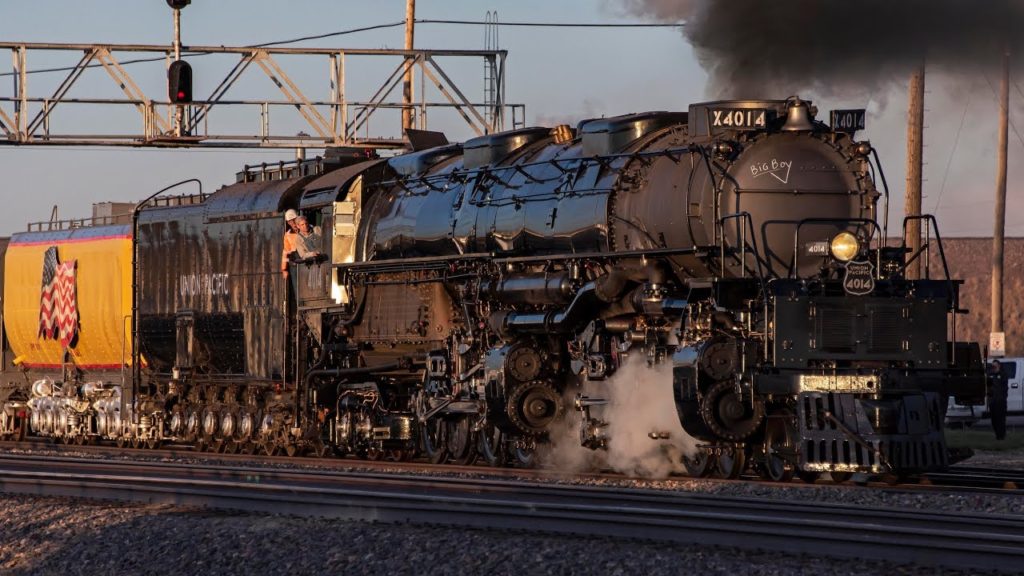
“As we say goodbye to summer and the cold takes hold, the historic Big Boy tour just ended. We drew crowds as large as 64,000, with dozens of communities excited to see the beauty of history in motion as they followed the steam engine across our system. We used it as a storytelling and goodwill machine to connect with many stakeholders, including local governments, community officials, investors, customers and media—but most important, you. I wanted to personally ensure employees and their families were able to experience this piece of living history. I am so excited that thousands of you took the opportunity to show off the Big Boy to your families, and I thank you for your continued work to keep us moving forward.”
TD COWEN: “MIX/PRICING CONTINUE TO LIMIT UPSIDE IN ’24 DESPITE VOLUME STRENGTH”
By Jason Seidl, Elliot Alper and Uday Khanapurkar
UNP is a well-run North American Class I railroad, in our view, and the only Western one that is publicly traded. The company has made great strides toward improving its OR through the adoption of Precision Scheduled Railroading, though declining volumes, network cost pressures and regulatory risk are near-term headwinds. UNP’s 3Q was in line with our estimate but fell slightly short of consensus while Q4 guidance came in ~5% below the Street. Volume strength is being partially offset by challenging pricing and mix as UNP works to run a leaner network while digesting labor expenses and rail inflation. UNP is tapping back into buybacks with strong cash flow.
UNP’s 3Q was in line with our estimate but fell short of consensus expectations largely due to a miss on the OR. UNP beat our estimate slightly on the top line as total revenues grew 2.5% in the quarter. UNP reported carloadings +6.1% in Q3, driven by +19% in intermodal volumes (+33% international) and +13% in grain products, partially offset by a 13% decline in coal (attributable to lower natural gas pricing).
Strong volume growth in intermodal, driven primarily from customers shifting freight to the West Coast, more than offset a 6.4% decline in revenue per car. As UNP discussed during its investor day, international freight comes at the expense of margins, but management doubled down that this is still quality freight it will continue to move. Fuel was a noteworthy drag to revenue per car (we estimate to the tune of 20%+ in Q3) that should continue into Q4. Terminal dwell at the ports has been an issue for UNP (which the Port of LA called out on our call) that likely challenges shipper confidence to lean into intermodal when service issues persist. While mix and fuel headwinds may dissipate in 2025, we continue to see a challenging intermodal pricing environment through 1H25 at a minimum.
Overall network productivity remained strong in Q3, with freight car velocity +5% and workforce productivity +12%. The last time UNP moved this much volume was back in 2018 when it had ~30% more employees; the company has done exceptionally well at running a lean network as volumes have returned. When pricing does see a more robust turnaround (UNP is currently seeing rail pricing exceed rail inflation) and mix challenges fade, we see more OR improvement opportunities into 2025 (while digesting labor costs).
UNP offered 4Q guidance that calls for the fourth quarter to look similar to Q3 (top and bottom line), which was below our previous forecast and ~5% below consensus estimates. Yields should continue to be a drag in Q4 and intermodal volumes may moderate through Q4 given pull-forward commentary we’ve heard from multiple companies through earnings. ~Flat OR sequentially should result in operating expenses stepping up sequentially and compensation per employee should take another step up in 4Q. We model +8% y/y in Q4 as labor agreements flow through the model.
UNP repurchased $738 million of stock in the third quarter and has now distributed $3.2 billion to shareholders via buybacks and dividends YTD. The company should repurchase a total of $1.5 billion in shares this year and continue to lean into buybacks in 2025. The capex plan of $3.4 billion was unchanged.
We adjust our 2024 and 2025 EPS estimates to $10.94 from $11.10 and $12.60 from $12.75, respectively. Continuing to use our 20x multiple and our updated 2025 estimate, our price target moves to $252. Reiterate Buy.




