
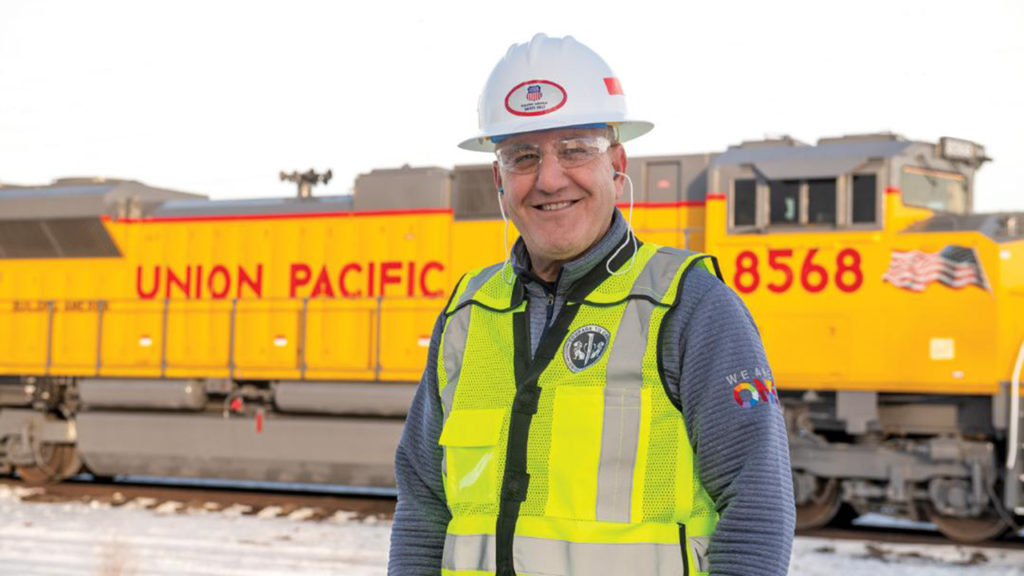
Union Pacific’s first-quarter 2025 financial results indicate a “solid start” to the year. Though earnings per diluted share and operating income were flat, “reflecting a 7% headwind from fuel and leap year,” revenue carloads and freight revenue excluding fuel surcharge rose.
“The team delivered a solid start to the year as we worked closely with our customers to meet their needs in an uncertain environment,” said CEO Jim Vena. “Looking to the rest of 2025, we will continue to execute our strategy that emphasizes safety, service and operational excellence. Building on a strong foundation with our record first quarter operating performance, we are positioned to deliver.”
Union Pacific reported 2025 1Q25 net income of $1.6 billion, or $2.70 per diluted share. This compares to 2024’s $1.6 billion, or $2.69 per diluted share. Operating revenue of $6.0 billion was flat on 7% volume growth and “solid core pricing gains offset by business mix, reduced fuel surcharge revenue, lower other revenue, and impact from leap year.” Freight revenue grew 1%; 4% excluding fuel surcharge. Core pricing dollars net of inflation were accretive to the operating ratio, which was 60.7%, flat compared to 2024. Lower fuel prices and leap year “unfavorably impacted the operating ratio 90 basis points.” Operating expenses were flat as “productivity improvements and lower fuel costs offset volume-related costs and inflation.”
Union Pacific’s operating performance showed “continued Improvement in service and operational excellence.” The railroad set 1Q records for personal Injury and fuel consumption rates, freight car velocity and workforce productivity. The FRA-reportable personal injury rate improved to 0.59 (44 injuries), compared to 0.91 in 1Q24 (69 injuries), “matching our best-ever quarterly performance.” Freight car velocity was 215 daily miles per car, a 6% improvement. Locomotive productivity was 136 gross ton-miles (GTMs) per horsepower day, a 1% improvement. Average maximum train length was 9,490 feet, a 2% increase. Workforce productivity improved 9% to 1,091 car-miles per employee. The fuel consumption rate improved 1% to 1.107 gallons of fuel per 1,000 GTMs. (UP also announced that members of the National Conference of Firemen and Oilers ratified a five-year agreement.)
Union Pacific noted it is “on track with Investor Day targets, focused on strategy amid an uncertain macro environment.” The Class I affirmed its 2025 outlook, based on “volume impacted by mixed economic backdrop, coal demand, and challenging year-over-year international intermodal comparisons; pricing dollars accretive to operating ratio, EPS growth consistent with attaining a three-year high-single to low-double-digit CAGR target; an industry-leading operating ratio and return on invested capital.” No change is anticipated in the long-term capital allocation strategy; with a 2025 capital plan of $3.4 billion. Share repurchases of $4.0 to $4.5 billion are projected.
Railway Age Editor-in-Chief William C. Vantuono spoke with Jim Vena following the earnings call:
Vantuono: Let’s talk about service and how your levels have been improving.
Vena: We’ve made a dramatic change on how we view service. For the longest time at Union Pacific, we looked at it as some measure that, when we talked with customers, they would say, “Oh really?” We were not on the same page, so now we measure what we sell to the customer. Our metrics are to the point where, if I speak to the leaders of our customers and the discussion doesn’t start with service, that’s the best statement. For some, it’s the second and third time I’ve spoken with them. So, we’re at the point where we start to really know each other. The metrics we give in the high 90s—94% on the SPI side and 95% on the on the carload side—are high numbers. Customers say we’re delivering what we told them and what we agreed to. We have to be good. If we’re not, customers are going to push back hard when we’re talking about how we’re going to price, and they’re going to look at other options. Eric [Gehringer] and the entire team have done well getting out our service product, with resiliency. We had tornadoes and flooding, hurricane remnants hitting us, winter—you name it, we had it. But I’m not whining about it. We recovered quickly. That’s what we’re supposed to do.
Vantuono: I think the most difficult uncertainty is this economy—tariffs, the stock market on a roller coaster ride, international intermodal shipments dropping. How do you navigate through that? You try to make business projections for the year. What’s your strategy?
Vena: I’ve been dealing with the idiosyncrasies of people and governments for a long time. We get a lot of things that are helpful, and that are unhelpful. At the end of the day, the way we look at it, Union Pacific is fundamentally in great shape. Financially, we’re in a great place. We’ll put our balance sheet up against anybody. Operating income is in a good place. Our debt level is right. Our dividend payout ratio is under 50%. On top of that, operationally, the first quarter was strong. Now we have the technical capability with some of the systems we put in place to react quickly, to be able to mitigate some of the changes in business flows. Yes, we’d like some clear vision about what’s going to happen. This uncertainty is not helpful. But as Union Pacific CEO, I would not bet against the United States of America. I’m comfortable that the country is going to do the right things for its citizens, for the consumers. It just that at this point, there’s a lot of things going on. We’ll have to deal with them as they come up, but I’m comfortable that we have the railroad and the business to be able to react to whatever is thrown at us. And it’s not always negative, We had all the East Coast intermodal issues and the Canadian strike, and we ended up handling 30%-plus more business in a very good, fluid manner because of who we are at Union Pacific.
TD COWEN INSIGHT: OPERATING, PRICING PERFORMANCE INTACT AMID MACRO HEADWINDS
By Jason H. Seidl, Elliot Alper and Uday Khanapurkar
Union Pacific’s 1Q missed estimates as intermodal outperformance generated mix pressure on yields and OR. This should moderate in 2H25 as intermodal faces a likely air pocket and tough comps. Strong pricing and emphasis on volume variability is positive. Macro overhang dominates an otherwise encouraging operating performance. PT intact at $252. Reiterate Buy
UNP reported 1Q EPS of $2.70, missing our $2.76 estimate and the Street forecast of $2.74. Consolidated freight revenue +1.3% missed our estimate on lower bulk and industrial volumes as well as intermodal yield mix pressures. OR missed our estimate by 40bps and was flat Y/Y.
The pricing outlook remains positive despite cracks in macro, which was also showcased at our investor dinner with management, and UNP saw 1Q pricing reach a 10-year record as sales efforts remain steadfast in yield repair. Growth in pricing was more than offset by mix headwinds (net –2.5% Y/Y) as international intermodal and coal drove volumes in the quarter. Mix headwind to yield should subside as we move through 2025. While UNP’s pricing outlook is encouraging, we acknowledge that upside for domestic intermodal remains somewhat limited by a pressured TL market.
Intermodal volumes will see volatility in the near term, but 2H25 sees tough comps, and decline is widely anticipated and should dominate aggregate carload trends going forward. Coal has been a bright spot in 1Q, and volumes are expected to remain relatively robust near term (natural gas prices are also helping rates so far). Chemicals will see support from share gains. Like the other rails, UNP emphasized that industrial development activity remains robust, with 200 construction projects in the pipeline.
The OR of 60.7% missed our estimate as mix headwinds exceeded our expectations and offset tailwinds from volume and pricing. UNP spoke to typical or slightly better OR improvement sequentially in 2Q and into 2H as mix headwind subsides. As expressed at our investor dinner with management, UNP focuses on running a volume-variable network, which was reflected in operating expenses down 2% except fuel, even as carloads were up 7% in the quarter. Hiring has slowed due to efficiency gains (locomotive, workforce productivity up Y/Y), but UNP can slow this down further if the volume picture deteriorates.
Amid well understood macro uncertainty, management reiterated UNP’s 3-year EPS growth target at high-single to low-double digits. UNP refrained from committing to this range for 2025, but we note consensus and our estimates were already well below into the print. We acknowledge that 2026 should see support from strong pricing, improved mix, and a commitment to volume variability in the cost structure.
We adjust operating estimates for 2025 and 2026 to reflect near-term volatility. Our 2025 and 2026 EPS estimates remain intact at $11.55 and $12.90, respectively. Continuing to use our 20x multiple, our PT remains at $252 as macro overhang dominates an otherwise encouraging operating performance.
Our investment thesis: UNP is a well-run North American Class I railroad, in our view, and the only Western one that is publicly traded. The company has made great strides toward improving its OR through the adoption of Precision Scheduled Railroading, though declining volumes, network cost pressures and regulatory risk are near-term headwinds. We reiterate UNP Buy for patient investors.




