

This is the fourth in a five-part series about railroad growth coming from truck conversions focused on the criticality of rail-to-rail competition to achieve Union Pacific’s growth outcome stated in the Dec. 19, 2025 merger application sent to the STB.
In Part 1, Part 2 and Part 3 of this series, we established the challenges and probabilities of truck conversions from the new proposed Union Pacific-Norfolk Southern network. In short, we see a myriad of challenges ahead to drive modal conversion against the industries’ proverbial “easy button”—trucks. It is our opinion that, of the 2 million trucks, it’s reasonable to see about 25% or 500,000 truckloads convert to rail over a seven-to-ten-year time frame. Though these conversions can be achieved, they will take significant new capital investment in customer rail infrastructure, railcars, 53-foot containers and chassis, and most critical, rail rates that justify the risk inherent with modal conversion. The “juice” needs to be worth the “squeeze” for customers to make the switch from truck to rail. Without new rail-to-rail competition, we’re pessimistic freight will meaningfully convert.
In addition to the new truck conversions, not talked about but relevant is that the new UP-NS entity should convert between 3% to 5% of existing BNSF and CSX freight to the new UP-NS using a variety of techniques. Through Week 52 of 2025, BNSF moved 9.6 million units. CSX through the same period moved 6.3 million units. Therefore, in three years, UP-NS should be able to capture and shift 500,000 to 800,000 units from BNSF and CSX to the new UP-NS network.
How, may you ask? To paraphrase many war historians, quantity (size) is a quality all its own. The new transcontinental UP, a single carrier connecting the east and western U.S., will have unprecedented rail market power and leverage CSX and BNSF will be unable to match separately. Any open or jump ball freight, interline or local, will be taken from CSX and BNSF onto the new UP-NS network. It’s in day one of railroad commercial training—exert your market power with leverage.
How does that work? In 2025, UP and BNSF moved almost 18 million loads. CSX and NS combined for almost 13 million loads. Relating carloads to gorilla size, let’s say UP and BNSF are two 900-pound “gorillas” in the West. Let’s say CSX and NS are roughly 650-pound “gorillas” in the East. Allow UP and NS to become one railroad creates a 1,550-pound gorilla competing against a 900-pound gorilla in the West and a 650-pound gorilla in the East. Who’s going to dominate who? If you’re the 1,550-pound gorilla, who do you go after first? Does it make sense now why CSX has been so quiet about UP-NS relative to BNSF, CN and CPKC? CSX may get a new 1,550-pound gorilla in their cage, the East. Ouch!
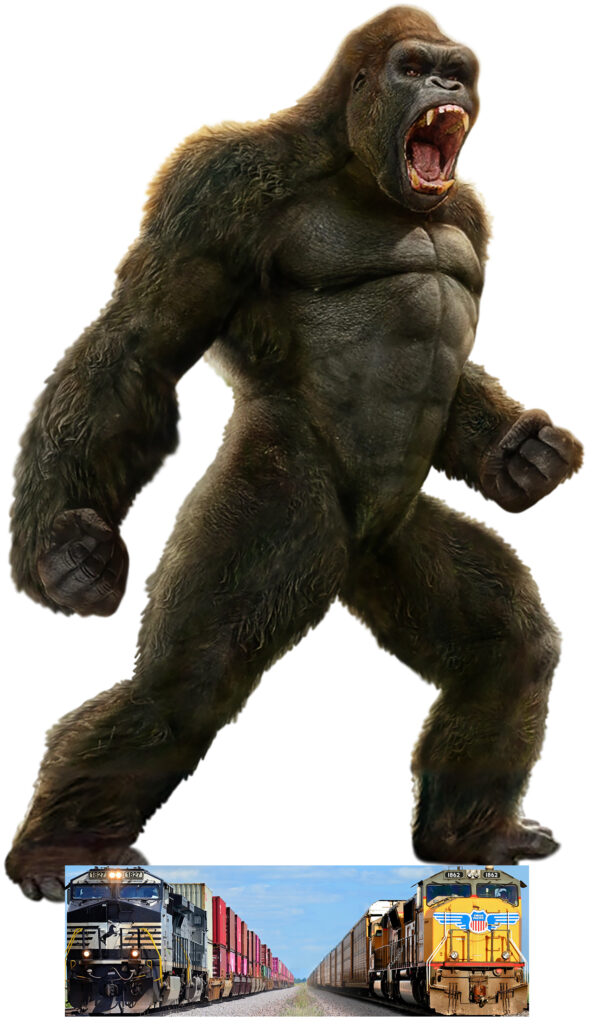
Why does size matter in rail? Rail is an interesting business model—part transportation, part utility and part real estate. The resulting contiguous franchise and market reach is what matters: which routes, to which markets connecting which origins and destinations without head-to-head rail competition. How many closed options can be provided to customers? UP-NS left unchecked will go beyond dominant in terms of extracting price from customers, long-term. Intelligent and financially motivated professionals at the new organization, left unchecked without new guiderails or ceilings, will leverage every element available to them to pull as much profitable business onto their network and extract as much price from other business to fund it as they can. Little jump ball business will remain at competitive returns on CSX or BNSF. UP will extract price at above market levels. Ultimately U.S. consumers will pay the price. Why? Lack of adequate direct rail competition.
What is competition? Competition is crucial in business because it drives innovation, forces efficiency and keeps prices competitive while improving product quality. It acts as a catalyst for excellence, encouraging companies to differentiate their offerings, enhance customer service and adapt to market changes. Ultimately, competition benefits businesses and consumers by ensuring better value and greater choice, and preventing complacency.
I recently moved from Omaha to Bucks County Pa. I RFP’d my move to four competing moving carriers. I evaluated their proposals, their people and their processes and chose a mid-priced provider. United Van Lines did a great job. Be it the Super Bowl, the recent Winter Olympics or my move from Omaha, competition brings out the best outcomes in most elements of business and life.
My point? I can’t do that as a carload rail customer. In most carload cases (~80%), I’m “closed” (captive) to one railroad, the only company in town free to charge what they want, provide me whatever service they deem adequate and perform when it suits them best. Welcome to railroading. People understand what the term being “railroaded” means in our culture. It’s well-earned. Without adequate rail competition, we get where we are today with an unhealthy rail industry whose only path to growth is to consolidate and further reduce competition.
In 2010, at the beginning of the domestic intermodal turnaround, we transitioned our messaging at Union Pacific to the “competition is trucks, not rail.” Though there was some signaling to other railroads in that message—”we aren’t investing in our intermodal franchise to come after your business”—the truth is the intent was to grow the entire domestic rail intermodal market, not just on UP. All the railroads adopted some form of this positioning by 2013. And business was good until 2018, when the proverbial spigot filling the trough we all drank from ran dry. Penetration of truck share stopped. Why?
Early in my career in the UP finance department, there was a saying: “Pigs get fed, hogs get slaughtered.” While being a “pig” (taking reasonable profits) is acceptable, being a “hog” (excessive greed or overextending) leads to deadly outcomes. From 2003 till about 2018, 80% of the Class I railroads’ value growth came from pricing, and the ability to extract price from the market. For the sake of completeness, 10% came from volume growth and another 10% from operational efficiency. Pricing, and the ability to extract price from customers because they have no alternative, has rewarded the rail industry financially in the short term but led to a position where we are today: Prices are too high, and businesses aren’t converting to rail.
Based on recent real-life scenarios, rates for closed carload and intermodal lanes are on average 25% to 100% higher than lanes open to two or more rail carriers. The rail industry has beat the price drum so hard that business is moving away from rail. Though all business doesn’t need to be open to benefit, there needs to be meaningfully more direct rail competition than today.
As the railroads have gotten to the point of the four mega-systems we have across the U.S., prices continue to rise while local service has never been worse per shippers and receivers. Yes, “over the road” service in the post-PSR world hasn’t been better. But local service, once 5-6 days a week, is now 2-3 days a week and more difficult and expensive than ever for customers using rail. Rail competition would enable competitive pricing, better service, and rail organizations designed to put new business on the rails and not simply hit the easy button of “how much price can I extract before my customer is incented to put together a $2 million rate case?”
But what about Committed Gateway Pricing (CGP)? The merger application says CGP will enhance competition. CGP is a disingenuous way to maintain competition at best. To be clear, CGP does not in any way enhance competition. A deeper dive on CGP and how it falls short in maintaining competition will be addressed in Part 5.
We’ve had three years of stagnant truck rates, while rail rates increased at above-inflation levels. The North American rail industry has not grown since 2017 and has consistently lost share to truck and other modes since 2018. Why? I offer there’s not enough intrarail competition nor enough affordable oversight by the STB. Customers don’t have enough options. Railroads have too much leverage. Customers have been bitten by years of irregular service reducing their competitiveness, faced unchecked rail pricing vs. competitive rates in other modes, and are faced with one of the most non-customer-friendly transportation business processes.
Railroads have significant market power. Many would argue, eloquently, too much. The railroads can’t self-correct when they get out-of-market on prices. The feedback loop is 3-5 years for a captive customer to move away from rail. Lost business to price is not seen or is dispensed as noise as the leadership team works to secure this quarter’s earnings, so they retain their jobs. Checks and balances were to be put in place with the STB. Many argue the STB hasn’t acted enough, given the industry has stalled out on growth. STB rate cases are too expensive for customers to argue against a railroad’s incentives and therefore the railroads’ sizeable investments in legal departments to not lose them. Ultimately, the railroads have gotten too big. Now, the industry wants to make an even bigger railroad.
Rail is a precious commodity, and the benefits of rail (e.g. transportation savings, access to capacity, environmental benefits and better jobs) are without dispute. Generating new rail competition is critical for this industry to alter its course. Adding competition through reciprocal switching among the Class I’s, like in Canada with interswitching, could make this transaction a win-win for all parties. Regardless, we can’t keep doing the same thing and expect a different outcome.

Rob Russell, Managing Partner, Russell-Kroese Partners (RKP), is a seasoned transportation executive who operates fluidly from the boardroom to the shop floor. A certified six sigma black belt and a LEAN champion, Rob is a proven business leader who has a track record of strategy development, financial planning, business development, operations and performance management to accomplish an organization’s desired goals. RKP partners with railroads, ports, shippers and land developers on growth strategy, market development, competitive positioning and operational execution. They help clients translate complex transportation dynamics into clear, execution-ready business decisions. You can learn more about RKP at www.russellkroese.com.




