
We heavily scrutinize operating metrics during, and on the back of, the four major public holidays during the year (Memorial Day, Fourth of July, Labor Day, Thanksgiving) due to the beneficial network effects from these volume-light weeks. It’s a volume pressure reprieve for any networks that are struggling, and the ability to work down backlogs and reposition power and crews usually sets up a further slingshot effect in the week following the major holiday. In the most recent case, the volume-light Fourth of July week ended July 5 and the slingshot week ended July 12. How did they do?
Mixed in The West
Union Pacific and BNSF had a clean Fourth of July week but were then hit with Hurricane Beryl, which flooded Houston on July 8th, and BNSF suffered a Transcon derailment in Oklahoma on July 11, further impacting its slingshot week. The data bears this out, with Union Pacific accelerating by 0.9% during Fourth of July compared to the week prior, and another 1.7% in the subsequent slingshot week. Handy numbers, but remember this is in the context of network velocity prior to the Fourth that was barely above its five-year low.
BNSF did better during Fourth of July week, accelerating 2.8%, but was of course stymied by the Oklahoma derailment, pushing average train speed down 1.2%. Still a net gain, however (+2.8-1.2%).
Killed It in The East
In stark contrast, Norfolk Southern and CSX were able to leverage the seasonal pattern much more effectively. NS pushed velocity 3.7% higher during Fourth of July and another 5.5% in the slingshot week, ending on the 12th. The last time NS ran this fast was in September 2020. CSX also broke out from a lower velocity glide path in prior weeks with a 2.4% acceleration during the Fourth of July and another 3.9% last week. CSX is now running at a six-month high.
“A Faster Network, if You Can Keep It.”
The rail version of the famous Ben Franklin quote, and the obvious point is that none of this matters if the gains in speed and asset turns all promptly unwind. It’s normal and expected that most of the holiday-related gains are given back, but the better operators are often able to lock in and maintain some portion of it (NS did exactly that with Memorial Day).
BNSF—Another Outage on the Southern Transcon
Late afternoon on July 11, BNSF suffered another outags on the Southern Transcon, linking LA to Chicago, this time due to a derailment in Oklahoma. There’s only modest damage to the full system operating metrics for the week ending July, which also includes the impact of Hurricane Beryl on July 8, but it remains to be seen whether this latest Transcon outage will have domino effects into the reporting week ending July 19). We’ve found ourselves writing about the Transcon a lot in recent months, so let’s look at the recent incidence of outages for some perspective. As a reminder, the Southern Transcon is basically BNSF’s backbone route that touches about 40% of all traffic, and when something goes wrong, train backups quickly exceed 200 and domino effects impact another ~10% of the traffic. It’s the critical route for BNSF.
The chart below shows outage history back to the start of 2023. The vast majority of the Transcon is double track, so when an incident occurs the usual pattern is for both tracks to be knocked out of service, and then one will typically be restored before the other. The orange columns in the chart show the first/worst scenario, with both tracks out, and the black columns the subsequent bottleneck state where one track is open but the second hasn’t yet been restored.
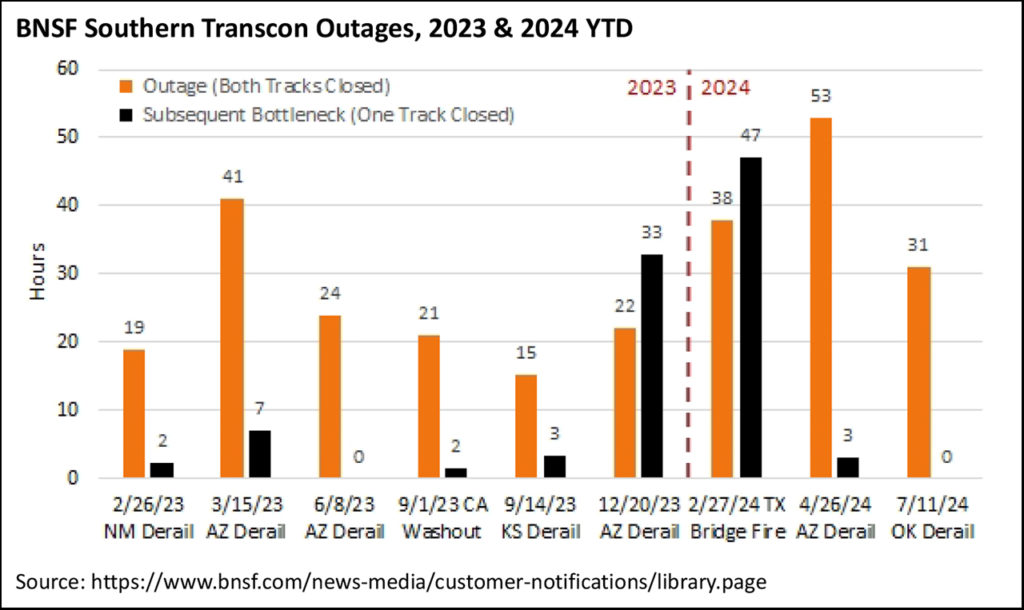
There were six significant Transcon outages in 2023, and so far in 2024, we’ve had three. However, 2024 is proving much tougher when you tally up the hours. So far in 2024, total outage hours are already at 122, which is 86% of the 2023 total of 142, and bottleneck hours of 50 already exceed the 2023 total of 47. We’re on track for a materially more challenging year. We’ve also had an unusually tough time since December last year, with an Arizona derailment—two month break—Texas Bridge Fire—two month break—another Arizona derailment—2.5 month break—Oklahoma derailment. We’re averaging a significant outage every two months, which makes railroading extraordinary difficult.
BNSF is, of course, laser focused on the Transcon and has been proactive in hardening infrastructure, including things like track raising to reduce flood risk, and more creative efforts like bridge wind fences. However, as you can see at the bottom of the chart, it’s the derailments that are the primary problem, accounting for seven of the past nine outages. The other two were a track washout due to Tropical Storm Hilary in California last September and the Texas Panhandle wildfires that took out a bridge in late February. As usual, let’s hope for a clearer runway going forward. PLEASE




