
Canadian Pacific Kansas City’s 2024-2025 Grain Service Outlook Report, which outlines the railroad’s grain transportation plan for export to international markets, notes that, “based on current forecasts, we expect a return to more typical demand for grain transportation this crop year. CPKC is once again well positioned to transport Canada’s grain crop to market.”
Key highlights:
- “On June 20, 2024, Agriculture and Agri-Food Canada (AAFC) estimated the total size of the upcoming crop to be 94.372 million metric tonnes (MMT), with a crop in Western Canada of approximately 71 MMT. Our grain customers currently estimate Western Canadian crop yields at a higher level than AAFC, with most customer estimates now in the high 70 MMT range.
- “Precise and accurate demand forecasts are critical to CPKC’s resource planning. CPKC is working with our grain customers to obtain a firm understanding of their specific demand forecasts for the upcoming crop year so that we can effectively plan capacity on the railway across all lines of business. Creating or shifting railway capacity takes time and cannot be done in a short period of time in response to dramatic shifts in customer demand. Large variability in grain transportation impacts the supply chains of other commodities.
- “A potential work stoppage on CPKC’s Canadian rail network involving the TCRC threatens the performance of Canada’s grain supply chain this upcoming crop year, particularly if it occurs in the lead up to or during the fall grain harvest. On July 12, 2024, the CIRB advised CPKC that it intends to issue its decision on the federal Minister of Labour’s referral regarding maintenance of activities by August 9, 2024. This development helps provide some predictability regarding the timelines for a potential work stoppage because the parties cannot legally strike or lockout prior to the CIRB issuing its decision. In any event, a legal strike or lockout would require a minimum of 72 hours’ notice, subject to any extension of the cooling off period ordered by the CIRB.
- “Based on our understanding of current customer forecasts, and subject to market demand, CPKC plans to supply the capacity required to move up to 685,000 metric tons (MT) of Canadian agricultural products on average each week when the Port of Thunder Bay is open (generally from August through early January, and from April to July). During the winter months when the Port of Thunder Bay is closed, CPKC plans to supply the capacity required to move up to 525,000 MT of Canadian grain and grain products on average each week, subject to market demand.
- “If the grain supply chain uses this available weekly capacity effectively, then CPKC expects to supply the capacity required to transport nearly 34 MMT of Canadian grain and grain products throughout the crop year, subject to market demand. This performance target is contingent on all elements of the supply chain, including grain customer terminals, ports, and vessels, operating with maximum efficiency, reliability, predictability, and balance throughout the duration of the crop year. The railway is only one part of a complex, integrated grain supply chain. The supply chain is only as strong as its weakest link.
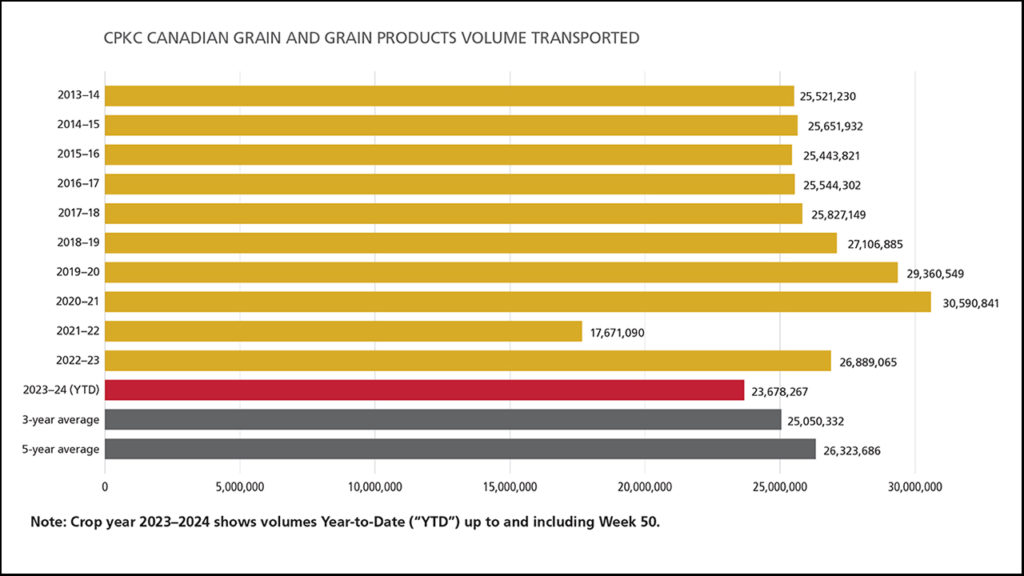
- “Unused rail capacity for grain transportation was a key feature of the 2023–2024 crop year. In fact, more than 8.8 MMT of capacity for Canadian grain transportation on the CPKC rail network went unused during this past crop year. This equates to approximately one quarter of the capacity CPKC had available relative to the supply targets outlined in last year’s grain report. Capacity cannot be saved up and used later; capacity unused in the week it is available is lost capacity that cannot be recovered.
- “There are several factors negatively affecting Canada’s ability to maximize the export of Canadian grain and grain products. These include labor instability, the resurrection of Extended Interswitching, and the decision by many terminal operators to suspend grain loading onto vessels in inclement weather at the Port of Vancouver. The federal government can show leadership by addressing these key, avoidable constraints on the overall performance and export capacity of Canada’s grain supply chain.”
“CPKC is dedicated to, and excels at, safely transporting Canadian agricultural products for export to global markets,” Keith Creel, CPKC President and CEO, said in the report. “Safely moving Canada’s grain has been part of our DNA since 1881, and it remains a key part of our franchise today. CPKC is strongly committed to our Canadian agriculture customers. We look forward to safely transporting Canada’s grain crop for export to global markets during the upcoming 2024–2025 crop year.”




