Following weeks of feverish analysis and speculation, most of it second- and third-guessing, after Union Pacific and Norfolk Southern formally announced their betrothal, Canadian Pacific Kansas City (CPKC) has declared it “is not interested in participating in immediate (emphasis mine) rail industry consolidation, despite suggestions by some that it take part. CPKC does not believe that further rail consolidation is necessary for the industry as currently structured.”
Conceived and assembled as the only transnational single-line railroad, CPKC stressed it “remains focused on delivering more of the benefits and unique value-creating opportunities of its three-nation network, which connects shippers in all parts of North America via effective interline service options. CPKC strongly feels, given what the existing competitive landscape has shown it can deliver, any major rail merger poses unique and unprecedented risks to customers, rail employees and the broader supply chain. Those risks would be exacerbated by the inevitable follow-on consolidation.”
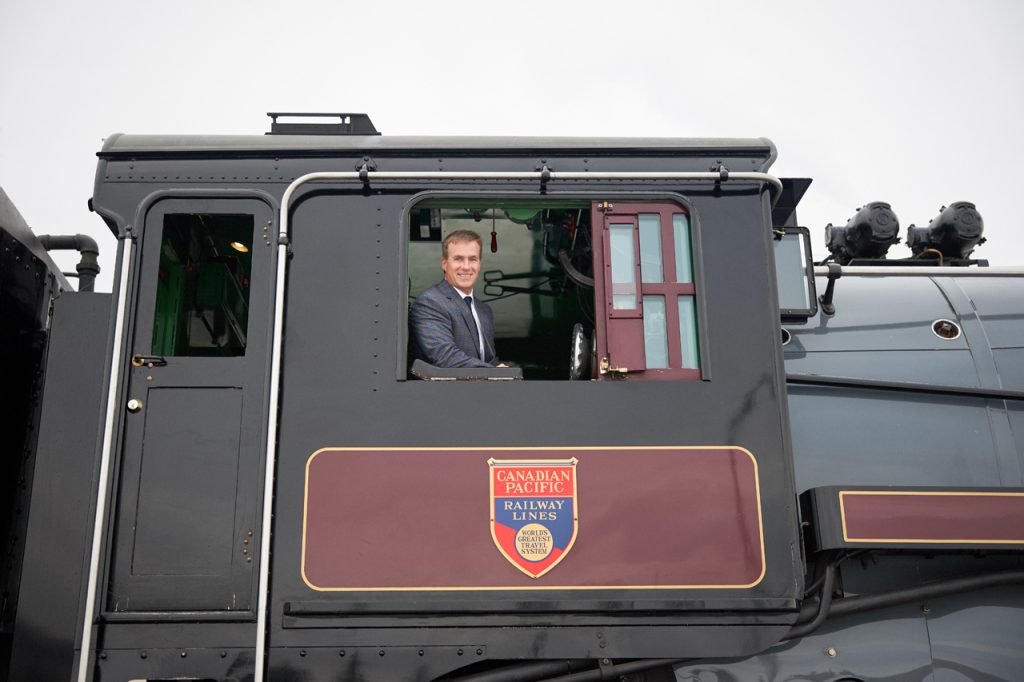
CPKC President and CEO Keith Creel, who stated his railroad would be “the loud voice in the room,” remarked that “a transcontinental merger would trigger permanent restructuring of the industry and result in a disproportionately large railway whose size and scope would require others to take action. This will likely result in an unnecessary wave of railway mergers that today is not the best way to support [U.S.] businesses nor the public interest and has the potential to create more [problems] than it solves.”
“UP+NS,” an industry observer opined to me, “is an acronym for Unnecessarily Predominant Network Structure.”
The existing six U.S. Class I’s “are capable of offering their customers high quality and near-seamless transportation services across the continent,” CPKC said. “As evidenced by previous rail network alliances by CPKC and CSX in the Southeast U.S., as well as the recent alliance announced by BNSF and CSX (and Warren Buffett’s assertion that Berkshire Hathaway is not interested in acquiring CSX), there remain opportunities for further cooperation between ‘willing’ railways to improve service while preserving optionality for shippers. Many of the kinds of benefits asserted in support of transcontinental mergers can be achieved through new and expanded industry partnerships, customer service innovations and additional cooperation among railways. CPKC continues to pursue these opportunities, such as its recently announced collaboration with CSX on the Southeast Mexico Express service linking the U.S Southeast to Mexico.”
The existing U.S. rail network “has the necessary capacity and operational fluidity to safely drive many years of service improvement, volume growth, truck conversion and resulting value creation for the nation’s rail shippers in support of the national economy,” CPKC concluded. “The public interest is best served by the nation’s railroads focused on delivering reliable, ‘truck-like’ service while investing in their networks to increase U.S. rail network capacity required for sustainable growth, rather than pursuing additional rail consolidation in an industry already greatly consolidated.”
So, what’s the unspoken message here? Is it “We will openly oppose UP+NS”? Or “We won’t openly oppose it but will make damn sure it either 1) doesn’t hurt us or 2) gives us some advantages”?
Yet, in my pointy little head, if UP+NS does get approved by the STB, why would any of the remaining four Class I’s be “required” to combine, in one way or another? Who would be holding a rivet gun to their heads? Shareholders? Maybe. Activist investors? Of course, provided they can gobble up enough stock. Certainly not customers, especialy those who would become captive shippers almost overnight. Definitely not agreement employees.
Our industry is not ready for the “Association of American Railroad.” At least not yet.
Let’s consider the rail industry from the perspective of a homeowner with a lawn, flower beds and vegetable gardens. I speak from personal experience. If my wife and I want our lawn to consist of just one type of grass, with a uniform appearance, 100% weed (especially crabgrass)-free, we would have to spend gobs of money, year after year, paying a landscaper, and accepting use of environmentally damaging chemicals like herbicides and pesticides. It might look nice, but the “stakeholders”—the variety of flowers, the fresh vegetables, the beneficial insects that pollinate everything, the birds that build nests—in the long-term, suffer. Instead, by choice, our home’s outdoor environment has a lawn full of clover. The grass has a few patches that don’t match—but it’s all green. Honeybees, bumblebees, butterflies (including migratory Monarchs) and hummingbirds abound. We’ve got a couple of chipmunks, and at least one rabbit. Yeah, the weeds (like hedge funds) try to invade, but with a little effort, we keep them at bay. As soon as they’re spotted, we yank them out with a special hand tool that doesn’t disturb the surrounding fauna, and toss them in the garbage. Our grass is doing well (it’s not the kind you smoke, in case you were wondering).
My point: Nature thrives with biodiversity. Why should business, of any kind, be any different?
Contrarian or concurring opinions welcome! You know how to reach me.