

RAILWAY AGE, JANUARY 2024 ISSUE: How a concept became an innovative new service, thanks to synergies created by CPKC’s transnational network.
Canadian Pacific Kansas City (CPKC) predicted at its 2023 Investor Day that the then-newly formed single-line transnational railroad would by 2028 generate $250 million of synergy revenue growth from its automotive business. “We’ll hit that number in 2025, three years early,” says Jonathan Wahba, Senior Vice President Sales and Marketing. That quarter-billion dollars is a sizable chunk of the overall nearly $800 million in merger synergies CPKC expected to achieve by fourth-quarter 2024.
An innovative new service, Automotive Closed-Loop, is helping drive this growth. A recently opened finished vehicle compound at Wiley Logistics Park, Wylie, Tex. (near Dallas and originally opened by Kansas City Southern in 2015) helps anchor the closed-loop service for finished vehicles among Canada, the U.S. and Mexico. Wylie is part of CPKC’s overall $275 million in capacity enhancements between Chicago and Laredo, Tex., among them the just-completed Patrick J. Ottensmeyer International Railway Bridge, the new second span crossing the Rio Grande linking Laredo with Nuevo Laredo, Tamaulipas, Mexico. Its name honors the last President and CEO of Kansas City Southern, who died in July 2024.
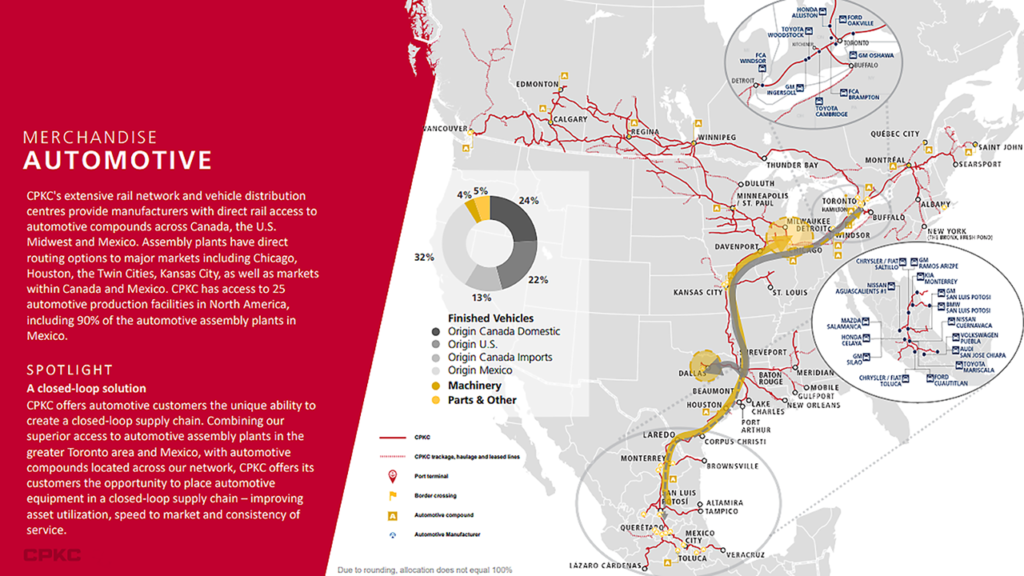
“This compound is part of our playbook that unlocks an entirely new supply chain model for the OEMs, giving them the service, reliability and capacity certainty they’ve never seen before,” said CPKC Executive Vice President and Chief Marketing Officer John Brooks at the railroad’s 1Q24 earnings call. Wylie now provides a destination for vehicles shipping out of Ontario, Canada, rather than shipping them to Chicago, as was done previously. It also enables empty autoracks to reach Mexico. Loaded autoracks that used to terminate at Laredo or Robstown now go to Minneapolis/St. Paul or Canada, offering “significant, accretive incremental improvements,” President and CEO Keith Creel notes.

The Automotive Closed-Loop concept began to take shape pre-merger. “My team and I, and John and Keith, were talking to customers about the merger, what we hoped to do with the new company, and about the products and services we intended to introduce, which we had filed in our STB application,” recalls Wahba. “If you think back to that time in the automotive space, it was the tail end of the pandemic and the peak of the microchip shortage. There was this scenario where cars were selling at dealers over MSRP because of the supply crunch. Most car dealer lots in North America were bare. And whether it was the Americans, the Japanese or the Germans, everybody was backed up. It was a global phenomenon.”

Fast-forward to April 2023, when the CPKC merger was finalized. “We had control of the KCS, and we were making those same customer rounds,” Wahba explains. “One of the first customers we saw was General Motors—and it was an unpleasant meeting. GM said to us, ‘We’ve got finished vehicles on the ground in Mexico we can’t move. What are you going to do to fix it?’ It was a crisis situation, because on day one, being realistic, there was more demand than we were able to provide service for. Just because we came along as the new owners of KCS didn’t mean we had a fleet of autoracks at our disposal. The question was, what are we going to do differently with the new network that wasn’t possible with CP and KCS as separate companies?”

CP had already been serving GM’s plant in Oshawa, Ontario, through joint access with CN, hauling vehicles to Buffalo, Detroit and Chicago. “That’s as far as we would take them, and we’d interchange with one of the U.S. Eastern or Western roads for transport to the markets where those products were consumed,” says Wahba. “Our concept for GM: With our new network, we can haul vehicles as far as we can, all the way to Texas. For example, the longest length of haul the new CPKC network would provide for someone buying a Chevy Silverado was now Dallas or Houston. Pre-acquisition, we took it to Detroit or Chicago, gave it to the Union Pacific, which took it to Dallas. We told GM, if you give us that business all the way to Texas, we will guarantee that we’ll take that empty railcar across the border and give it to you in Mexico. At the time, our demand in Mexico was double our supply. So, if every week we had a couple thousand autoracks of car supply, the demand was double—and that was GM, Ford, Stellantis (Chrysler), Nissan, Honda, everybody.
“KCS didn’t really have a strategy for how to handle that situation. How do you decide whom to give railcars to? If I’ve got 200 passengers at the gate and 100 seats on my airplane, who gets on and who gets bumped? And so it was really a ‘spread the pain’ approach. Do the best you can.”
CPKC took “a totally different approach,” Wahba says. “For anybody who could give me a southbound load from the north, we will guarantee you that railcar into Mexico. That really was the genesis of the concept.”
Then, the bigger question: How to operationalize it? “That was a lot harder because we didn’t have a compound in Texas to land the vehicles,” explains Wahba. “It took us the better part of 2023 to negotiate an agreement with GM on how we would do this. Now, we use the term “closed-loop” because everyone can get their head around it. We’ll move a train of product from GM in Oshawa to our new Wylie compound, where we’ll empty it, and route it to one of GM’s Mexican factories. It comes back loaded. Some cargo goes to Texas, some to Kansas City, some to Chicago, some to Minneapolis/St. Paul, some to Canada.”
The autoracks are traditional bilevels running in TTX pooled service, “free runners” that handle 40% of CPKC moves. “We can play pitch and catch with ourselves,” notes Wahba. “We’re still 60% reliant on TTX for a one-way move, so if we pick up a load of vehicles in Mexico that are destined for Denver, we’re still doing what we did before. We’ll go from Mexico to Robstown or Corpus Christi and inter-change with BNSF or UP. We obviously don’t go everywhere, but we can execute this operating model where it works.”

More opportunities could present themselves in the near future. Southern Ontario has the biggest node of OEM assembly plants on the North American continent outside of Mexico—GM (Oshawa), Toyota and Lexus (Cambridge and Woodstock), Honda (Alliston), Ford (Oakville, now closed for retooling) and Stellantis (Brampton, also closed for retooling). In Windsor/Detroit, there are several legacy American OEMs that CPKC can access. Ford and Stellantis are CN-exclusive, but both plants, when open, will truck or drive vehicles to CPKC’s Scarborough facility for loading and rail transport.
“If you look at our footprint, we can access seven plants in Ontario, 18 or 19 in Mexico,” Wahba points out. “That gives us a good base at both ends of our network to play pitch and catch. We were able to capture some traffic from our competitor’s exclusive factory access because CN now has the situation we had prior to the merger. We’re enthusiastic about the opportunities because even though all the other railroads have good origination destination networks depending on where they reach, none have access at both ends to OEM plants. In the world of negotiating with automotive manufacturers, the railroad with the best access to the plants wins because the most important thing to the OEMs is building their vehicles, getting them off the lot, and getting them to market. Our role, our importance, in the relationship is based on servicing their plants.”





