According to CN, the fundamental changes that the railroad made to its rail operations and planning in spring-summer 2023 to effect improvements in operational performance delivered the desired results.
These changes included increasing the frequency of internal coordination and planning calls to enhance the impact of changes that CN made to its operations plan this past spring and summer, and ensuring it had the right level resources in place, including recruiting and training conductors.
CN says it was “disciplined when challenged with extreme weather conditions,” and its focus on “ensuring that local rail service was adjusted to match the capacity of the mainline network to accept that traffic during periods of extreme weather was key in allowing network productivity to recover much more quickly at the end of any prolonged period of widespread extreme winter weather.” Conservative early implementation of train length restrictions before extreme cold developed in the first place was also a key measure that supported a quicker recovery in velocity once extreme cold conditions eased, the Class I reported.
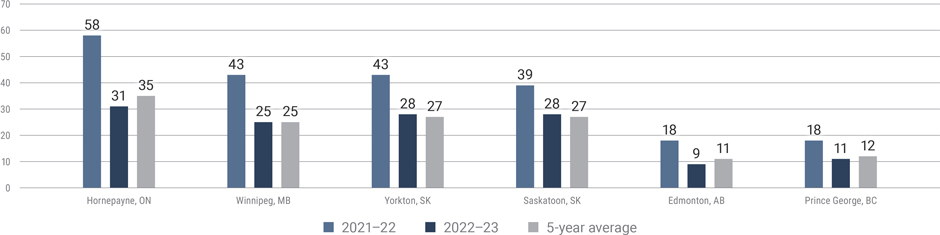
According to CN, the frequency of extreme cold weather (defined as -25°C or colder) was in line with average levels compared to winter 2021-22 when the frequency of extreme cold approached double of normal levels.
There were, however, several instances during winter 2022-23 of multiple days of extreme cold back-to-back. In the Prairies, for example, these periods were December 1-7, December 17-24, January 26-February 3, and February 20-25. Compared to when CN experiences one or two days of extreme cold, much longer periods of persistent extreme cold have a more pronounced impact on rail operations because the ability to recover is delayed that much more, the Class I said.
According to CN, there were no major mainline disruptions across CN’s western Canadian network, while a mainline disruption near Grafton, ON, on Dec. 24 halted on traffic on the CN Kingston subdivision. CN crews, the railroad says, worked around the clock in very difficult winter conditions to restore the track to a safe and usable state as quickly as possible, and operations resumed Dec. 27.
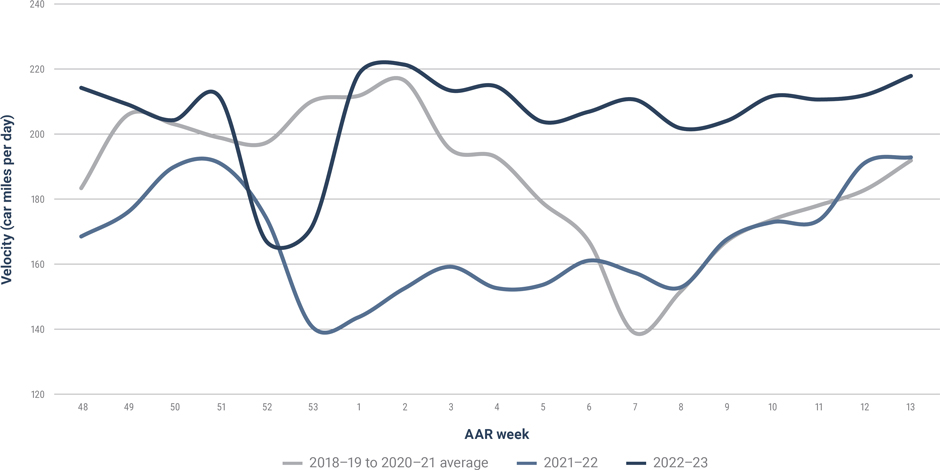
Velocity, CN reports, was resilient throughout winter 2022-23. Excluding late December, when multiple winter storms and persistent extreme cold weather affected Canada’s West Coast, the Prairies, the U.S. Midwest, and Eastern Canada all at the same time, average network-wide car velocity was in the 200 to 220 mile per day range. Notably, once extreme cold conditions abated after prolonged periods of extreme cold, CN says its network velocity recovered more quickly compared to previous winters. In fact, CN’s velocity this winter was on par with the velocity levels CN was achieving this past summer and fall.
Other key operational performance measures were also strong throughout winter 2022-23, CN reports, including industry train speed on the Canadian network, which was in the range of 25 miles per hour or higher throughout the winter, excepting late December. Industry terminal dwell was also consistently well below average levels.
“By taking the comprehensive, coordinated, and collaborative approach outlined in the 2022-23 Winter Plan, CN was as well-positioned as possible to meet the challenge of winter 2022-23 head on,” the Class I said. “The breadth of the integrated actions and the scale of the planning were designed to ensure CN was able to deliver the best possible service during the winter months. The foundation for the steps CN took was based on safety, delivering the best possible service, increasing network productivity, and improving resilience.”