According to the railroad, the plan builds on its “successful operational improvements and strategic capital investments” from the 2023-24 crop year. It was prepared in consultation with, and input from, key stakeholders, including the CN Agricultural Advisory Council, a group of western Canadian farmers and industry leaders.
The 32-page plan (download below) assesses and describes CN’s ability to move the anticipated levels of grain in the upcoming crop year, and outlines the steps the railroad is taking to ensure it has the capacity to move grain “safely and efficiently” on behalf of farmers, customers and supply chain partners.
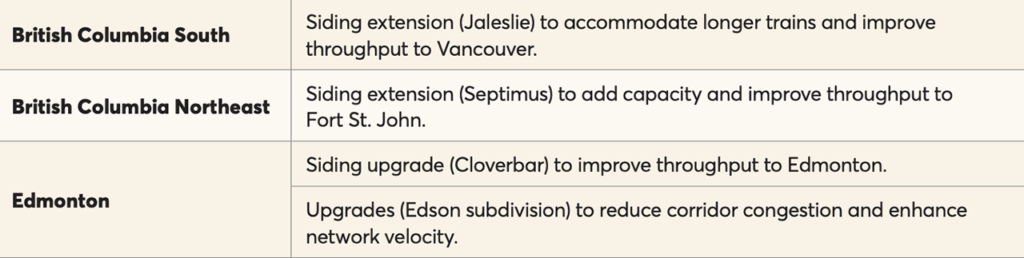
CN reported that among the factors affecting its overall rail capacity for the crop year are demand forecast accuracy, which helps determine short‑ and long‑term resource planning; resource planning, including infrastructure, crews, locomotives and rolling stock; weather; and “corridor balance.” According to the railroad, “the quality and timeliness” of hopper car demand forecasts vary significantly among its grain customers. Typically, it said, “demand planning less than 12 months out is focused heavily on operating crew base and locomotive fleet size.” Demand, it said, “is converted into train counts, which in turn is converted into crew and locomotive demand.” Longer‑term forecasts focus on rail infrastructure and network capacity, according to CN, which said it ”monitors traffic levels on individual sections of track and individual traffic corridors to help assess what additional track infrastructure is required.” From initial planning to completion, infrastructure investments “can take months or years, depending on the scale.” CN said it has invested into the network more than $15 billion between 2019 and 2023, with nearly two‑thirds of that investment going into track infrastructure and railway assets; for 2024, its capital expenditures are expected to increase slightly over previous years, to approximately $3.5 billion. New major rail infrastructure capacity enhancement projects in Western Canada expected to be in service in 2024–25 include:
CN also reported that it has “remained focused on reaching an agreement [with the Teamsters Canada Rai Conference]—which represents approximately 6,000 conductors, conductor trainees, yard coordinators and locomotive engineers across its Canadian network—that avoids supply chain disruptions and addresses crew availability challenges, while maintaining the safety of its employees.” At the time of the Grain Plan’s writing, CN said that it was awaiting a decision from the Canadian Industrial Relations Board (CIRB) regarding the Minister of Labor’s request for clarity on the continuation of activities during a work stoppage. “The CIRB has advised CN that they intend to make that decision by August 9, 2024,” the railroad reported. “Prolonged negotiations create uncertainty across all supply chains, including grain. CN will continue to strive for predictability for our customers and supply chain partners. As per Canada’s Labor Code, no work stoppage can occur until either party files the required 72‑hour notice after the CIRB issues its decision, subject to any extension of the cooling off period that may be ordered by the CIRB.”
Regarding weather, CN reported that “the extreme cold of a Canadian winter isn’t the only thing we can count on”; “heavy, persistent” rainfall occurs at Canada’s West Coast ports every year. “Like clockwork, every time it rains, grain movement slows down at terminals,” it noted. “However, rain is a solvable problem and wet weather should not impact modern grain terminal operations on the West Coast of Canada. Operational and infrastructure solutions to this problem are in place in the U.S. Pacific Northwest, which is an area with the exact same issue. Rain should not reduce supply chain capacity, especially in Vancouver where capacity is limited, and inefficient operations have a negative effect on the entire supply chain.” CN added that “the longer and more frequently conditions such as extreme cold or persistent rainfall occur, the more the supply chain’s ability to recover is reduced.” The railroad said it “continues to innovate and find ways to improve our ability to deal with severe weather events.”
Additionally, the Canadian Class I reported that the “key to fully utilizing the maximum end‑to‑end grain supply chain capacity is corridor balance.” Beginning in spring 2024, “this became more important as a major national infrastructure project, the expansion of the Trans Mountain (TMX) pipeline, was completed and began operation,” according to CN. The marine‑based export of petroleum products, it said, “will create increased levels of commercial vessel traffic in the Port of Vancouver, specifically in the Burrard Inlet where vessels (inbound and outbound) cross beneath the CN Second Narrows rail [lift] bridge.” CN said it is “monitoring TMX vessel traffic impacts [since under current rules, marine traffic has the right of way] and working closely with customers to maintain supply chain fluidity and maximize capacity.” CN said it is also “engaged with the Port of Vancouver and the government of Canada on this issue.” The goal, it said, is to “ensure that both rail and marine traffic can maximize their volumes.”
The following are among the new actions and initiatives CN reported for 2024-25 crop year:
- The delivery of 750 new high-efficiency grain hopper cars this crop year. (The railroad noted that its locomotive fleet “will be sufficient to move the anticipated volumes of Western Canadian grain shipped during the 2024–25 crop year.” Heading into fall 2024, CN said its inventory of high‑ and mid‑horsepower locomotives is expected to total approximately 1,950 locomotives.”)
- A “continued focus on scheduled railroading, which has produced demonstrated improvement since implementation in 2022-23.”
- Deployment of new firefighting equipment “to help protect the supply chain.”
- The use of “new technologies to improve safety, such as testing new mobile fire detection equipment and the continued use of CN’s autonomous track inspection program.”
2024-25 Crop Year Outlook
“Based on current estimates, projected movement of grain and processed grain products via carload on CN over the course of the 2024-25 crop year is projected to be 28.5 to 31.0 MMT [million metric tons], with grain shipped via container direct from Western Canada in addition to these volumes,” CN reported. “As forecasts inevitably change during the Western Canadian growing season, we will refine our assessment based on overall crop production and other market factors sourced in part from information collected by grain customers and other industry stakeholders.” CN noted that it moved more than 750,000 MT of grain direct from the Prairies via container during the 2023-24 crop year, and “expects that containerized grain shipments will continue to represent a significant volume of grain shipments in the upcoming crop year.”
CN said it anticipates delivering “strong performance for the upcoming harvest and beyond.” During the 2024-25 crop year, it is “well positioned” to ship up to 7,800 cars per week (up to 744,000 metric tons per week) of grain and processed grain products outside of winter, and up to 6,250 cars per week (up to 595,000 metric tons per week) of grain and processed grain products during winter. “These estimates assume all the conditions required to meet these levels across the end‑to‑end supply chain are in place, including corridor balance,” according to the railroad.
“We are confident that we have the right approach and resources in place to move this year’s Canadian grain crop efficiently,” CN President and CEO Tracy Robinson said during the Grain Plan’s release. “We continue to lean into our scheduled railroading model and making sure that our ongoing capital investments position us for success again this year. Working with supply chain stakeholders and governments, we are taking steps to address several regulatory issues impacting the sector, to remove obstacles so we can focus our attention on continuing to deliver even better service to our customers.”