NS
NS spends $1 billion per year on fuel—its second-largest expense after compensation and benefits. In the “Story Yard” section of its website, the Class I railroad shared these four strategies that are helping it to reduce fuel usage:
1. Upgrading the locomotive fleet. NS said it is “right sizing” its locomotive fleet to car volumes to reduce fuel consumption and increase network fluidity. The railroad is also aligning train-specific horsepower to tonnage to optimize each train’s fuel efficiency. “As we optimize our fleet across our operations, we are establishing a fluid network,” NS said. “This drives fuel efficiency by reducing stops while simultaneously providing consistent and reliable service to our customers.” Additionally, the railroad is upgrading its locomotive fleet with more fuel-efficient AC-traction motors. “These modern locomotives can pull more weight with fewer locomotives, creating greater fuel efficiency and improved train handling,” NS pointed out. “Over the past eight years, we’ve converted around 100 locomotives annually. We’re also supporting research into the locomotive of the future through investments in new propulsion systems.”
2. Advancing technology and processes. “We are moving our trains on time and achieving additional fuel savings using energy management hardware and software,” NS reported. “This technology is EPA-certified for fuel savings of at least 10%. Energy management takes into account the unique train makeup and terrain to develop optimum plans to safely achieve greater fuel efficiency. The technology takes detailed train information such as the consist position, the weight of cars, and train length to plan the train’s journey and meet our schedules. In June, around 60% of road train miles traveled on energy management auto control, an all-time high.” NS also continues to “focus on fuel efficiency instructions with the crews,” and said it is starting to monitor, in real-time, compliance with those instructions for shutting down locomotives on a consist that may be overpowered. “Coaching the crews on the importance of fuel efficiency technology and processes is on-going and will continue to evolve,” the railroad noted.
3. Reducing locomotive idling. “By using automatic start and stop technology, we’ve taken noise and emissions out of our communities by substantially reducing the number of locomotives idling when not in use,” NS reported. “Additionally, when unoccupied locomotives are not anticipated to be used shortly and weather conditions allow, the locomotives are shut down in compliance with our fuel conservation procedures.” Since June 2021, there are thousands of fewer idling locomotive daily hours, NS said.
4. Doubling biofuel consumption. Using biofuel blends instead of petroleum diesel reduces the amount of greenhouse gas (GHG) emissions per gallon, according to NS, which has more than doubled the amount of biofuels used from 2022 to 2023, with plans for expansion in the coming year. In 2023, NS used more than 8 million gallons of low-carbon fuels, it said. The railroad looks to “capitalize on opportunities to purchase low-carbon fuels when economically feasible.“
“Our success with reducing fuel consumption is due to close collaboration and alignment between team members from throughout Transportation, Mechanical, Engineering, Finance, Sourcing, and IT,” NS Director of Fuel Efficiency Jamie Helmer said.
“We are committed to building a better planet through comprehensive, year-round initiatives aimed at reducing the fuel consumption of our locomotive fleet,” added Josh Raglin, Chief Sustainability Officer at NS. “Every one of our efforts is specifically designed to achieve our GHG emissions reductions goals as we transition to a sustainable, low-carbon economy.”
In a related development, NS in January released its inaugural Climate Transition Plan. The plan, NS said, focuses in part on fuel management and consumption, all to help achieve its science-based target of reducing GHG emissions intensity 42% by 2034.

Meanwhile, NS recently reported participating in the Southern Economic Development Council’s (SEDC) Annual Conference, held in Savannah, Ga. “In the last year, SEDC members have helped secure $220 billion in new capital investments, creating a quarter million new jobs, and SEDC member states collectively represent the third largest economy in the world,” according to the railroad. “Norfolk Southern has been a ‘go to’ partner in this space for 130 years. In fact, the Southern Railway established an industrial development department in 1894, and our international presence followed shortly after, starting with an agent in London who helped European farmers settle in the South. Throughout more than a century of transformation, our industrial development efforts have always been anchored by two key principles: a steadfast commitment to our customers and partners and a site-centered approach.”
NS said that in 2023 it supported 35 “significant” economic development projects within SEDC’s membership territory, leading to the creation of 1,261 jobs and $75.9 million in investment.
“[O]ur pipeline of opportunities is strong with about 450 active projects and more than 800 available rail-served sites along our … network,” the railroad reported.
BNSF
BNSF on Aug. 2 provided customers with updates on operational performance, a new capacity and efficiency project, and service expectations:
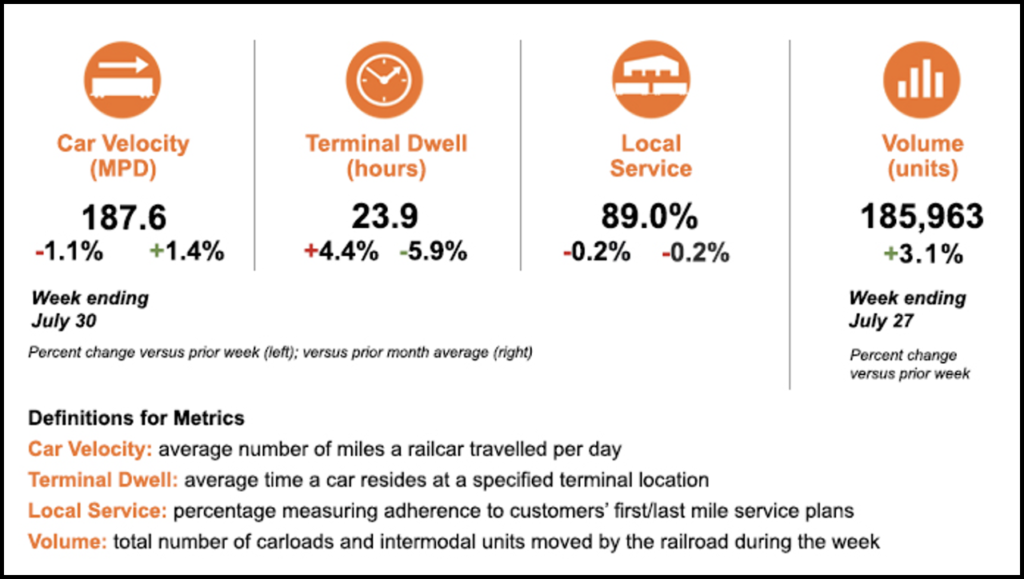
- Operations: “BNSF responded to significant weather-related service challenges that impacted normal train flows on our busy Southern Transcon route between Southern California and the Midwest during the past week,” BNSF told customers. “Our operations teams confronted extreme heat and wind disruptions on the central part of the Transcon, from North Texas across the Central Plains. High winds with gusts of around 75 miles per hour caused reduced velocity, with speed restrictions in some areas. BNSF’s wind mitigation procedures helped to reduce some of the delays caused by these extreme winds. Current mitigation efforts include wind fences in strategic locations across the network and utilizing AI wind collection data applications to better predict potential impacts and find solutions to continue to minimize impacts caused by high winds on the network. A power outage near our Lincoln terminal in Nebraska on Wednesday [July 31] afternoon, caused by storm activity in the area, impacted some merchandise traffic moving through the region. Despite this challenge, BNSF operating teams maintained good fluidity across our Northern Corridor.” Regarding key service metrics (see chart, top), BNSF reported that average car velocity, “while slightly lower than last week, has improved from last month,” and terminal dwell, “while elevated from last week, has improved significantly from June.” The Class I railroad added that its “local service compliance measure remains steady with last week and month.”
- New capacity and efficient project: BNSF crews placed into service two processing tracks, totaling about 40,000 feet, as part of a multi-year main line improvement project in Becker, N.Mex., adjacent to its Belen fueling facility. “Belen is a primary fueling, inspection and crew change location on our Southern Transcon for traffic moving between Los Angeles and the Midwest,” BNSF said. “It is also the single-largest fueling facility in North America, fueling approximately 25% of the total traffic moving on our network and dispensing approximately 250 billion gallons of diesel each year.” The two new tracks are slated to minimize the time it takes for trains to stop for fueling, inspections, and crew changes and get moving again toward their destination, which BNSF said will improve “fluidity and total train capacity through this busy section of the Southern Transcon by about 30%.”
- Service expections: “A heat wave is moving across parts of the Northwest, Southern California, and parts of Texas and Louisiana, where excessive heat warnings and advisories are in effect,” BNSF reported Aug. 2. “Flood watches may affect parts of the Southwest as monsoonal rains move through the area over the next several days. BNSF teams will monitor conditions closely, address any track washouts and quickly restore service through impacted locations. Seasonably high temperatures are expected in other areas of our network, and no other major weather events are expected.”
In other news, BNSF recently reported its second-quarter 2024 results. Excluding the impact of litigation costs stemming from a civil suit filed by the Swinomish Indian Tribal Community in Washington State, the railroad said its earnings and operating ratio “showed solid improvement.”