CSX
Through its Responder Incident Training (RIT) program, CSX in 2025 completed 75 training sessions and equipped 5,645 first responders with the skills and knowledge needed to handle railroad-related emergencies, the Class I railroad recently reported, sharing a specially produced video (see above).
The RIT program “provides first responders, emergency managers, and public safety officials with hands-on experience and critical insights into rail incident response,” according to CSX. Training is said to focus on rail equipment familiarization, hazardous materials awareness, and coordinated emergency response, which fosters “stronger preparedness and collaboration at the local level.”
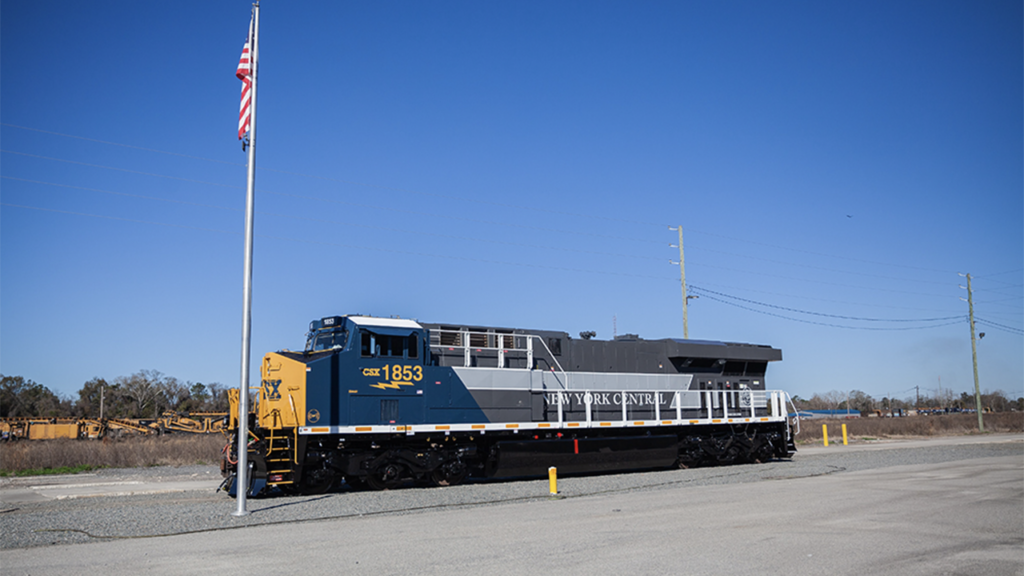
The railroad in 2025 it introduced a training locomotive, described as “a dedicated asset that provides first responders with realistic, hands-on learning opportunities.” The unit is said to help users better understand “locomotive systems and the challenges of incident response.”
“Safety is at the core of everything we do at CSX,” CSX Director of Hazardous Materials Joe Taylor said. “Through the RIT program, we’re proud to share our expertise and work alongside first responders to ensure they are well-prepared to protect their communities, our employees, and our network in the event of a rail emergency.”
In a related development, CSX TRANSFLO and the Beauharnois Fire Department recently held an emergency response drill in Quebec (see social media post below).
Further Reading:
BNSF

“Despite a year of unusual market dynamics,” BNSF’s agriculture business—from field crops to fertilizer to renewable fuels—wrapped up 2025 “with some notable achievements,” the railroad recently reported in the Rail Talk section of its website.
Corn volumes reached an “all-time annual record” and were the most since 2018, according to BNSF. “All-time annual volume records” were also broken for oil seeds/meals and ethanol.
However, “[n]o one could have predicted the trade situation that unfolded in 2025, especially with soybeans,” noted the railroad, which transports them annually from the heart of America to Pacific Northwest (PNW) export facilities. “For five consecutive months, no soybeans were exported from the U.S. to China, the world’s largest market. That hasn’t happened in at least three decades.”
While 2025 “was another great year for soybean production,” BNSF Assistant Vice President of Ag Products Marketing Matt White said, “without demand for soybean exports out of the PNW, the market needed to pivot on where soybeans needed to be shipped.”
Soybean export demand moved to the Gulf, according to the railroad, which shifted “a significant number” of shuttle trains south to the Gulf ports in September and October.
“Shout out to our operations team for handling these additional trains,” said Angela Caddell, BNSF Group Vice President of the Agricultural and Energy Business Unit. “This is way beyond what they would typically move, but they stepped up and handled the challenge extremely well.”
According to BNSF, PNW export demand resumed in late fall, and the railroad posted the highest number of PNW export deliveries in November and December since 2020.

BNSF also reported that more than a dozen new facilities opened along its lines in 2025. Among them:
- In Hager City, Wis., “[a] former rail-loading frac sand site was transformed into a rail-loading grain terminal, offering producers year-round access to our extensive network,” the railroad reported. “Operations began last spring, enabling ALCIVIA, a member-owned agricultural and energy co-op, to move grain even during winter months when other terminals are closed.”
- “In July, Central Valley Ag opened a new facility [in Courtland, Kans.] that includes a 3.5-million-gallon fertilizer plant and a grain shuttle with direct access to our rail network,” BNSF said.
- USD Clean Fuels in San Bernardino, Calif., in January 2025 opened a facility that handles renewable diesel, biodiesel and E85.
Further Reading:
CPKC
CPKC recently reported via social media that it is actively testing B20 biofuels in its locomotive operations. Ten AC4400s, powered in part by “plant-based fuel,” are running in the coal loop near Golden, B.C., it said.
“Since launching our pilot in 2023, these locomotives have completed over 2,750 fueling events and have used more than 25.5 million liters of B20,” according to CPKC.
The railroad, in early 2025, published a climate mileposts report (download below) that highlighted the British Columbia pilot, saying that it had successfully conducted “more than 1,100 fueling events” in 2024. “This initiative,” it said, “in cooperation with the broader rail industry, aims to validate the operational impacts of using advanced renewable biofuel blends.”
The report also noted that CPKC is “[m]aking significant strides with our pioneering Hydrogen Locomotive Program, which has swiftly progressed from initial movement trials to recording more than 6,000 miles in freight service testing by the end of 2024”; and is “[d]oubling the size of our hydrogen test fleet in early 2025 to include three additional locomotives and an added tender car; then adding further to this test fleet with four more locomotives planned for later in 2025.” (For more on the hydrogen program, read: CPKC Hydrogen Locomotive Program Creating Innovative GHG-Reduction Solutions.)
In January 2026, CPKC announced that having completed the purchase of 100 Wabtec Evolution Series ET44AC Tier 4 locomotives, it expects to take delivery of an additional 70 this year. The Class I also said it expects to take delivery in second-half 2026 of 30 new Progress Rail EMD® SD70ACe-T4 Tier 4 locomotives; they are part of an order for 65.