BNSF
BNSF on July 7 announced the recipients of its 2025 “Tracking to Zero” award, honoring five state departments of transportation (DOTs) in their shared commitment to improving grade crossing safety.
The Class I railroad recognizes Montana, Idaho, and Wyoming for the second straight year, as well as Wisconsin and Illinois, for averaging less than one grade crossing incident per one million BNSF train miles traveled in their respective states. Data reported in 2024 to the Federal Railroad Administration (FRA) confirms the findings.
The award, launched last year, “is a first-of-its-kind initiative to reduce grade crossing incidents across BNSF’s 32,500-mile network,” the Class I noted. “This year’s honorees demonstrate significant growth in BNSF’s shared commitment and dedication to safer communities in which it operates.” (In-person award ceremonies are forthcoming with/at each state DOT headquarters.)
“The momentum behind our ‘Tracking to Zero’ initiative is a testament to the power of partnership,” said BNSF Assistant Director of Public Projects, Rich Scott. “We’re not only celebrating the accomplishments of these five states—we’re also strengthening our commitment to help more partners join them next year.”
As an industry safety leader, BNSF says it relies on the communities it serves, as safety gains are better achieved by improving how drivers and pedestrians interact around the railroad tracks.
Examples of actions taken by the winning state DOTs to improve railroad crossing safety include, but are not limited to:
- Eliminating at-grade crossings/Installing grade-crossing separations.
- Enhancing signal systems and signage at existing crossings.
- Researching and piloting new crossing safety technologies.
- Utilizing both state and federal funding to maximize railroad crossing safety improvements.
- Prioritizing community education and utilizing land use planning and awareness campaigns.
- Implementing various measures to reduce railroad trespassing.
UP
UP’s Bailey Yard team in North Platte, Neb., recently hosted CEO Jim Vena and senior leaders for a field visit and employee town hall.
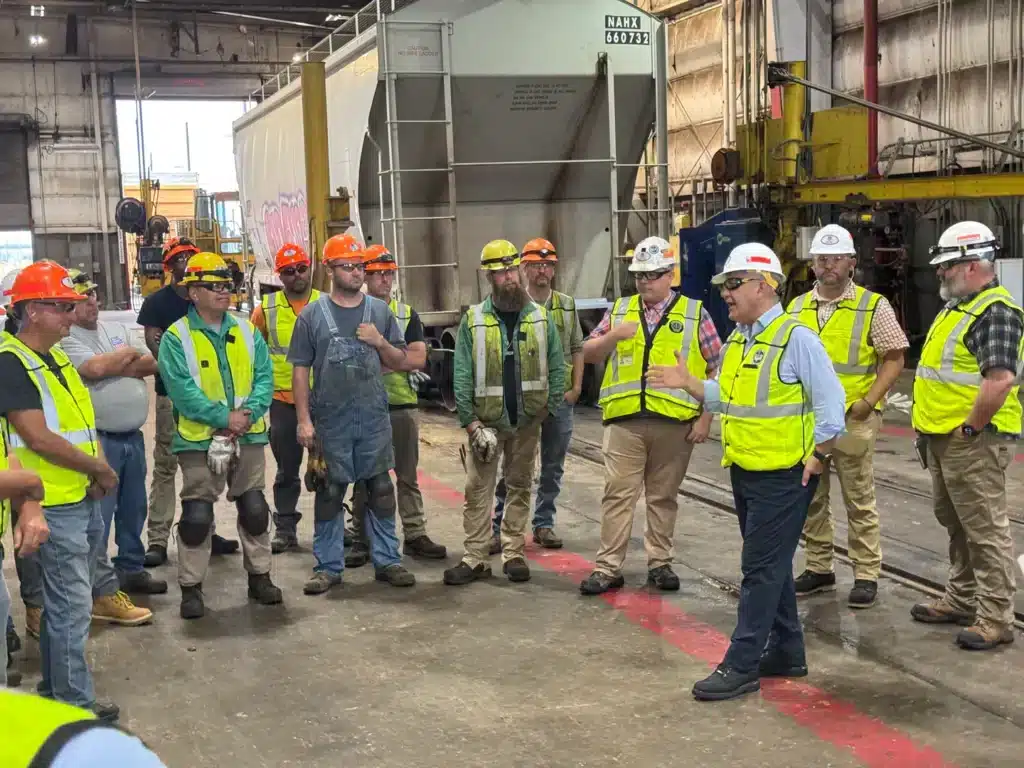
The leadership team had the opportunity to see the world’s largest classification yard in action, which covers 2,850 acres and handles approximately 10,000 cars daily. The visit included a tour of the yard; meetings with Engineering, Car and Locomotive department employees; and a lunch that featured a safety award presentation.
Located amid key east-west and north-south corridors, Bailey Yard is a critical part of Union Pacific’s network.
“If North Platte doesn’t work—if we don’t switch cars, if we don’t maintain the cars, if we don’t have Engineering fixing the place—this railroad does not work,” Vena said. “Everybody I’ve met is very proud of working here and delivering the goods.”
Vena reinforced UP’s vision is to be the safest railroad in North America, which Executive Vice President-Operations Eric Gehringer said it’s making progress toward.
“Let there be no doubt—that is our No. 1 job at Union Pacific,” Gehringer said.
The leadership team in attendance—which also included Jennifer Hamann, Executive Vice President and Chief Financial Officer; Rahul Jalali, Executive Vice President and Chief Information Officer; Kenny Rocker, Executive Vice President-Marketing and Sales; Christina Conlin, Senior Vice President, Chief Legal Officer and Corporate Secretary; and Josh Perkes, Senior Vice President and Chief Human Resources Officer—fielded live questions from the nearly 300 employees who joined the diesel shop town hall, as well as the more than 2,400 employees who joined virtually.
CN
In Quebec, lumber producers rely on rail to move wood chips to pulp and paper mills across the province. With CN’s fleet of 290 woodchip gondola cars nearing end-of-life, the industry needed a forward-looking solution, according to the Class I. “Few used cars were available on the market and the high cost of a new build put the forestry supply chain at risk.”

Rather than retiring the fleet, CN collaborated with the Société du chemin de fer de la Gaspésie (SCFG), named CN’s 2025 Short Line of the Year at our annual Short Line Conference, which purchased the aging railcars.
They have an ally on their lines: Rail GD, an Association of American Railroads (AAR) certified railcar refurbishment expert based in New Richmond, QC. Rail GD handles repair work for passenger cars like VIA Rail and the luxury Rocky Mountaineer. This strategic move, CN says, “will enable SCFG to refurbish and repair the cars, effectively extending their operational lifespan. These cars are now leased to forestry customers, securing reliable service for years to come.”
Together, SCFG, CN, and key customers found a sustainable solution to ensure the continued affordability and mobility of rail service in Québec, safeguarding 500,000 metric tons of annual woodchip shipments across origins like Parent, Amos, Matagami, and Nouvelle, to destinations including La Tuque, Masson, and Rivière-du-Loup. SCFG is now one of Canada’s largest woodchip railcar lessors, “strengthening regional networks and maintaining vital freight solutions for forestry customers across the region.”

“Our partnership with SCFG shows how collaboration can unlock long-term value for our customers. It’s a model of innovation, regional expertise, and supply chain resilience,” said CN Marketing Director, Industrial Products Massimo Carmosino.
This project is more than a fleet renewal—it’s about strengthening the supply chain and building local capability. Thanks to our partnership with CN, we’re helping forestry businesses grow and building a stronger future for Gaspésie,” said SCFG General Director Luc Lévesque.

In another example of local action, SCFG partnered with Cedrico, a wood products company, to restore rail service to Causapscal, QC. The plant had been disconnected from the network for more than a decade. SCFG quickly assessed the site to identify a cost-effective solution. Their team provided engineering guidance and developed a new track design to reintroduce rail service, with construction set for fall 2025. Also, to support this renewed service, Cedrico will use a subset of the refurbished woodchip cars to fulfill their equipment needs.
The project, CN says, “highlights how short lines like SCFG deliver tailored solutions to local customers. By listening, designing, and delivering, SCFG reactivated a critical logistics link to bring new volumes to CN’s mainline. It’s a clear example of how local railways connect regional needs to national infrastructure.”