RAILWAY AGE JANUARY 2025 ISSUE: Railway Age’s 2025 Railroader of the Year is CSX President and Chief Executive Officer Joe Hinrichs, who joined the railroad industry in September 2022 and in a little more than two years has made immediate and long-term positive impacts. His collaborative approach to labor relations—for example, CSX being the first Class I to offer paid sick leave and forge preliminary agreements with its unions prior to the start of national bargaining—has gone a long way toward transforming the dynamic between management and rail labor from adversarial distrust to engaged problem-solving.
Hinrichs firmly believes that for CSX to fully realize its growth potential, labor and management must function as one team, with mutual respect and trust. He knows that change is difficult, but he also knows it’s necessary. And as a long-time railroad customer in his prior role as President of Ford Motor Company, he knows the importance of providing good service. CSX’s overall excellent performance is a testament to that.
Joe Hinrichs—only the third CSX executive to be named Railroader of the Year (he was preceded by Michael Ward in 2009 and Hays Watkins in 1984)—will be presented with the award at the traditional dinner hosted by the Western Railway Club at the Union League Club of Chicago on March 11, 2025. He sat down with Vantuono at CSX’s Jacksonville, Fla., headquarters for this interview.

RAILWAY AGE: I’d like to be the first to congratulate you on being named our 2025 Railroader of the Year. You are the first from CSX since Michael Ward back in 2009 and Hays Watkins in the early days of CSX, so congratulations. Well deserved.
JOE HINRICHS: It’s nice to be recognized along with names like Michael and Hays Watkins, who are famous CEOs of CSX, but really, it’s about our 23,000 railroaders. I’m here to represent them. It’s kind of like a coach who gets to watch the players win on the field and sometimes the coach gets some accolades, but this is really about CSX and what we’re doing to try and change the perception of railroads and what our company stands for with all 23,000 of our railroaders.
RA: CSX, as you know, if you go back in history, dates to 1827. We have the 200th anniversary of the railroad industry coming up in two years. The Baltimore & Ohio and CSX are a big part of that celebration. CSX is made up of so many different railroads, all the predecessor companies. I won’t even start naming them, there’s too many of them, but it has always been, at least to my knowledge, to my experience, starting in 1992 with Railway Age, a difficult company to form one corporate culture. Since the Conrail acquisition back in 1999, you’re covering the whole Eastern seaboard, but we see real evidence of what you call ONE CSX, establishing that single corporate culture. As you said, it’s all about people.
HINRICHS: Our history goes back to Feb. 28, 1827, with the B&O, a famous railroad on the Monopoly board that we played when we were kids, but you’re right. Even our union contracts still will be referenced as B&O or L&N or CSRA or the southern part of the railroad. What we’re trying to do is get everybody on the same page, to be on one team and celebrate being a part of that team, and to be aligned in our goals and what we’re trying to accomplish, and for every employee to feel valued, appreciated, respected, included in what we do, and listened to. That’s why we do so many surveys. That’s why we’re out in the field every week. That’s why we do all the family days.
All those things are about bringing a team together. I’ve always said, the magic happens when people work together in teams to do great things. We’re trying to form this great team called ONE CSX to serve our customers better, improve safety, improve efficiency, bring about value for our shareholders, but it starts with the employees. Without them, we don’t achieve what we want to accomplish.

RA: There are several firsts that, really, you started, and the rest of the industry picked up, like the preliminary labor agreements. Well before that, there was the paid sick leave, which was something the craft people had really been wanting. Now, with these early agreements, and we’re not quite sure how that’s going to play out with national bargaining, changes are afoot.
HINRICHS: They are. It’s fascinating because when I came into this industry, most of the stakeholder groups were really disgruntled and unhappy, whether it was unions or government officials or regulators or customers, because of everything that happened post-COVID. There was also in many cases a resistance to change, but if you don’t change, you don’t make improvements. You don’t change, you don’t change the outcome. We stepped back and said, let’s listen to our employees and see what’s important to them. We listened to obviously our customers too, and we’ll talk about that later. Basically, it was a big deal. It became a cause célèbre issue at the end of the negotiations’ last round. Our view is, if it’s important to our people, if it’s important, let’s go solve this, find a solution. We worked very closely with many unions to make that happen.
Same thing with the national negotiations. What I and our team heard loud and clear coming out of the last round, which took three years, was very contentious. You know the story. They didn’t want a repeat of that. They don’t want three years of no raises. Even though they got it retroactively, that didn’t make them feel appreciated and valued. We went to the union presidents and said, if that’s how you feel also, which is what we’re hearing from our employees, then why don’t we go to work? Why don’t we find a solution? Why don’t we work on that to show our employees we are listening to them, that we do care about them. They are valuable, they are an important part of what we’re trying to do. Thankfully, most of our unions, 10 of 13, have already reached agreements with us for the national contract [as of early November 2024, when this interview was held]. Most of our employees are represented by that. There’s more work to be done to be sure. It’s a change and people are uncomfortable with change, but it’s the right thing to do to give certainty to our employees about what their raises are going to be next year and beyond and also get the animosity and all of that angst out of the system, so we can focus on serving our customers, improving safety, improving the efficiency of our network.

RA: It all works together. Coming from your background in the automotive industry, dealing with really one union, the UAW, you moved from one to 13 unions. Tell me about that transition because what you’re trying to accomplish is difficult.
HINRICHS: It’s very complex. Frankly, you have the interplay between the unions and then you have the 13. In some cases, it’s more than that because the way the structure works in the railroad industry is different than the auto industry. In the auto industry, you dealt with the UAW in the U.S. and UNIFOR in Canada. You dealt with the president and the vice presidents, and you reached an agreement and it kind of cascaded. The plants had their own local agreements, but they were done locally.
In the railroad industry, you have a lot of these situations where the general chairs—there are four general chairs, for example in our network for BLET or SMART-TD—have their own veto power when you’re not in national negotiations. They have their own deals, so it’s far more complex than anything we had in the auto industry. However, you can get to more meaningful local issues if you work together. Part of the goal here is to get the higher-level issues out of the way—wages, benefits, vacation, those kinds of things—so we can work on the things that mean something to our employees on their work-life balance, scheduling, safety, efficiency. We can work on those things for the next five years because we have the other stuff out of the way. That’s our objective, and I think we have an aligned objective with all the unions. But it is complex, and you have to deal with the interplay, and you try to treat everybody fairly because you don’t want to be able to say, well, you did this for somebody, not for somebody else, because all employees are valuable equally. That makes it harder, but certainly still worth the objective we’re trying to accomplish.

RA: Within that context of working together and the interplay among the unions and the different crafts, not everybody is going to get everything they want, but there must be at some level some sort of compromise. Kind of like a marriage. You may not always agree, but if you can sit down and communicate and say, okay …
HINRICHS: It’s called collective bargaining for a reason. You’re together collectively. I’ve found that for good or bad, I’ve had probably more labor experience than most. I’ve found that if you can develop relationships to the point where you listen to what the real issues are, you can find solutions if you work together hard enough to find them. That’s what we’re trying to do. If it’s important to our employees, it’s important to us. Now, you’re right: We can’t do everything, and the company needs to be more efficient. The company needs to be safer. The company needs to serve customers. But I don’t find that there’s a resistance to that. When you talk to people, they understand the business must be successful for them to be successful. What we’ve accomplished with the last round of bargaining and this round of bargaining, from 2020 to 2029, is our average railroad worker has a 50% compounded increase in wages for the same job. Where do you find that? That’s great. They earned it and we’re happy for them, but that’s the kind of benefits we can get if we work together. The important thing is about working together, listening to each other, not just speaking over each other. Finding solutions, like we did on paid sick leave. We came together, we compromised, and people were able to make that successful. That’s the objective: to develop those relationships to a point where we trust each other and can listen to each other. We truly believe that we can find a solution inside of that relationship.

RA: You know, Joe, literally at the end of the day, after you’ve put in a solid day’s work, railroading is hard work. I spend most of my time looking at a computer screen, but I’ve been out in the field, and I’ve seen, numerous times, people working on locomotives, putting spikes in, whatever. I think if they can go home at the end of the day, safely, to their families, they would feel, “I did something great here. My maintenance-of-way crew, we installed hundreds of ties or we put in so many miles of welded rail, or we completed an overhaul of a locomotive and got this beast up and running.” That’s satisfying.
HINRICHS: It is. First, it’s an outdoor sport and you’re in all weather conditions. It’s 24 hours, seven days a week, as you know, holidays, weekends, everything, so we have to give a lot of respect to our employees who are willing to do that work, and we need more and more of those people to come into our organizations. Railroaders are proud of what they do, rightfully so. They always have been, and they helped build this country. They’re fundamental to the economy. They’re the backbone of the economy. We want to make them not only proud of what they do, but how we do it and the team they’re on and the company they work for. That’s what we’re trying to do with ONE CSX, to bring people together and take that pride of what they do and expand it to how we do it as a team, supporting each other, helping each other, listening to each other, to serve our customers better, to grow the business. If we grow the business, a lot of good things can happen for our employees, especially if we do that profitably. It’s all about that focus. Celebrate those workers.
I tell people all the time in this company, every time I’m in a town hall, the value of our organization is created where the work gets done. We get paid for moving something from point A to point B. That’s the only thing we get paid for. We don’t build a product; we don’t sell consulting services. At one level, it’s hard. The people that move those goods from point A to point B should be celebrated, respected, appreciated. That’s where the value is in the company. Now, all the rest of us are here to help that to be successful, to be safe, to have customers, to have capital, to have accounting, finances that we can raise money, all those things, but we never lose sight.
That’s why I go out in the field every week. Never lose sight of where the value of the company is. It’s those employees in the field who move the goods for our customers every day, every hour, in all weather conditions.

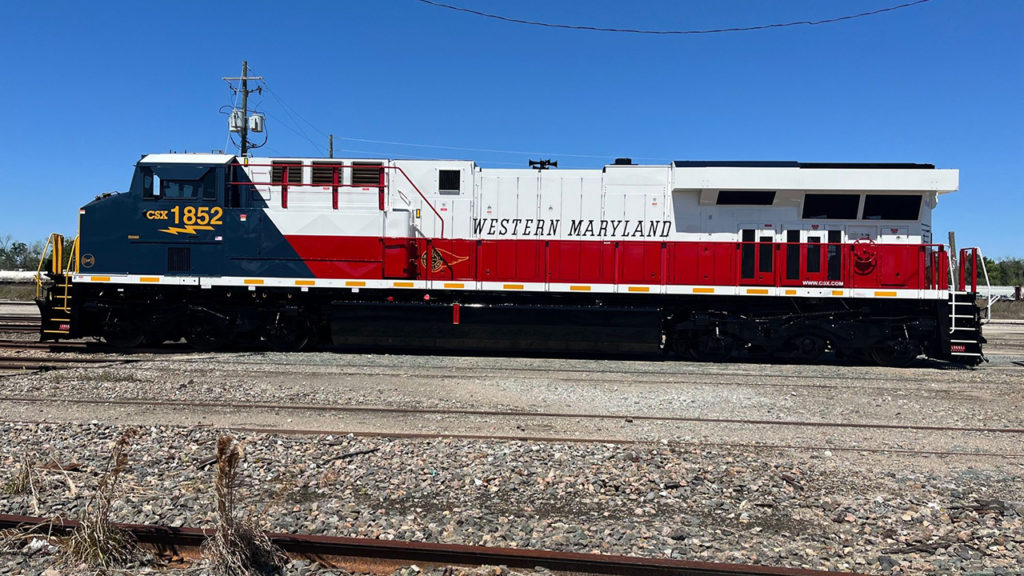
RA: On that note, what you’ve done with the Heritage Locomotives, very popular. The fans love it. It’s interesting. Your approach is different. You retain, on the nose of the unit, the CSX logo, but then it transitions to a heritage scheme. That’s proven to be very popular.
HINRICHS: We did that on purpose because we want to celebrate where we were and where we’re coming from, but we want people to know that where we’re going is CSX and when they see us coming, it’s CSX. We always want to appreciate and recognize our past and who we were and how we got here. Our employees love the heritage units. Our team at Waycross that does them is so proud of them and importantly, as you said, the railfans like it too, but it’s all about, again, getting back to celebrate who we are, what we do, how we got here and where we’re going. We want our engineers and conductors in that cab to know they’re part of taking CSX forward into the future, while we build on the legacy of the past.
RA: Let’s talk a little bit about your background. Now everybody knows, me especially, I think, because I’m a “car guy,” you came out of the automotive industry, and were a railroad customer for a while. Tell me about your background.
HINRICHS: I was born in Columbus, Ohio, but I grew up in Fosters, Ohio, which is a nice little railroad town in northwest Ohio. It has the iron triangle where Norfolk Southern and CSX meet. I remember, when I was young there was only one way out of town—it was only a 12,000-person town—where you didn’t go over railroad tracks. When I was in sixth grade, we did a newscast, and I was the anchor person. We found this on YouTube the other day. I did a story about model trains, believe it or not. Sometimes you just go back and think, wow, was this meant to be?
When I graduated as an engineer from college, I went to work for General Motors and spent 10 years in engineering and manufacturing. I got my MBA. I left GM to go be a partner in a private equity group for a couple of years and that was a great experience. I learned a lot, but I missed the auto industry, so I went back. I ran a supplier to the auto industry. Then I went to Ford. I spent 19 years at Ford, retiring as President of the company in 2020. During that time, one of the things I did early in my career was run material planning logistics worldwide, managing all the supply chains, logistics, transportation, schedules, etc. I got to know the railroads because we spent a lot of money with them. I got to know the railroad CEOs, like Jim Young (Union Pacific), David Goode (Norfolk Southern), Matt Rose (BNSF). I was asked to speak to the Norfolk Southern Board of Directors in 2002 or 2003, to talk about the auto industry in rail. Maybe it was destiny? I’m not sure.
Once I retired from Ford and during COVID, I took a couple years off. Then I was recruited by our Board for CSX. When I was contemplating [the offer], I thought about the railroads and my relationships and knowledge, and what transpired at Ford over the past 20 years—getting out of the rail business for almost all the parts, components, etc. It was all about our perception of the experience, the service and the reliability and dependability and ease of doing business with railroads. When I was able to take on this opportunity, I came in saying, listen, here’s what it’s like to be a customer. I told our people, honestly, I said, many of our customers do business with us because they have to, not because they want to.
Our goal with ONE CSX is to create customer advocacy for rail and specifically for CSX. You do that by making the customers feel important, treating them with respect and with the kind of service they deserve and pay for. That goes back to ONE CSX because you can’t make that happen without the employees being engaged to want to make that happen. That’s where it’s all circular. My experience is very relevant because I had a lot of union experience, too, negotiating UAW contracts, and a lot of government experience because we were heavily impacted with the government as well. But just being a customer, I was able to look at things, I think, through a different lens and say, let’s look at this from the outside in. If we want to grow, which the rail industry has been talking about for 10-plus years, we’re going to have to serve our customers better and establish a better relationship with them.
RA: Getting back to the automotive industry, movement of motor vehicles and parts, that is a huge piece of business for the railroads. Logistically, it’s very complicated, with plants, suppliers and dealers spread all over.
HINRICHS: It’s a shared fleet of autoracks. It’s complicated. Getting the empties back is just as important as delivering the finished vehicles. Sometimes it’s more important to the customers, so it is complex. We’re fortunate. I think we’ve now moved more autos by rail than anybody else at CSX, which we’re proud of, and I think it’s because of the service we’re providing.
RA: I would say, and you probably would agree, that a finished automobile is probably, even though it’s a big heavy vehicle, one of the most fragile things you can move. The specialized cars, the specialized equipment, the draft gears, the cushioning devices, the suspension.
HINRICHS: Even a scratch can really impact the value of a vehicle or upset a customer. The delicacy we have to treat those vehicles with is unlike anything else, other than military shipments maybe, we move. That’s why you see so much at these loading facilities, so many cameras and so many ways of keeping the vehicles protected. Once you’re inside that autorack, there’s not a lot of room. I mean, it’s tight in there, literally inches. The people that do that work hard and they must get in there and latch everything up and make it safe and secure. You can’t hump them. You don’t want the cars jamming. There are all kinds of things you have to think about, but again, very important to our economy, very important to our business, a very important customer base.
RA: You have quite a personal collection of cars, some rare automobiles. If you don’t mind, just give us a few details on that.

HINRICHS: Well, I can’t collect big trains. They’re too big, although I am getting some trainsets. They’re fun, including the CSX ones. I was fortunate. Obviously, you get the bug when you work 30-plus years in the auto industry, and you get to a level where you can maybe have some discretionary purchases. The first vehicle I bought that was not my daily driver was a 2005 Ford GT. I was part of that program, running manufacturing when we launched the vehicles and built them in Wixom, Mich. I have VIN number 5. It’s a beautiful car, blue with a white stripe. Since then, I’ve bought a few more—hopefully with the support of my wife and staying married for 34 years—but the crown jewel of my collection is the 2017 Ford GT, which is the carbon fiber one where we went back and won Le Mans after 50 years. The first three we did in the Le Mans race livery of the car that won in 2016. I have VIN number 3. It’s red, white and blue. It’s beautiful. That’s probably the rarest car. I have been able to purchase a few other non-Ford vehicles since I retired from Ford, mostly European makes. Sports cars are a little fun, but I’ve been blessed. I have a couple of Shelby Cobra GTs. I have the first Shelby Cobra Mustang. I have the first F-150 Raptor of the second generation produced, which is kind of fun. I have a Bronco Raptor. I was a big part of bringing back the Bronco to the portfolio, so I have several. Cars are fun. I still love them. I’m trying to bring some more to Florida so I can drive them a little bit more, but I’m a railroader now.

RA: A lot of railroaders are interested in automobiles, and they’re also interested in model trains. I’m unabashedly vocal about that. Something about big things that move.
HINRICHS: They’re electrical, mechanical. There’s beauty in the design. They’re works of art, and the tie to the railroad industry goes back to whether it was oil or steel or metal or any kind of metals. We’re interconnected and we always will be.
RA: Raymond Loewy, who designed locomotives for the Pennsylvania Railroad, and designed automobiles for Studebaker, and so there’s a connection.
HINRICHS: Rockefeller had a railroad. Henry Ford had a railroad. There are always connections at the end of the day. Having spent time at General Motors, Ford, now CSX, and I’m on the Board of Goodyear—these companies are more than 100 years old, in our case almost 200 years old—it has been really fun for me, just being a part of the history and the stewardship of these industrial companies that mean so much to this economy and are foundational to the way of life we to get to enjoy in America.
RA: Which brings us to growth. That’s something that the industry and the people who observe the industry have talked about for a long, long time. We need to grow the top line. You can grow the bottom line through cost efficiencies, technology, various ways, as you well know. But growing the top line, competing with truckers, who are our partners in many respects. Taking traffic off the highways and putting it either in containers or boxcars. Where do you see the growth coming from, longer term?
HINRICHS: This is one of the most important topics for the rail industry today. There’s been such a focus on the efficiency of operations over the past 10, 20 years, which has been great to bring the profitability of the railroads up to a point where we’re healthy enough to reinvest in the business. We can keep our infrastructure up, which we pay for as you know, but there’s a higher-order purpose here. The U.S. economy runs better when railroads run better. The taxpayers benefit when the railroads run better. Congestion gets better. It’s safer to get things off the road and onto rail and profitably grow the business.
The biggest area of growth opportunity for the railroads is intermodal and it’s more than just, well, okay, that’s where the volume is. A lot of our customers have moved their logistics, their whole transportation strategy, away from what used to be boxcars or the like. Now they have truck docks, so they’re loading truck containers. Intermodal allows that infrastructure to still be used and not transferred over, because a lot of the rail docks no longer exist at a lot of our customers. In the auto industry, we took most of them out, for engines and transmissions and frames and sheet metal.
We must get better at intermodal, and celebrate that intermodal is a big part of our growth. We need to do it in a way that doesn’t degrade the margins of our traditional merchandise business. That’s where the disconnect comes in sometimes for our investors, where they get confused. If you’re going to grow intermodal, will your merchandise business somehow decline in profitability? It doesn’t have to be that way, but intermodal is highly service-sensitive. Speed matters, time matters, and relationships and communication matters. The customers need to know when the container gets to the intermodal yard and when it’s ready to be picked up. The time they’re in the terminal to get that container matters a lot to truck drivers, so there’s a lot of service-oriented pieces to this. We’re much better for the environment, too. There are reasons why people want to do business with rail. It’s up to us to show them we can be reliable and dependable.
There’s also merchandise opportunity with all the industrial development activity happening in the U.S., especially in the Midwest and Southeast on our network. There’s growth opportunity as we bring [manufacturing] back to America. We see tremendous opportunity for growth over the next several years—if and when we deliver the service that customers expect and do it repeatedly and reliably. If they can’t count on us, they go to a truck because they can count on a truck. It’s all about us getting our service levels up and sustaining and maintaining them. That goes back to our people. And we’re cheaper for customers, too. There are reasons why customers should want to do business with rail, but it starts with, can they trust us to deliver on time?
RA: Yes, it’s when they have a choice, that they make the choice for rail. Certain commodities, as you well know, will always move by rail because they move best by rail—grain, coal, iron ore, automobiles, what have you—but the commodities where the customer has a choice, we as an industry need to give them reasons to make the choice to move it in a train.
HINRICHS: We’ve given them the choice, but it has been higher risk in the past 10, 20 years to go by rail because of service inconsistency and the time it takes to deliver. We must keep compressing the time to get better at speed, but we also must reliably deliver on time so customers can trust us. Nobody gets fired from moving from rail to truck, but if they move from truck to rail and it doesn’t get delivered, then they get in trouble. It’s on us. The onus is on us to show that we can be reliable. I think the opportunities are significant.
RA: The service provided by CSX has gotten considerably better. CSX was the first Class I to be released from certain reporting requirements by the Surface Transportation Board.
HINRICHS: That’s right, and we were the winner of the inaugural Bill Thompson award from Loop Capital last year for the best-run railroad. In the past three Journal of Commerce surveys over the last year and a half, we were number one each time. That consistency goes back to our people. It’s an honor and a privilege to serve with our team. Our people understand that we’re here to serve a customer and to do it together as a team. I’m proud of the progress we’ve made, and we know there’s a lot more progress we can make. That’s what’s exciting about coming into work every day and working with this team of people, this ONE CSX team: We know we can get better. Our customers are saying we’re industry-leading in service, but we’re nowhere near where we can and should be and where the opportunity is to grow.
RA: Joe, it’s been a pleasure speaking with you. We look forward to presenting you officially with the Railroader of the Year Award at our annual dinner, which we hold in Chicago at the Union League Club. It has been wonderful to see the turnaround at CSX and the progress that CSX and the entire industry has made, in many respects, as we’ve discussed, led by CSX and your team. Congratulations again.
HINRICHS: Thank you, Bill. Thanks for recognizing the ONE CSX team.