Trinity’s Savage: 2Q25 Results Highlight ‘Robust Performance’

Trinity reported total company revenue of $506.2 million for the second quarter ended June 30, 2025, down 39.8% from the prior-year period’s $841.4 million. It attributed this to “lower external deliveries in the Rail Products Group.” Additionally, quarterly income from continuing operations per common diluted share (EPS) came in at $0.19 vs. $0.67 in 2024.
Operating profit for second-quarter 2025 was $95.4 million, down 32.7% from second-quarter 2024’s $141.9 million, reflecting “lower external deliveries in the Rail Products Group, lower gains on lease portfolio sales, and costs associated with workforce reductions, partially offset by lower selling, engineering, and administrative expenses,” Trinity said.
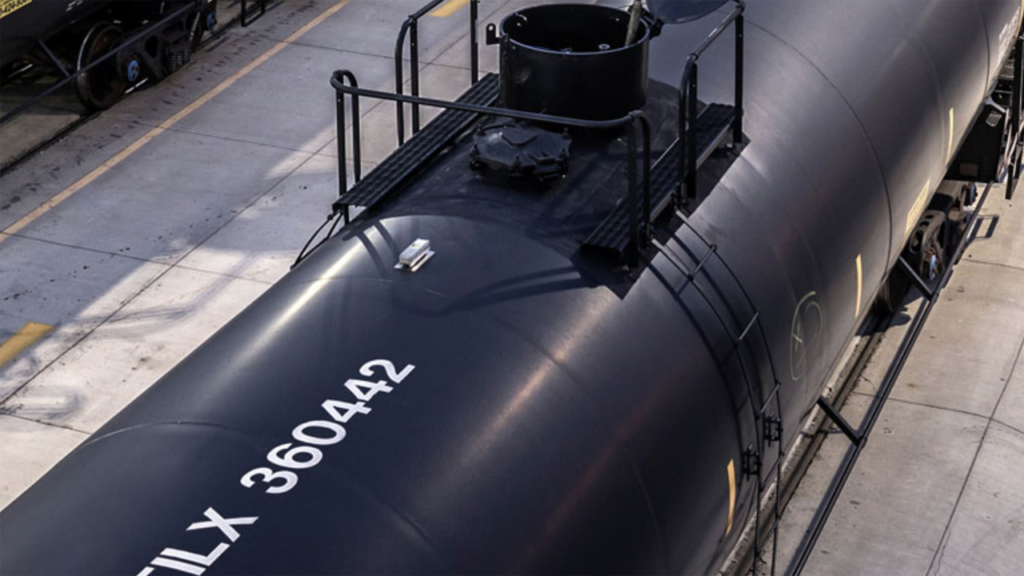
Rail Products Group revenue came in at $293.5 million in second-quarter 2025, falling 53.7% from $634.2 million in 2024, due to “lower deliveries.” In the six months ending June 30, 2025, the Group delivered 1,815 railcars; received orders for 2,310 railcars, valued at $318.3 million; and had a backlog value of $2.0 billion. This compares with first-quarter 2025’s 3,060 railcars delivered; 695 railcars ordered, valued at $109.3 million; and a backlog value of $1.9 billion.
For the Railcar Leasing and Services Group, revenue was $302.4 million in second-quarter 2025, up 7.4% from the prior-year period’s $281.4 million. The company attributed this to “higher lease rates, as well as favorable pricing on, and the mix of, external repairs in the maintenance services businesses.”
Lease fleet utilization—including wholly-owned railcars, partially-owned railcars, and railcars under leased-in arrangements—came in at 96.8% vs. second-quarter 2024’s 96.9%. The Future Lease Rate Differential (FLRD) was positive 18.3% at the end of second-quarter 2025 vs. positive 28.3% for the prior-year period due to “continued strength in current lease rates.” According to Trinity, FLRD calculates the “implied change in lease rates for railcar leases expiring over the next four quarters” and “assumes that these expiring leases will be renewed at the most recent quarterly transacted lease rates for each railcar type”; FLRD is “useful to both management and investors as it provides insight into the near-term trend in lease rates.”
“In our Railcar Leasing and Services segment, the market has remained strong with utilization of 96.8% and an FLRD of 18.3%, which gives us confidence that the industry fleet is in balance,” Savage said. Year-over-year segment revenue increased by 7.5% as we continue to re-price our fleet upward. Additionally, Trinity continues to find consistent opportunities in the secondary market as both a buyer and a seller. In the Rail Products Group, our margins reflect the strategic initiatives we have undertaken over the last several years that give us the ability to perform in a low volume environment.”
2025 Guidance
Looking ahead, Trinity reported that it expects industry deliveries of approximately 28,000 to 33,000 railcars in 2025. Additionally, this year it would have a net fleet investment of $250 million to $350 million; operating and administrative capital expenditures of $45 million to $55 million; and EPS of $1.40 to $1.60, which the company said, “excludes items outside of our core business operations.”
“In keeping with our capital allocation strategy, we capitalized on favorable mar-ket conditions and repurchased shares worth $39 million year-to-date to further optimize our balance sheet position. We are maintaining our full year EPS guid-ance of $1.40 to $1.60, which reflects our expectation of improved deliveries from second quarter levels and continued improvement across the business in the second half of the year,” Savage concluded.
For more financial information, visit Trinity’s Investor Relations webpage.