Next-Generation” or its abbreviation, “next-gen,” is a popular expression that has been used (some say abused) to name things from television shows (Star Trek, The Next Generation) to conferences (Railway Age’s Next-Generation Freight Rail and Next-Generation Train Control, our joint effort with Parsons since 1995). For train control, it has become a kind of blanket definition for CBTC (communications-based train control), PTC (Positive Train Control), and various iterations of both that have evolved into an addling acronym alphabet soup: ATC, ACSES, ASES, ETMS, ERTMS, ETC, ITCS, I-ETMS, VTC, etc., etc.
As far as the global railway industry and its continuously contracting cadre of suppliers and consultants are concerned, they have taken Capt. Jean-Luc Picard’s command for “warp speed” from the bridges of the Enterprise D and E starships—engage!—to heart, though at times the warp core has sputtered out, leaving only impulse power available.
But “failure is not an option” (Apollo 13), and “fail-safe” or “vital” is usually an imperative. Thus, there are now a burgeoning number of greenfield and brownfield next-gen train control programs for transit and main line freight and passenger operations, with AI (artificial intelligence) and other “space age” technologies added to spice things up a bit. There was more than enough going on to support the annual Railway Age/Parsons get-together.
MTA leads the way
Roughly 30 years after a then-younger Railway Age editor whose initials are WCV wrote his first piece on MTA New York City Transit’s then-new Advanced Technology Signals program, NYCT—with a brief stall during a 2007-08 financial crisis—is still ahead of the curve in brownfield (sounds more like a lawn that hasn’t been watered during a drought than a major technology upgrade to a “legacy” system) projects. It’s fair to say that, with three CBTC-equipped lines in service—Canarsie (L), Flushing (7), QBL West (E, F, M, R)—two in progress—Culver (F), Eighth Avenue (A, C, E)—another recently awarded—QBL East (E, F, M, R)—and three in procurement—Crosstown (G), Fulton (A, C), Sixth Avenue (B, D, F)—NYCT remains the first major network, globally, successfully transitioning to CBTC. The workload and required financial resources for so many parallel projects are, at the very least, daunting. But they’re doable.
The MTA can thank Tom Prendergast (Railway Age 2017 Railroader of the Year) for resurrecting its CBTC program and accelerating it. With his rail career rooted in safety, he had always championed the technology, particularly during his tenures as NYCT President (2009-13) and MTA Chairman (2013-17). After Prendergast retired from the MTA to go to STV and then AECOM (where he is EVP and Americas Transit Market Leader), the “British Invasion” (Andy Byford and Pete Tomlin) took up the CBTC flag, opening the door to new technologies like UWB (ultra wideband) through the “Genius Challenge” program. This, and initiatives like the Transit Tech Lab, are where companies such as Piper Networks, 4AI Systems, Luminar, Ouster and Lux Modus can demonstrate their capabilities alongside those of long-time players Alstom, Siemens, Thales and Hitachi. Relative newcomers to the MTA like Mitsubishi Electric and E-J Electric Transit Division have joined its growing list of suppliers. At the NGTC conference, the MTA plans to announce a change in technical approach to CBTC procurements.
Piper Networks’ UWB-based position and speed technology system recently received safety certification from TÜV SÜD. It was the first to achieve CENELEC Safety Integrity Level 4 (SIL-4) certification to the following standards:
• Functional Safety Certification: EN 50126, 50128, 50129 and 50159.
• EMI/EMC Certification: EN 50121-1, 50121-3 and 50121-4.
• Environmental Certification: EN 50155 and IEC 60068-2.
Piper, TÜV Rheinland, Frauscher, Clear-Vu Lighting, Thales and 4AI gave sponsored NGTC conference proceedings on some of their latest developments. Again, ya had to be there!
FRA PTL
Here’s another acronym to add to the train control dictionary: PTL (Positive Train Location), a Federal Railroad Administration initiative. “The ability to precisely locate and track train movement on the rail network is the cornerstone of modern train control systems,” says Sam Alibrahim, FRA Chief, Train Control and Communication Research Division. “The Interoperable Electronic Train Management System (I-ETMS) and PTC systems currently used by Class I railroads, operational on approximately 54,000 route-miles, rely on GPS to identify the location of the lead locomotive, crew-entered track information and switch position. The location of the rear of the train is then derived from the location of the lead locomotive using train length, typically provided by the railroad’s management information systems (MIS) and confirmed or updated by the locomotive engineer.
“The relative inaccuracy of GPS and the manual entry of track information at train initialization often results in operational deficiencies. For these reasons, FRA’s Office of Research, Development, and Technology (RD&T) and the railroads cooperatively launched research into innovative methods to precisely locate and track train movements. This research resulted in what is now known as the PTL system, which is being commercialized by the railroad industry and deployed by Class I railroads.”
PTL research was conducted in multiple phases from 2011 through 2017; in Phase I, FRA RD&T and the railroads set forth the following performance requirements:
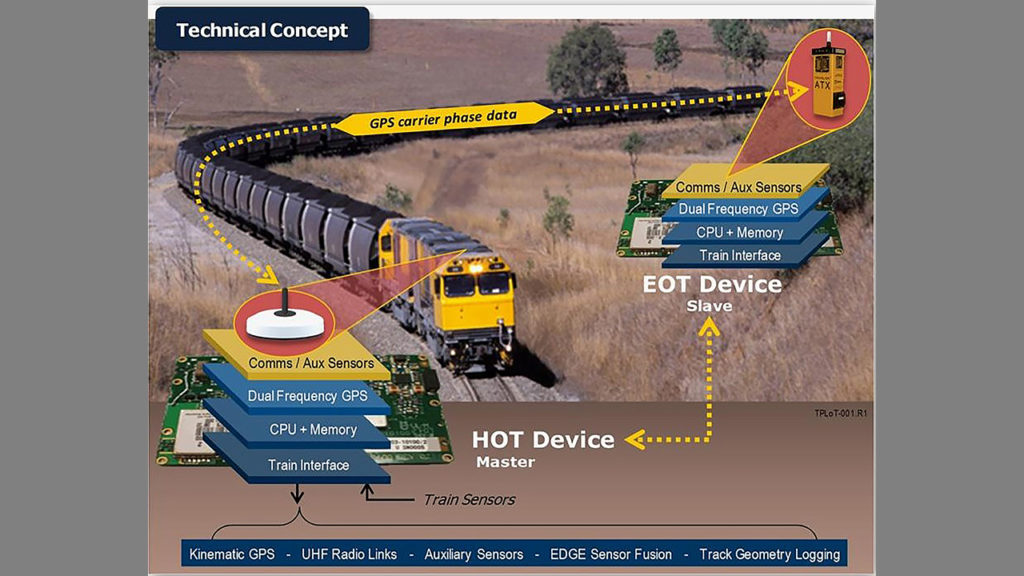
PTL is required to accurately determine locomotive and end-of-train position and train location at initialization and during operation. Key performance requirements include estimating the navigation state for Head-of-Train (HOT) and End-of-Train (EOT) units, support HOT/EOT communications for trains up to five miles in length, track HOT/EOT navigation state in all environments (with and without GPS), and support navigation accuracy requirements.
Alibrahim presented on how FRA is supporting next-gen train operations at our conference. Again, ya had to be there!
‘operations are paramount’
The PTC mandate was a very heavy lift—technical, operational and financial—for railroads. Herzog, through its HTI (Herzog Technologies Inc.) division, is among the companies engaged in easing the burden. “Many railroads still face significant challenges with the costs and complexity associated with PTC,” HTI tells Railway Age. As such, it has developed “a full suite of PTC-related services and software solutions” for freight and commuter railroads called HMOS (Hosting, Maintenance and Operational Support), which “integrates qualified personnel, specialized systems, PTC software and highly available architecture and centralizes it into a simplified service offering. The service is supported by a 24/7 systems operations support center staffed with knowledgeable and experienced PTC professionals that provide dedicated, versatile and operations-centric solutions. The HMOS Center is fully interoperable, reliable and secure. Utilizing advanced phone systems, a robust ticket management solution and proactive monitoring software tools, the HMOS Center is designed for rapid and organized responses to PTC issues.”
HMOS currently supports 215-plus daily, 6,500-plus monthly and 78,000-plus annual PTC trains “with skill sets ranging from Support Center Representative to Communications Technician to Systems Administrator, to provide tiered levels of support. The HMOS Center is designed for rapid and organized responses to everything from CAD, PTC and Voice & RF Systems troubleshooting to environmental dangers or even unruly passengers. We aim to recognize issues before they impact operations. The HMOS Center is designed with the understanding that operations, not various PTC technologies, is paramount. These solutions can mean the difference between seconds, minutes or hours of operational impact.”
Unruly passengers? Would that be “Passenger Tantrum Control”?