RAILWAY AGE, MARCH 2026 ISSUE: Creating safer rail operations through artificial intelligence applications.
Around 2016, Derel Wust, founder of Australian software engineering provider 4Tel, approached the robotics laboratory at the University of Newcastle to explore how cameras and sensor technology could process and respond to situational information in real-time, according to Wust’s daughter Joanne Wust, 4Tel’s Group CEO. At the university, a special interest group was preparing to compete at an international robotics competition where teams were creating robots that could play soccer and abide by FIFA rules. Wust’s company sponsored the team, and Derel Wust identified that his company could take those robotics concepts and apply them to the railway.
“Learning from the robots’ spatial awareness, how they are aware of their location and proximity to objects and then applying that into the train is quite relevant. It’s a different use case, but the same sort of principles. It’s being able to see and determine where you are and what’s in front of you,” Joanne Wust told Railway Age.
Derel Wust recognized the commercial future of this research combined with the expertise of 4Tel’s core rail systems development and integration staff. This led to the spinoff company, 4AI Systems, formed in 2020 that develops perception systems powered by artificial intelligence (AI) “to create better operational outcomes for rail network operators across the world.” Years later, in 2026, “we’ve now got a couple of different pilots and demos out there. And, you know, the future is looking pretty good,” Joanne Wust, who also serves as Group CEO for 4AI Systems, adds.
Indeed, tech companies like 4AI Systems and RailVision are developing AI-informed technology that provides train operators and engineers with an additional set of eyes that’s focused on preventing collisions. These technological tools use sensors that gather real-time data that is analyzed alongside historical data to ensure that the passenger or freight train does not hit something on the tracks.
“From RailVision’s perspective, AI-powered digital twins and perception systems allow rail operators to predict and prevent collisions by continuously analyzing live sensor data and simulating how situations are likely to evolve—not just reacting to predefined rules or fixed thresholds,” says Doron Cohadier, Vice President of Business Development and Marketing for RailVision, an Israel-based company that develops tools that incorporate advanced sensors, AI and Big Data for the rail space.
Collision Prevention
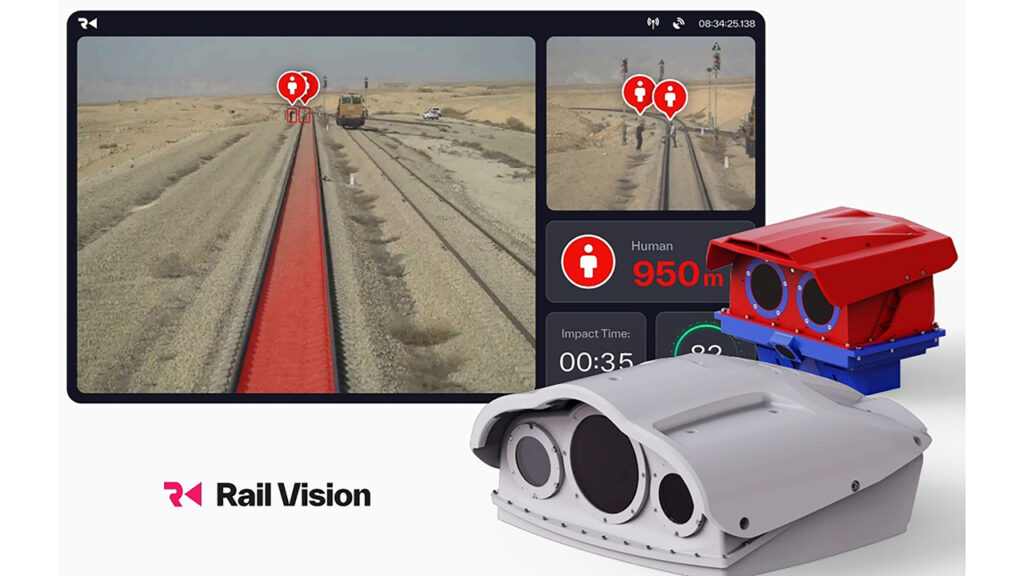
RailVision has been working with Israel Railways to develop and implement its AI-informed sensor technology on Israel Railways’ freight and passenger network. In a pilot project, RailVision’s system combines video analytics and AI to identify objects on railway infrastructure and anticipates potential obstacles on the track based on train speed, according to Hagay Rozenfeld, Chief Innovation Officer with Israel Railways. This obstacle detection—a type of predictive analytics—happens in real time, enabling operations to be more efficient while also reducing accident risk, he says.
Cohadier describes RailVision’s offerings as AI-powered digital twins and perception systems that allow rail operators to predict and prevent collisions. These onboard AI vision systems operate directly on locomotives. “Right now, the rail industry is using technologies like wayside sensors, GPS-based train control, and largely rule-based monitoring systems,” Cohadier notes. “In practice, these tools mostly help railways execute the plan: enforcing procedures, validating expected conditions, and monitoring known, structured scenarios, but they are less effective at identifying truly unexpected, unplanned events in real time, which is exactly where Rail Vision focuses. Looking ahead, the near-term trend is more automation and tighter integration: more sensors, more connected data, more AI-assisted decision support, and faster intervention workflows. The gap that remains—and the opportunity we address—is reliable detection of the unexpected, early enough to enable quicker decisions and intervention.”
At 4AI Systems, the focus has been on developing technology that can be installed on the train, according to Joanne Wust. “How can we help determine where the train is in real time without having to take a feed from the track or the wayside infrastructure?” she says. “When we can pull more technology on board, it starts to open up a lot of efficiencies for operators.”
Mark Wood, 4AI Systems Chief Technology Officer, describes his company’s offering as providing “better situational awareness so that the engineer is assisted in all conditions to make better decisions.”
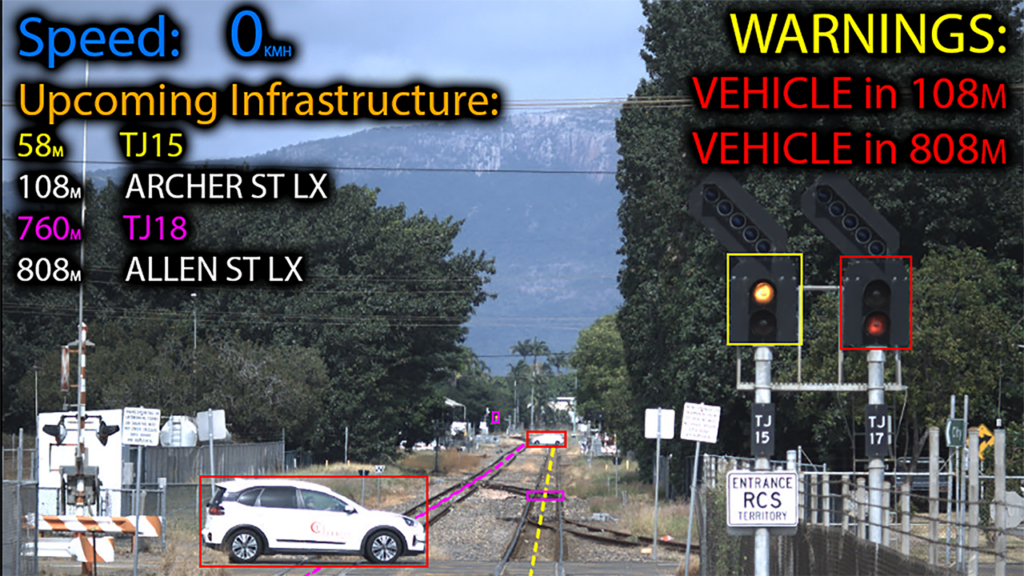
The technology, which can be used for freight and passenger rail operations, consists of onboard sensors that detect visuals, movement and positioning. Data from these sensors is compared with information that the software already knows about the track and adjacent infrastructure such as signals or speed signs. The technology compares the real-time data with the reference and historical data, uses AI to detect anomalies that could result in a collision, and informs the train conductor or engineer of any potential hazards on the track.
“The AI is helping us not only perceive the environment from an object detection perspective but also provides input into helping us localize ourselves,” Wood notes. “We use the multi-sensor array to allow us to have confidence in what we’re detecting as the train travels forward. This is one of the things that’s important when detecting an object. So, detecting an object with a single sensor, that’s easy. But validating whether that detection is correct and whether you care about that detection from a collision avoidance perspective is a lot more complex. That’s where a multi-sensor array, allowing overlap of sensor redundancy of different types, allows for those decisions to be more confident so that we’re not creating false alarms.”
Integrating AI With Operations
While the integration of AI into onboard sensor technology has already begun, the rail industry overall has yet to maximize AI’s potential.
“MxV Rail remains engaged in work related to onboard sensor technology through the AAR’s Train Control & Communications Oversight (TCCO) Committee. That effort includes collaboration with several suppliers (including 4AI Systems) who are exploring technologies that support increased levels of automation, such as enhanced situational awareness and restricted‑speed collision avoidance,” says Niki Toussaint, Assistant Vice President of Marketing and Education. “While some of these suppliers use AI within their systems, our current work is focused on broader sensor-based automation rather than an explicitly AI-driven project.”
Other areas where MxV Rail is exploring AI applications are AI-assisted track geometry monitoring, automated- or AI-enabled visual inspection technologies and AI models supporting ultrasonic rail flaw detection, according to Toussaint.
For the rail industry to integrate this kind of technology into current operations, multiple partners are often involved. RailVision, which has developed AI-driven technologies for main line and switching operations, is partnering with startup Exodigo to carry out advanced underground infrastructure detection across various Israel Railways track segments. Exodigo, which has developed a mapping platform, has incorporated RailVision’s technology to deploy a multi-dimensional visual model or digital asset that allows Israel Railways’ teams to access accurate, high-quality information about existing infrastructure along a railway corridor, according to RailVision. The company says this technology will help prevent damage to infrastructure during construction works, streamline maintenance and development processes, and reduce disruptions to project timelines. The offering involves mounting Exodigo’s AI-powered remote-sensing platform onto railcars, which enables the development of precise 3D digital models of buried utilities and infrastructure beneath the tracks.
“Israel Railways faces challenges similar to those of railway operators around the world, including the need to maintain schedule accuracy and high-quality service while maintaining and expanding the existing network,” Exodigo CEO and Co-Founder Jeremy Suard says. “Our proposed solution will enable the railway to efficiently and systematically map all existing rail assets and introduce new capabilities for digital asset management in a dynamic environment. This will allow future integration of AI tools into infrastructure-related decision-making processes, with the goal of maximizing services for the public.”
Israel Railways also has an Open Innovation strategy that provides innovation partners opportunities to pilot and promote their AI technologies within railway regulations, Rozenfeld says. More than 70 innovation partners are already working with Israel Railways.
At 4AI Systems, their offerings are not on test trains but rather are on revenue service operations. “In each of those environments, the technology is in various stages of development,” according to Wood.
Even as 4AI Systems is working with rail companies to implement and use the technology on their trains, the company also continues to collaborate with universities and is part of a working group for MxV Rail “to understand the challenges of implementing the technology in different rail environments,” Wood notes. “This is the future. There’s no one that’s actually using this technology in full rail operations. We’re currently going through the program of getting it there. The technology is one step, but the application into an operation is a whole change management process that doesn’t happen overnight.”
But the big benefit that will come as the technology improves over time is helping train crews “manage their jobs in inclement weather or if they’re tired,” Wood says. “If something jumps on the track and you can’t stop the train, well, that’s the laws of physics. But if we can reduce the impact—give a few seconds more to the engineer to apply brakes or perform an action—that may avert an incident.”